

Minimalist travel helps you save money by focusing on essentials and cutting unnecessary expenses. By traveling light and making smarter choices, you can enjoy meaningful trips without breaking the bank. Here’s how:
- Pack Light: Avoid baggage fees, save $250–$600 on multi-leg trips, and reduce stress.
- Affordable Accommodations: Stay in hostels, private rooms, or negotiate long-term rates to save thousands.
- Avoid Impulse Purchases: Plan intentionally, stick to budgets, and limit luggage space to curb overspending.
- Use Public Transit: Skip taxis and flights; save $50–$200 daily while immersing in local life.
- Cook Your Meals: Save $20–$30 per person daily by preparing food instead of dining out.
- Capsule Wardrobe: Pack versatile clothing to avoid extra luggage fees and simplify packing.
- Avoid Hidden Fees: Research true costs, use fee-free cards, and plan ahead to dodge surprise charges.
Minimalist travel is about spending less while still enjoying your trip. By cutting excess, you can focus on experiences and save for future adventures.
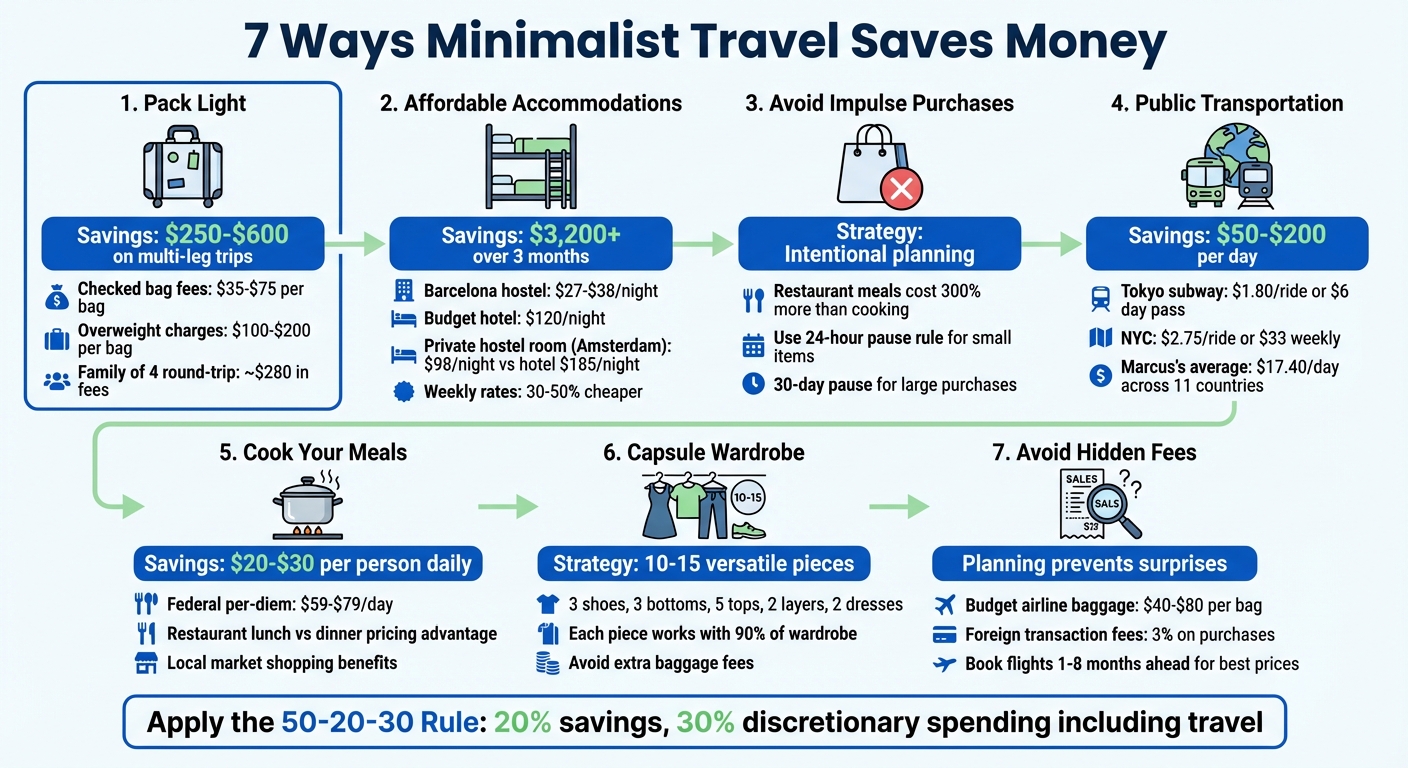
7 Minimalist Travel Money-Saving Strategies with Cost Breakdowns
How I Travel Cheap! Tips for Traveling on a Budget | Minimalist Travel Tips
sbb-itb-2a9374f
1. Pack Light to Avoid Baggage Fees
Checked baggage fees can quickly add up, ranging from $35 to $75 per bag. For instance, a round-trip for a family of four could mean spending around $280 just on baggage fees. And if your bag tips the scale at over 50 pounds, you might face overweight charges of $100 to $200 per bag.
To steer clear of these costs, stick to a carry-on and a personal item. Major airlines like American, Delta, and United typically allow these for free. However, budget carriers like Spirit and Frontier often charge between $39 and $65 for carry-ons. If you’re planning a 10-leg trip, packing light could save you anywhere from $250 to $600 in fees. The key is refining your packing strategy to make this work.
"If you bring a bigger bag, you’ll fill it. If you bring a smaller bag, you’ll cut out the stuff that doesn’t matter." – James Clear, Author and Photographer
One way to streamline your packing is by following the 5-4-3-2-1 Rule: bring 5 tops, 4 bottoms, 3 accessories, 2 pairs of shoes, and 1 jacket. Wear your bulkier items on the plane, and opt for versatile fabrics like merino wool that are quick-drying and odor-resistant. Packing cubes can also help you make the most of your space.
Traveling light not only saves you money but also eliminates the hassle of waiting at baggage claim and reduces the risk of losing your luggage. This approach lets you focus on the joys of your journey instead of worrying about extra fees or misplaced bags.
2. Choose Affordable Accommodations
Where you stay can make or break your travel budget. Take Barcelona as an example: a hostel dorm bed runs between $27 and $38 per night, while a budget hotel averages around $120. Over three months, sticking with hostels could save you more than $3,200 compared to hotels.
Minimalist travelers often see accommodations as a way to stretch their time on the road. Marcus, an experienced minimalist traveler, says it best: "Every dollar you do not spend on logistics is a day you get to stay longer". This mindset encourages prioritizing cost-effective lodging options.
Not a fan of dorms? Private hostel rooms are a great middle ground. In Amsterdam, for instance, a private hostel room costs about $98 per night, while a standard hotel room averages $185. That’s a savings of $87 per night, plus you get access to shared kitchens and social spaces. And having a kitchen can save you even more – about $30 to $50 a day – by cooking your own meals instead of eating out.
For longer stays, the "10-Day Minimum" rule can help you score major discounts. Weekly hostel rates are often 30% to 50% cheaper than nightly ones, and negotiating directly with hosts can cut monthly rentals by 50% to 70%. Staying in one place also reduces what’s known as "discovery cost" – the time and money spent finding affordable local spots.
Want to push your savings further? Consider alternatives like house-sitting through platforms such as TrustedHousesitters or tapping into your personal network for free stays. Timing your trip for the shoulder seasons – spring or fall – can also slash nightly rates. In Lisbon, for example, rates drop from $46 to $25 during these off-peak times. Choosing budget-friendly accommodations not only saves money but also keeps your travels simpler and more sustainable.
3. Avoid Impulse Purchases Through Intentional Planning
Intentional planning is a powerful way to keep your travel spending aligned with minimalist principles. By setting clear goals and priorities before your trip, you can create a structure that naturally discourages spur-of-the-moment purchases.
Start by defining your core values – such as mobility, creativity, or relationship building – and let them guide your spending decisions. As Notes on Less explains:
"When purchases are filtered through values, every buy becomes an act of design rather than default".
If something doesn’t align with your values, it’s easier to pass it up.
Budgeting is another essential step. Break your travel expenses into categories like transportation, food, activities, and souvenirs. Assign specific amounts to each. For example, knowing you’ve allocated $50 for souvenirs makes a $30 impulse buy feel much more significant. As Youthentity wisely points out:
"Developing the skill to develop a budget can help you tell your money where you want it to go instead of wondering where all of your money went".
Packing light can also help curb unnecessary purchases. Limited luggage space forces you to be selective about what you bring – and buy. You can even use the One-In-One-Out Rule: for every new item you purchase, remove a similar item from your bag. This approach keeps your load manageable and ensures every purchase is intentional.
Another helpful tactic is the Pause Rule. For smaller items, wait 24 hours before buying. For larger purchases, give it 30 days. This waiting period allows you to separate genuine needs from fleeting desires.
Finally, consider saving on meals by planning to shop at local grocery stores instead of dining out. Restaurant meals often cost 300% more than preparing the same dish yourself. By planning meals in advance, you avoid food-related impulse spending while keeping costs in check.
4. Use Public Transportation or Walk
Opting for public transit or walking can save you anywhere from $50 to $200 per day, which adds up significantly over a week-long trip. This approach not only keeps costs low but also enhances your connection with the local culture.
Take a look at some typical transit costs: In Tokyo, a single subway ride is just $1.80, but you can grab a day pass for $6.00. New York City charges $2.75 per ride, with a weekly pass available for $33.00. Sydney’s fares start at $2.30, while London’s begin at $4.90 per trip.
Marcus, a minimalist traveler, embraced this strategy during his 13-month journey across 11 countries. By following what he called the "Slow Transport Doctrine" – choosing buses, trains, and ferries over flights and taxis – he managed to keep his daily expenses to an average of $17.40. For example, he took an $8 bus from Bangkok to Chiang Mai instead of flying, a $14 train from Barcelona to Valencia, and a $35 ferry from Athens to Santorini.
Beyond saving money, using public transportation or walking immerses you in the local vibe. Public transit lets you ride alongside residents, explore less touristy neighborhoods, and observe the rhythm of daily life. Walking, on the other hand, reveals hidden gems like tucked-away cafes, bustling markets, or vibrant street art. Marcus summed it up perfectly:
"The man on a bicycle sees a city the way locals see it. The man in a taxi sees the meter".
To make the most of this approach, rely on transit apps like Google Maps (download offline maps for convenience) and consider multi-day or weekly passes. These passes often offer better value than single tickets, particularly if you travel during off-peak hours. Choosing these practical and budget-friendly options is a cornerstone of minimalist travel.
5. Prepare Your Own Meals and Snacks
Eating out can quickly drain your travel budget, especially compared to the cost of cooking your own meals. If you’re staying in a rental or hostel with a kitchen, you can shop locally and prepare your own food, cutting daily expenses significantly. In fact, cooking your meals could save you $20 to $30 per person each day, helping you stay well below federal per-diem food rates, which range from $59 in rural areas to $79 in pricier cities like San Francisco. Preparing your own meals is a straightforward way to keep costs low while sticking to your travel plans.
When you arrive, make a stop at a nearby grocery store to stock up on essentials. Even if your accommodations only have a mini-fridge and microwave, you can still make simple meals. Packing some shelf-stable snacks from home – like peanut butter, nuts, whole-grain crackers, and granola bars – not only saves money but also helps you avoid overpriced airport snacks or tourist-trap food options, where a single 16 oz bottle of water might set you back $5.
If you’re craving a restaurant experience, opt for lunch instead of dinner. Lunch menus often feature similar dishes at lower prices, leaving you free to prepare a lighter, affordable meal back at your lodging. Shopping at local markets is another great way to find fresh, budget-friendly ingredients, and carrying a refillable water bottle ensures you won’t need to spend on pricey bottled water. Sally French, Lead Writer at NerdWallet, sums it up perfectly:
"Having food on hand means you’ll likely save money, as you’ll be less tempted to buy the stale, overpriced muffin from the hotel cafe just because you were hungry".
Don’t forget to take advantage of free food options at your hotel, like continental breakfasts or snack hours, to stretch your budget even further. These small adjustments not only help you save money but also fit perfectly with a minimalist travel mindset – keeping things simple, flexible, and focused on what truly matters.
6. Travel with a Capsule Wardrobe
A travel capsule wardrobe is all about packing smarter, not more. It’s a curated collection of versatile clothing pieces where nearly every item can mix and match with the others. Instead of cramming your suitcase with options, aim for 10–15 carefully chosen items to create multiple outfits. This method keeps your luggage compact – perfect for carry-on travel – and simplifies your trip.
Take travel blogger Giulia Moretti as an example. On a 14-day European adventure in March 2026, she managed with just three pairs of shoes (white sneakers, black flats, and ankle boots), three bottoms (jeans, trousers, and a denim skirt), five tops, two layering pieces, and two dresses. A good rule of thumb? Each piece should work with at least 90% of the other items in your wardrobe.
To build your capsule, start with footwear that suits your planned activities, and ensure all clothing coordinates with those shoes. Stick to neutral tones like black, navy, beige, or white, and sprinkle in one or two accent colors to keep things interesting. Before you leave, create a digital lookbook by photographing all possible outfit combinations. This not only saves time during your trip but also helps curb impulse buys.
The perks go beyond just saving on baggage fees. Packing multipurpose items – like a button-down shirt that can serve as a light jacket, swimsuit cover-up, or even a dressy top – means you’re prepared for almost any situation without needing extra clothes. For instance, Marcus, a former financial services professional from Toronto, spent 13 months traveling through 11 countries with just a 32-liter backpack. His essentials? Three merino wool t-shirts, two pairs of pants, and two pairs of shoes. Despite the minimalist setup, he maintained a daily spending average of just $17.40.
This strategy isn’t just practical – it’s freeing. As Meredith Rimmer, Editorial Leader at Rank & Style, explains:
"By bringing along high-quality, functional, and versatile clothes, you’ll take the guesswork out of getting dressed."
7. Plan Carefully to Avoid Hidden Fees
Hidden fees can quickly turn an affordable trip into an expensive one. Charges like resort fees, baggage fees, foreign transaction fees, and rental car fuel surcharges can sneak up on you without proper planning.
Before you book anything, research the true cost. For example, a hotel advertised at $89 per night might actually cost closer to $140 when additional fees are included. Similarly, budget airlines often wait until you’re at the airport to tack on baggage fees, which can range from $40 to $80 per checked bag. Sally French, Lead Writer at NerdWallet, advises:
"Knowing the general prices of things can help you avoid getting up charged with a so-called, unofficial ‘tourist tax’".
To avoid these hidden costs, plan ahead. If you’re traveling internationally, use a credit card that waives foreign transaction fees – this alone can save you about 3% on every purchase. When withdrawing cash or paying at terminals, always choose to pay in the local currency rather than opting for dynamic currency conversion, which often comes with worse exchange rates. For rental cars, return the vehicle with a full tank of gas and check if your credit card includes rental insurance to avoid paying for unnecessary add-ons.
It’s also wise to set aside 10% to 20% of your trip budget as a safety net for unexpected expenses like missed connections, weather-related delays, or minor fees that might arise. Small steps, like downloading offline maps to avoid roaming charges or researching local taxi rates in advance, can help you stretch your budget further and feel more confident navigating public transit or negotiating fares.
Transportation planning is another area where hidden costs can creep in. Booking flights well in advance can save you a significant amount. Domestic flights are often cheapest when booked one to three months in advance, while international flights are typically more affordable when booked two to eight months ahead. Waiting until the last minute can cost you – flights booked just 15 days before departure average $576.51, compared to $464.77 when booked 180 days in advance.
Conclusion
Minimalist travel blends smart money management with a streamlined travel experience.
By making thoughtful decisions about accommodations, food, and transportation, minimalist travel helps you save money while still enjoying your trip. These savings can then be redirected toward your broader financial goals. For instance, the 50-20-30 rule suggests putting 20% of your net income toward savings or debt reduction, while reserving 30% for discretionary expenses like vacations. Trimming unnecessary travel costs ensures that your trip doesn’t jeopardize your financial progress. As Sally French, Lead Writer at NerdWallet, points out:
"Saving money on travel with these tricks can give you more freedom to spend where you need, whether that’s on this trip or your next one".
If you’re tackling credit card debt or building an emergency fund, every dollar matters. Minimalist travel allows you to enjoy meaningful experiences while staying financially disciplined. By focusing on what truly matters – experiences over extravagance – you can travel without compromising your financial objectives.
For those looking to align travel spending with debt reduction, check out Steps To Be Debt Free at https://debtloansrelief.com for a free debt review consultation.
FAQs
How do I pack for a week in just a carry-on?
Packing for a week in just a carry-on might sound tricky, but it’s totally doable with some smart planning. Start by picking versatile clothing – think pieces that mix and match easily, like neutral tops and bottoms. Rolling your clothes can save space, and packing cubes make everything more organized and easier to find.
Stick to lightweight, quick-drying fabrics, especially if you plan to do laundry during your trip. Limit the number of outfits you bring, but don’t forget the essentials like underwear and sleepwear. Multi-purpose items are a lifesaver – bring a jacket that can double as a blanket or a scarf that works as a pillow. These small adjustments can make a big difference!
Are hostels safe and worth it for saving money?
Hostels are a budget-friendly option for travelers and can be a safe choice when proper precautions are taken. They often provide shared spaces and amenities, which help reduce costs. To stay safe, it’s wise to read reviews, pick well-rated hostels, and take steps like securing your belongings while you’re there.
What are the most common hidden travel fees to watch for?
Traveling can be full of surprises, and unfortunately, some of them come in the form of unexpected fees. For instance, airlines often promote low ticket prices, but the real cost can climb once you factor in charges for checked baggage, seat selection, or even priority boarding.
It doesn’t stop at flights. Many accommodations sneak in extra costs like resort fees or service charges that aren’t always clear when booking. Airport-related expenses, such as parking or security fees, can also catch you off guard.
Knowing about these potential charges ahead of time can save you from overspending. This is especially helpful if you’re trying to stick to minimalist travel habits, where every dollar – and every ounce of luggage – counts. By planning carefully, you can keep your trip both stress-free and budget-friendly.
