
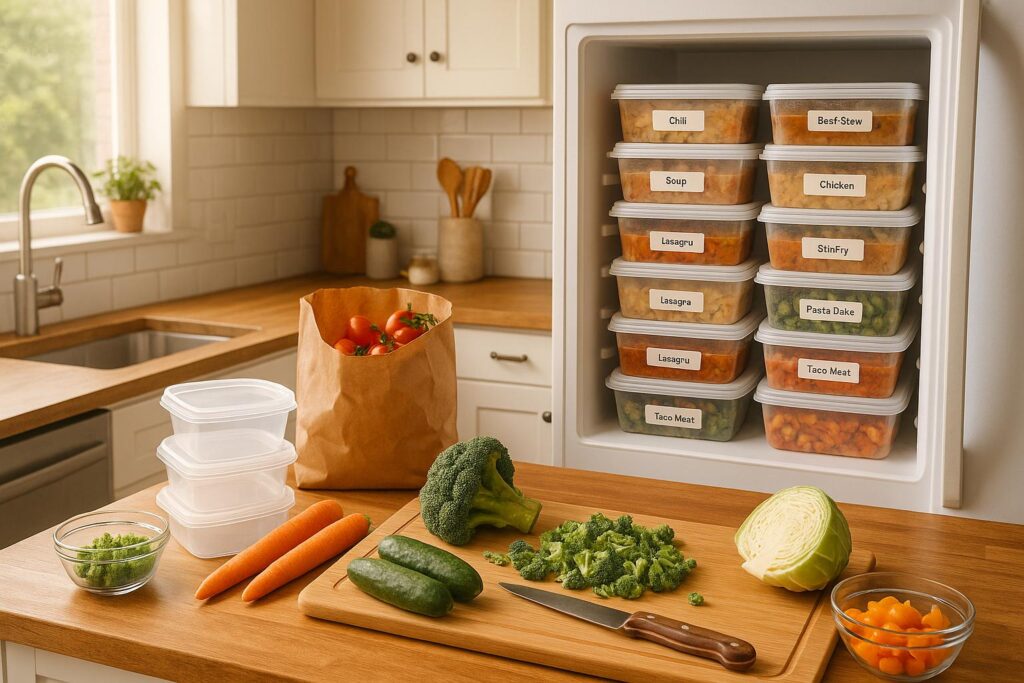
Freezer cooking is a simple way to cut grocery bills, reduce food waste, and avoid expensive takeout. By preparing meals in advance and freezing them, you can save up to $200 a month while making dinner less stressful. Here’s how it works:
- Reduce Food Waste: Freeze leftovers or bulk-bought ingredients before they spoil, saving $10–$20 per week.
- Buy in Bulk: Stock up on sale items like meat, veggies, and staples, then batch-cook to stretch your dollar.
- Skip Takeout: With ready-to-eat meals at home, you’ll spend less on restaurants and delivery.
Even modest savings – $50 to $150 per month – can add up to hundreds annually. Use this extra cash to pay off debt or build savings. Freezer cooking is easy to start: focus on budget-friendly recipes like casseroles, soups, and marinated meats, and organize your freezer with clear labels and an inventory list. A few hours of prep can yield 10–30 meals, saving time and money every week.
24 Frugal Freezer Meals for $22 | Extreme Budget Meal Prep
How Freezer Cooking Cuts Your Grocery Costs
Freezer cooking helps lower your grocery bills in three powerful ways: it reduces food waste, makes bulk buying more practical, and cuts down on pricey takeout meals. These strategies work together to create noticeable savings every month.
Reducing Food Waste
Throwing out spoiled food is like tossing money straight into the trash. Many U.S. households regularly discard items like wilted vegetables, leftover meats, or unused portions of bulk-bought chicken or ground beef. This waste can add up to $10 to $20 – or more – per week. Freezer cooking steps in to break this cycle by extending the life of your food. For example, you can portion and freeze fresh ingredients or leftovers on the day you shop or cook. Dividing a large pack of ground beef into single-serving portions or freezing shredded chicken from a roast gives you weeks, sometimes months, to use them instead of letting them spoil.
Freezing also lets you take advantage of near-expiry clearance items at the store. The key is proper storage: cool cooked food quickly, pack it in airtight, freezer-safe containers or bags (removing as much air as possible to avoid freezer burn), and label everything with its contents and freeze date. A simple freezer inventory – whether on your fridge or your phone – helps you keep track and use older meals first. Beyond reducing waste, this method pairs perfectly with bulk buying for even more savings.
Buying in Bulk for Lower Prices
Buying in bulk is a great way to reduce your cost per unit, but only if you can use everything before it spoils. That’s where freezer cooking shines – it allows you to preserve large quantities of food for future meals. By batch-cooking and freezing, you can turn a single shopping trip into weeks of ready-to-eat meals.
Take proteins, for example. Buying a large family pack of chicken breasts or ground beef at a discounted price, then cooking and freezing it into multiple meals, can save you several dollars per meal compared to buying smaller packages. One freezer meal service estimated that preparing and freezing meals ahead saves an average of $2.56 per four-serving meal. Over time, this adds up – about $25 saved for 10 meals and roughly $75 for a 30-meal monthly plan.
This approach isn’t just for meats. Vegetables like onions, peppers, and carrots, along with staples like shredded cheese, bread, tortillas, and cooked rice, are excellent candidates for bulk buying. Watching weekly sales or shopping at warehouse clubs can help you stock up while also avoiding unplanned grocery runs and impulse purchases.
Eating Out Less Often
Freezer cooking doesn’t just save you money on groceries – it also helps you spend less on dining out. When you have quick, ready-to-heat meals at home, the temptation to grab takeout or hit the drive-thru decreases significantly. And since home-cooked meals are almost always cheaper than eating out, this shift can lead to substantial savings.
Meals that go straight from the freezer to your oven, slow cooker, or skillet – like casseroles, soups, stews, or slow-cooker "dump" meals – are perfect for busy evenings. Planning just two to four freezer dinners each week on a simple meal calendar ensures you always have a convenient option, cutting back on expensive takeout. In fact, a survey found that 57% of parents appreciate the time-saving benefits of having frozen dinners ready to go.
The savings can be impressive. Some families report cutting their food budgets by about $200 per month by combining reduced waste, bulk buying, and fewer restaurant meals. Over the course of a year, even modest monthly savings can add up, freeing up funds to tackle high-interest debt or build an emergency savings cushion.
How to Start Freezer Cooking
Starting freezer cooking doesn’t require much – just a little planning, some basic tools, and a few hours of your time. The trick is to pick meals that freeze well, follow a simple batch-cooking process, and keep your freezer organized so nothing goes to waste. Let’s break down how to make freezer cooking work for you.
Budget-Friendly Meals That Freeze Well
When freezer cooking, it’s smart to focus on low-cost ingredients like beans, rice, pasta, and affordable proteins. These staples can stretch into multiple servings and are often on sale.
- Casseroles are a classic choice. Dishes like lasagna, baked ziti, and chicken-rice bakes are easy to assemble and reheat beautifully. Use disposable aluminum pans or reusable 9×13-inch dishes, and you can freeze them either before or after baking, depending on what works best for your schedule.
- Soups and stews are another freezer-friendly option. Using inexpensive ingredients like canned tomatoes, dried beans, and frozen veggies, you can whip up large batches for just a few dollars. Portion them into single or family-sized containers for easy reheating.
- Marinated meats are a great way to stock up on proteins when they’re on sale. For example, chicken thighs at $1.49 per pound can be frozen raw with marinades like teriyaki or barbecue. Ground beef bought during buy-one-get-one sales can be browned and seasoned for tacos, spaghetti sauce, or chili.
- Breakfast items like burritos or egg bakes are perfect for freezing. Wrap individual burritos in foil or parchment paper, and you’ve got a quick, homemade alternative to pricey drive-thru breakfasts.
- Slow cooker "dump meals" are lifesavers on busy days. Combine ingredients like canned tomatoes, beans, frozen veggies, and sale-priced meat in a freezer bag. When you’re ready to cook, just dump the frozen contents into your slow cooker and let it do the work.
Steps for Batch Cooking
Once you’ve picked your recipes, it’s time to get cooking. Start small – there’s no need to fill your entire freezer in one go. For your first session, aim for 8–10 dinners that cost around $2–$3 per serving by using sale items and store-brand ingredients.
- Plan meals with overlapping ingredients. For example, ground beef can work for chili, meat sauce, and taco filling, while chicken can go into soups, casseroles, and fajitas. This simplifies shopping and cuts down on waste.
- Shop smart. Check weekly grocery deals and use loyalty card discounts to plan your menu around sale proteins and produce. Buying meat during buy-one-get-one promotions can save a lot. Stick to a categorized shopping list to avoid impulse buys.
- Prep efficiently. Chop all your vegetables at once, cook large batches of rice or pasta, and brown or bake proteins in bulk. Prepping ingredients in one go saves time and energy compared to cooking each meal separately.
- Assemble meals systematically. Start with no-cook options like "dump meals" (raw meat with sauces and veggies in freezer bags), then move on to casseroles, and finish with soups or stews. Portion meals intentionally – for example, a family of four might need 4–5 cups per meal, while individuals might prefer 1–2 cup portions.
- Cool and freeze properly. Let hot foods cool in shallow containers for 20–30 minutes before refrigerating them briefly. Then transfer them to the freezer. Lay bags flat on a baking sheet so they freeze in thin, stackable bricks, which saves space and keeps your freezer organized.
For beginners, a half-day session (2–4 hours) is manageable and can still yield 10–30 meals. This method can save you up to $75 per 30-meal cooking day while reducing the temptation for last-minute takeout.
Labeling and Organizing Your Freezer
Clear labeling is crucial to avoid "mystery meals" and wasted food. Each item should include the meal name (e.g., "Chicken Chili"), the freeze date (e.g., 03/15/2025), the portion size (e.g., "Serves 4" or "2 cups"), and cooking instructions (e.g., "Thaw overnight; bake at 350°F for 45 minutes").
Use a permanent marker to write directly on freezer bags or apply masking tape to containers. Proper labeling helps with meal planning and ensures everyone in your household knows how to reheat meals correctly.
Organize your freezer into zones to maximize space and reduce waste:
- Dedicate one shelf or bin to fully cooked meals, another to raw marinated meats, and others to breakfast items or ingredients.
- Freeze bags flat so they can stand upright like files, making it easy to see what’s available.
- Keep an inventory on your freezer door or fridge. A simple list like "3 × Beef Chili (Serves 4), 2 × Chicken Alfredo Bake" helps you track what’s inside and plan meals without extra grocery trips.
Supplies You’ll Need
You don’t need fancy tools to start freezer cooking. Here are the basics:
- Heavy-duty gallon and quart freezer bags for casseroles, soups, and marinated meats
- Reusable plastic or glass containers with tight lids for single-serve or family portions
- Aluminum foil pans for casseroles or baked pasta that go straight from freezer to oven
- Masking tape or freezer labels and a permanent marker for clear labeling
Opt for stackable containers and flat-freezing bags to make the most of your freezer space. This way, you can stock up on sale items without worrying about spoilage or clutter.
sbb-itb-2a9374f
Using Grocery Savings to Pay Off Debt
Saving money through freezer cooking doesn’t just lower your grocery bill – it can also supercharge your efforts to pay off debt. Once you’ve established a routine and started seeing noticeable savings, channeling that extra cash toward credit card debt can make a big difference in your financial situation.
Turning Grocery Savings Into Debt Payments
Start by figuring out exactly how much money you’re saving each month. Treat those savings like a bill you need to pay – but instead of paying a utility or service, you’re using it to reduce your debt. Compare your typical monthly food expenses, including groceries, takeout, and dining out, to a month where you’ve fully embraced freezer cooking. For example, if your usual food spending is $900 on groceries and $300 on dining out (totaling $1,200), and freezer cooking reduces that to $800 on groceries and $150 on dining out ($950 total), you’ve freed up $250 that month. Tracking your spending over a few months will give you a clearer picture of your average savings.
Once you know your savings, adjust your budget to allocate that amount toward extra debt payments. As soon as the savings hit your account – usually right after payday – schedule an additional payment to your credit card. Automating this process ensures you won’t accidentally spend the extra cash elsewhere.
Even small extra payments can make a big dent in high-interest debt. With credit card interest rates often exceeding 20% APR as of 2024, every extra dollar you pay reduces the amount of interest you’ll owe. For instance, a family with a $5,000 balance at 22% APR making only the $150 minimum payment would take years to pay it off. But if freezer cooking frees up $150 monthly and you add that to your payment (making it $300), you could cut your payoff time nearly in half and save hundreds of dollars in interest.
Even smaller amounts help. Saving $50 a month adds up to $600 a year, which can significantly shorten the payoff timeline for a $2,000 balance. If you can redirect $100 a month ($1,200 annually), you’ll see even faster progress on balances of $4,000 to $5,000. And for households saving $200 monthly ($2,400 a year) by reducing grocery and dining expenses, paying down $8,000 to $10,000 in credit card debt becomes much more manageable, potentially avoiding thousands in interest.
To make sure your savings go directly toward debt reduction, use clear budgeting strategies. Create separate categories for "Groceries", "Dining Out", and "Extra Debt Payments", and assign every dollar a purpose at the beginning of the month. Budgeting apps that let you tag transactions can help you track spending in real time. Some people even open a separate account for debt payments and transfer their savings there immediately before making extra payments.
When deciding which debt to tackle first, you can choose between two popular strategies: the debt avalanche method, which targets the highest-interest debt for maximum savings, or the debt snowball method, which focuses on paying off the smallest balance first for quicker wins. Either approach works – pick the one that keeps you motivated. After a few months of consistent freezer cooking, reevaluate your progress and see if you can increase your extra payments as your routine becomes more efficient.
Shifting your mindset is just as important as the numbers. View your grocery savings as a dedicated tool for debt reduction, not as extra spending money. Celebrate small wins, like replacing a restaurant meal with a freezer-cooked dinner, and mentally count the avoided cost as a payment toward your debt. Setting specific goals, such as “Pay off $3,000 in credit card debt within 18 months using freezer cooking savings,” and tracking your progress visually can help you stay focused.
How Steps To Be Debt Free Can Help
Turning grocery savings into a structured debt payoff plan is easier with the right tools. Steps To Be Debt Free simplifies the process by helping you organize your credit card accounts, balances, interest rates, and minimum payments. It also shows how extra payments can shorten your payoff timeline and reduce interest costs.
You can input your estimated monthly savings to see how it impacts your debt repayment schedule. The platform helps prioritize which card should receive your extra payments, whether you’re focusing on high-interest debts or smaller balances. It also tracks your progress, reinforcing the connection between lower food spending and faster debt relief.
To provide accurate projections, Steps To Be Debt Free asks for details like your credit card balances, APRs, current payments, extra payment amounts, and your chosen strategy (avalanche or snowball). It even factors in your income and pay schedule to align payment dates with your cash flow. With this information, the tool calculates side-by-side comparisons of payoff timelines – with and without your extra savings – so you can see the impact clearly.
Regularly reviewing these projections, whether monthly or quarterly, helps you stay on track. If your spending creeps up, you can adjust by adding more budget-friendly freezer meals or cutting back on dining out. If you’re ahead of schedule, consider increasing your extra payments or applying the savings to another debt. The platform’s feedback helps refine both your meal planning and financial strategies, ensuring every freezer meal contributes to your debt-free journey.
Steps To Be Debt Free also offers a free debt review to get you started. This consultation provides a personalized assessment of your debt, evaluates your current repayment strategies, and offers tailored recommendations to help you manage your debt effectively – often within a 24- to 48-month timeline. With a clear plan in place, your grocery savings become a reliable source of extra payments, bringing you closer to financial freedom with every meal.
Conclusion
Freezer cooking offers a smart way to stretch your budget while simplifying your daily routine. By buying ingredients in bulk at discounted rates, preparing meals from scratch, and freezing portions for later, you’re essentially creating a financial safety net every time you stock your freezer.
Having ready-to-eat meals on hand also keeps those last-minute takeout splurges in check. Instead of dropping $40 to $80 on restaurant meals for a family of four, you can reheat a homemade casserole, soup, or batch of burritos for just a fraction of the cost. These small, consistent savings can add up quickly, and channeling that extra money toward high-interest debt can significantly shorten your repayment timeline.
The beauty of freezer cooking is that it doesn’t demand a massive chest freezer or hours of effort. Even with a standard freezer and just one batch-cooking session a month, you can see noticeable results in both your budget and stress levels. Start with simple, freezer-friendly recipes like soups, chilis, casseroles, taco meat, or breakfast burritos. Cook double or even triple batches, label and date everything, and keep a quick inventory on your freezer door to avoid wasting food or buying duplicates.
Once you’ve saved some extra cash, consider putting it toward an extra debt payment. For example, applying those savings to a high-interest credit card can help reduce your balance faster and cut down on interest charges over time. If you’re looking for a structured way to tackle debt, Steps To Be Debt Free offers tools to organize your accounts, track balances, and create a payoff plan. They even provide a free debt review to help you identify the best strategies for your situation.
Freezer cooking doesn’t just save money – it also simplifies meal planning and builds better financial habits. With a stocked freezer, you’ll stress less about dinner decisions, avoid unnecessary store trips, and enjoy more home-cooked meals with your family. By turning small, manageable changes – like cooking in bulk and skipping takeout – into everyday habits, you’re setting yourself up for long-term financial success. Redirect those savings toward your debt strategy and take one more step toward a stress-free, cost-effective lifestyle.
FAQs
How can I start freezer cooking if I don’t have much freezer space?
If your freezer is short on space, it’s smart to start with smaller portions and focus on freezing meals or ingredients that save both time and money. Smaller portions make a big difference – opt for compact containers or freezer bags to make the most of the available room. For soups or sauces, flatten the bags before freezing so you can stack them neatly. And don’t forget to label everything with the name and date to keep things organized.
Another space-saving trick is to freeze individual ingredients like chopped vegetables, cooked meats, or shredded cheese. These take up less space than full meals and give you flexibility when cooking later. Focus on freezing items that tend to spoil quickly or are more expensive, ensuring you get the most out of every inch of your freezer.
How can I prevent freezer burn and keep my meals fresh for longer?
To keep your meals tasting their best and avoid freezer burn, always store food in airtight containers or heavy-duty freezer bags. Make sure to press out as much air as possible before sealing – this helps reduce contact with moisture and cold air, which can affect the food’s texture and flavor. Don’t forget to label each item with the date you froze it. This simple step makes it easier to use older items first and prevents food from lingering in the freezer too long. For top-notch results, freeze meals when they’re at their freshest, and set your freezer to 0°F (-18°C) or lower to maintain quality.
How do I figure out the right portion sizes to freeze meals for my family?
To figure out the best portion sizes for freezing meals, start by thinking about your family’s usual eating habits. How much does each person typically eat in one sitting? Use that as your guide. For instance, if a family of four usually finishes 2 cups of soup per person, you can freeze the soup in an 8-cup container. Alternatively, divide it into smaller portions for more flexibility when reheating.
Make sure to label each container with the portion size and the date it was prepared. This small step makes it easier to grab the right amount when you need it and ensures you’re keeping track of freshness. Freezer cooking is a smart way to cut down on waste, stretch your budget, and make the most out of your ingredients while reducing those last-minute grocery runs.
