
If you’ve ever found an unexpected charge on your credit card, disputing it could be your best course of action. Whether it’s a billing error, a product that wasn’t delivered, or a charge you didn’t recognize, understanding how to provide the right evidence can significantly improve your chances of success. Here’s what you need to know:
- Timing matters: File disputes within 60 days of spotting an error on your statement.
- Evidence is key: Strong, relevant documentation can increase your success rate from 5% to 60%.
- Common evidence types: Delivery confirmations, signed receipts, email logs, and proof of terms agreement.
- Tailor your case: Match your evidence to the specific dispute type (e.g., fraud, non-delivery, defective items).
- Stay organized: Submit files in a clear, chronological order and avoid unnecessary clutter.
The process requires preparation, but with the right approach, you can resolve disputes effectively. Always focus on submitting concise, relevant evidence and meeting deadlines to maximize your chances of a favorable outcome.
How to Never Lose a Credit Card Dispute
sbb-itb-2a9374f
Types of Evidence for Credit Card Disputes
The kind of evidence you need depends on the type of dispute you’re facing. Submitting the right documentation can improve your chances of success, increasing your win rate from 5% to 60%.
Proof of Customer Authorization
Evidence of authorization shows that the cardholder knowingly approved the transaction. For online purchases, this might include:
- Address Verification System (AVS) matches
- Card Verification Value (CVV/CVC) confirmations
- 3D Secure authentication logs
Other useful records include IP addresses matching the cardholder’s billing address, device identifiers, and system logs showing account activity like logins or downloads.
For in-store transactions, EMV chip data is particularly strong since chip-enabled cards are hard to duplicate. Additional evidence like signed receipts, surveillance footage of the cardholder, or scanned photo IDs can further support your case. Under Visa‘s Compelling Evidence 3.0 standard, you can also reference two prior non-fraudulent transactions (older than 120 days) to dispute friendly fraud.
"Fraudulent disputes account for over half of all disputes. It’s important to prove the legitimate cardholder was aware of and authorized the transaction in such cases."
– Stripe Documentation
Communication logs – emails, texts, or chat transcripts – where the customer discusses the transaction can also show they were aware of it.
Once you’ve established authorization, move on to proving delivery or service completion.
Proof of Delivery or Service Completion
When dealing with "product not received" disputes, delivery evidence is key. For physical goods, provide:
- Carrier tracking numbers
- Full delivery address (street, city, state, and ZIP code)
- Delivery confirmations, especially those with recipient signatures
"Choosing a carrier or delivery method that requires a signature on delivery provides the best defense against product not received or fraudulent disputes where you’ve shipped to a verified billing address."
– Sara Kincaid, Aisle Planner
For digital goods, use system logs, IP address records, or screenshots showing download timestamps and account activity. If your business is service-based, include photos of completed work, signed contracts, or geolocation data proving the provider’s presence. If the item was sent to someone other than the cardholder (like a gift), include documents explaining the relationship or shipping details.
Customer acknowledgments – like emails or chat logs where they confirm receipt or express satisfaction – can further strengthen your case.
When organizing your evidence, highlight critical details such as delivery dates or signatures using bold text or arrows. Arrange everything in chronological order for clarity. Avoid external tracking links since card issuers only review uploaded files.
Terms of Service and Refund Policy Records
Your terms of service (TOS) and refund policies are also vital for chargeback disputes. Show that the customer saw and agreed to these terms at checkout by including:
- Screenshots of the checkout page displaying the policies
- Proof of agreement, like a clicked "I agree" checkbox or a signed contract
Submit only the relevant sections, such as cancellation or refund clauses, with clear highlights. For recurring charges, include the original agreement outlining renewal terms, billing frequency, and cancellation deadlines. Communication logs where the policy was explained or acknowledged can further support your case.
Make sure all documents are easy to read – use at least a 12-point font – and ensure your total file size is under 4.5MB. Group related evidence, like multiple emails or screenshots, into a single PDF. Always tailor your evidence to the specific dispute reason. For example, refund policies matter for canceled merchandise disputes but won’t help with claims of non-delivery.
Evidence for Common Dispute Situations
Every dispute scenario comes with its own set of challenges, and the evidence you present needs to match those specific circumstances. Different types of disputes require distinct documentation, and knowing exactly what to submit can significantly boost your chances of success. While the average merchant win rate hovers around 45%, tailoring your evidence to the dispute reason can give you a stronger edge.
Fraud Disputes
Fraud claims, particularly Visa reason code 10.4 (Other Fraud – Card-Absent Environment), made up a staggering 77.5% of disputes in 2021. Many of these cases involve "friendly fraud", where customers falsely claim they didn’t authorize a charge. To challenge these claims, you must prove that the actual cardholder was involved in the transaction.
Under Visa Compelling Evidence 3.0 (CE 3.0), merchants are required to demonstrate a legitimate purchase history. Specifically, you need to submit evidence of two prior, undisputed transactions that occurred 120 to 365 days before the disputed charge. These transactions must match at least two data points – such as the customer account ID, delivery address, device ID, or IP address – with the condition that one of these matched elements must be either the IP address or device ID.
"Compelling evidence is defined as ‘proof the cardholder participated in the transaction, received the goods or services, or benefited from the transaction.’" – Visa
In its first year, CE 3.0 helped businesses prevent disputes worth tens of millions of dollars. To strengthen your case further, include additional data such as AVS matches, CVV verification, and 3D Secure authentication logs. For digital products, server logs showing access or downloads tied to matching IP addresses or device identifiers can be crucial in proving the cardholder actively used the service.
Don’t stop there – ensure your documentation also covers delivery or product condition details to address potential claims of non-delivery or defective items.
Non-Delivery or Defective Item Claims
When disputes involve "product not received" claims, your tracking evidence must clearly show "last mile" delivery to the recipient’s exact street address, not just the city or ZIP code. Include details like the carrier name, tracking number, delivery date, and, if available, a signature. A photo of the package at the delivery location can further solidify your case.
For disputes involving defective items or claims that the product was "not as described", focus on proving the item met its specifications before shipping. Submit documentation such as the original product description from your website, photos of the item prior to shipment, and any quality control records. If the customer failed to follow your return policy, include a screenshot of the policy as displayed on your checkout page, along with evidence that the customer agreed to it.
For digital goods, server logs can once again be a powerful tool. Provide records showing when the customer accessed or downloaded the product, complete with matching IP addresses and device identifiers. Additionally, retain communication logs to establish a clear timeline and show whether the customer attempted to resolve the issue before escalating to a dispute.
How to Organize and Submit Your Evidence
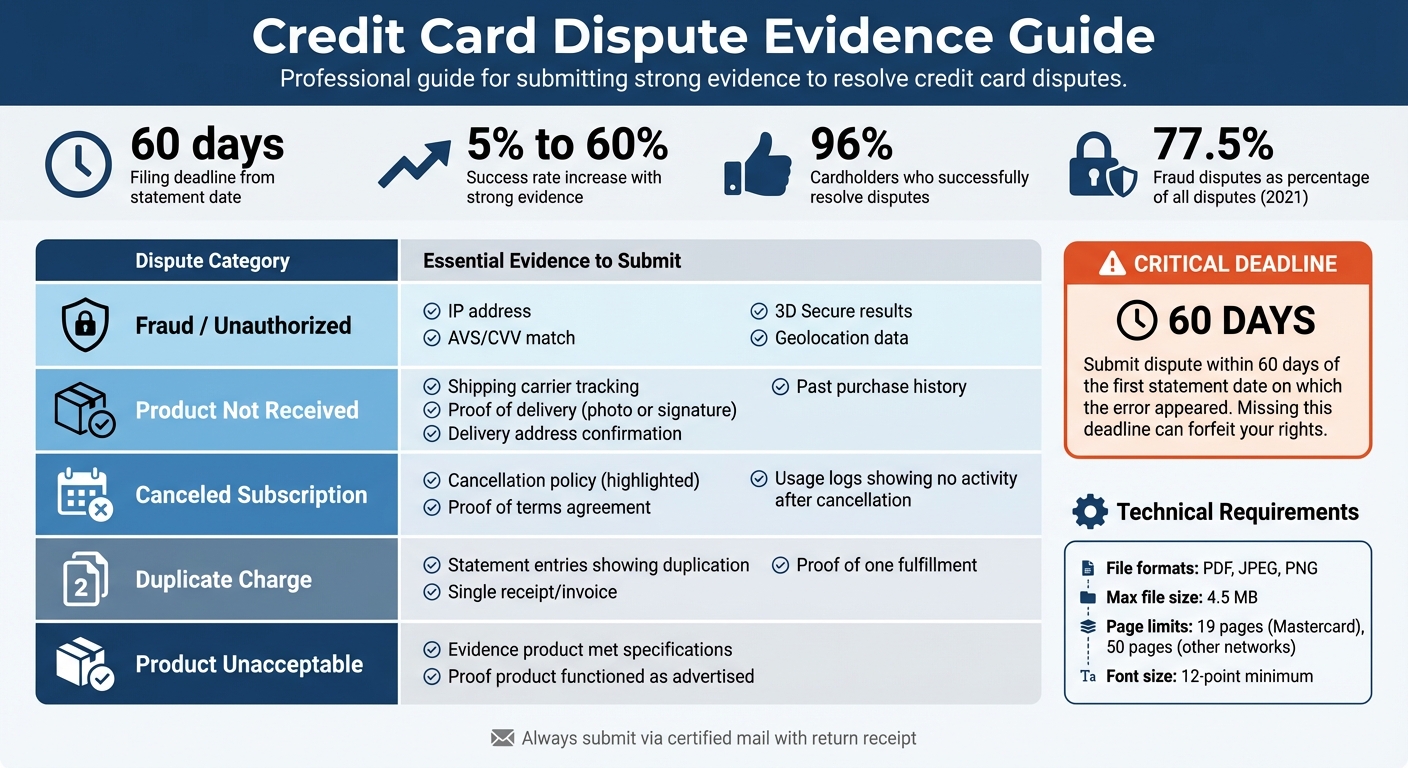
Credit Card Dispute Evidence Requirements by Dispute Type
When submitting evidence for a dispute, organization is everything. Card issuers often review claims quickly, so a well-structured submission can make a big difference. Presenting your evidence in chronological order helps create a clear narrative, which strengthens your case.
Best Practices for Submitting Evidence
Before anything else, make sure your evidence meets the technical requirements. Most card networks accept PDF, JPEG, or PNG files, with a combined size limit of 4.5 MB. Page limits vary – 19 pages for Mastercard and up to 50 pages for other networks. Use a 12-point font or larger on US Letter or A4 paper in portrait orientation to ensure readability.
To streamline your submission, combine similar types of evidence into one document. For instance, merge all email threads into a single "Customer Communication" file. Many systems limit uploads to one file per category, so this approach ensures all relevant information is included. If your file exceeds size limits, reduce the font size slightly, use single spacing, and compress images. Never include links to external drives or cloud storage – card issuers won’t access them for security reasons.
"Providing too little evidence is a problem, but overwhelming the card issuer with unnecessary content can obscure your argument." – Stripe
When submitting screenshots, crop them to highlight key details such as delivery confirmations or tracking numbers. Avoid using color highlights, as these often become unreadable after processing. Instead of uploading full documents like your Terms of Service, extract and submit only the relevant sections. Use arrows to point out key clauses, such as your cancellation policy.
Always organize your evidence chronologically to create a logical timeline that supports your argument. Add a brief summary (about five to seven sentences) for each piece of evidence to help reviewers quickly understand its relevance. Keep your tone neutral and stick to factual information – emotional language can weaken your case.
Once your documents are organized, tailor your evidence to the specific type of dispute you’re addressing.
Matching Evidence to Dispute Types
Each dispute category requires specific types of evidence. Here’s a quick guide to what you’ll need for some common scenarios:
| Dispute Category | Essential Evidence to Submit |
|---|---|
| Fraud / Unauthorized | IP address, AVS/CVV match, 3D Secure results, geolocation data, and past purchase history |
| Product Not Received | Shipping carrier tracking, proof of delivery (photo or signature), and delivery address confirmation |
| Canceled Subscription | Cancellation policy (highlighted), proof of terms agreement, and usage logs showing no activity after cancellation |
| Duplicate Charge | Statement entries showing duplication, a single receipt/invoice, and proof of one fulfillment |
| Product Unacceptable | Evidence that the product met specifications and functioned as advertised |
Submitting a single, well-structured PDF file organized by evidence type is far more effective than uploading scattered screenshots.
Common Mistakes to Avoid
Even with organized evidence, certain mistakes can hurt your case. The most critical? Missing the 60-day deadline. Under the Fair Credit Billing Act (FCBA), you must notify your card issuer in writing within 60 days of the statement showing the error. Disputing by phone doesn’t preserve your rights – always follow up in writing and send it to the billing error address listed on your statement, not the payment address.
"Disputing by telephone does not preserve your rights under the FCBA." – Christopher Elliott, Founder, Elliott Advocacy
Don’t file disputes for charges that are still "pending." Many duplicate charges are temporary authorizations that disappear automatically within 3–10 days. Wait until the transaction posts before initiating a dispute to avoid confusion.
Another common error is relying solely on screenshots of your credit card statement. You’ll need supporting documents like receipts, order confirmations, or invoices to back up your claim. Avoid uploading entire policy documents when only a specific section matters, and steer clear of emotional language or personal opinions like "this ruined my vacation". Stick to facts and relevant documentation.
Finally, always send your dispute letter via certified mail with a return receipt requested. This ensures you have proof of delivery and timing, protecting your rights if the issuer claims they didn’t receive your submission. A clear paper trail is invaluable when resolving disputes.
Steps To Be Debt Free
Tackling credit card debt starts with addressing any errors on your statements. Disputing incorrect charges is crucial because these mistakes can inflate your balance and negatively affect your debt-to-credit ratio.
Steps To Be Debt Free provides a clear system to evaluate your debt levels, payment history, and personal details – key elements needed to prepare dispute evidence. Carefully reviewing your monthly statements can help you spot unauthorized transactions that might be adding to your debt. Recent data shows that 50% of cardholders have disputed a credit card charge, with an impressive 96% of those cases resolved successfully. This process not only ensures your statements are accurate but also lays the groundwork for better credit management.
When a dispute is resolved in your favor, the result is a chargeback, which removes the incorrect charge from your balance. This adjustment can improve your debt-to-credit ratio and might even boost your credit score. Additionally, federal law caps your liability for unauthorized charges at $50, making it vital to identify fraud quickly to prevent further financial strain.
"The most common complaint people make about credit cards is a problem with a purchase shown on their statement." – Sarah Brady, Personal Finance Writer
Conclusion
Winning a credit card dispute requires thorough preparation and carefully organized evidence. While 96% of cardholders manage to resolve disputes, even with strong evidence, only about 60% of cases end in a win for the cardholder.
The 60-day deadline under the Fair Credit Billing Act is crucial. Missing this deadline means an automatic loss, and reversing a final decision often requires formal arbitration or legal action. This underscores the importance of submitting timely, relevant evidence. Tailor your documentation to the specific reason code for the dispute – submitting unrelated evidence, like a return policy for a non-delivery claim, is almost guaranteed to result in rejection.
"The issuing bank is looking for clear, credible, and complete documentation that proves the transaction was legitimate and the customer received what they paid for. Anything less reduces your chances of winning." – Disputifier
To improve your chances, ensure your evidence is clear, well-organized, and directly relevant. Card issuers deal with thousands of disputes daily, so presenting a strong, easy-to-review case can make a big difference. Businesses, for instance, contest only about 43% of disputes and win just 12% of those cases. This gives cardholders an edge – if they provide evidence that directly addresses the reason code for their dispute.
When disputing by mail, always use certified mail with a return receipt, and keep copies of all your documents. Following the advice in this guide – matching your evidence to the specific dispute type – puts you in the best position for a favorable outcome. For further tips on managing credit card debt and maintaining financial health, check out Steps To Be Debt Free for practical strategies to regain control of your finances.
FAQs
What evidence is strongest for an unauthorized charge?
The best way to prove an unauthorized charge is with clear documentation showing the transaction wasn’t approved. This could include evidence like a charge with the wrong date or amount, or proof that the cardholder wasn’t involved in the transaction. Backing this up with rules outlined in the Fair Credit Billing Act can make your case even stronger.
How do I prove I never received the item?
If you need to prove that an item wasn’t delivered, start by collecting evidence that supports your claim. This might include shipping records, tracking information, or delivery confirmations showing the item was never marked as delivered. Additionally, any communication with the seller where they acknowledge the issue can be incredibly helpful. Keep all this information well-organized and submit it during the dispute process to make your case stronger.
What should I do if I missed the 60-day dispute deadline?
If the 60-day deadline has passed, you might still have options. For example, disputes related to product or service quality could give you up to 120 days to file a chargeback. Additionally, the Truth in Lending Act provides potential legal remedies for unauthorized charges. If you’re beyond the usual timeframe, consider reaching out to a consumer protection attorney to discuss what steps you can take.
