
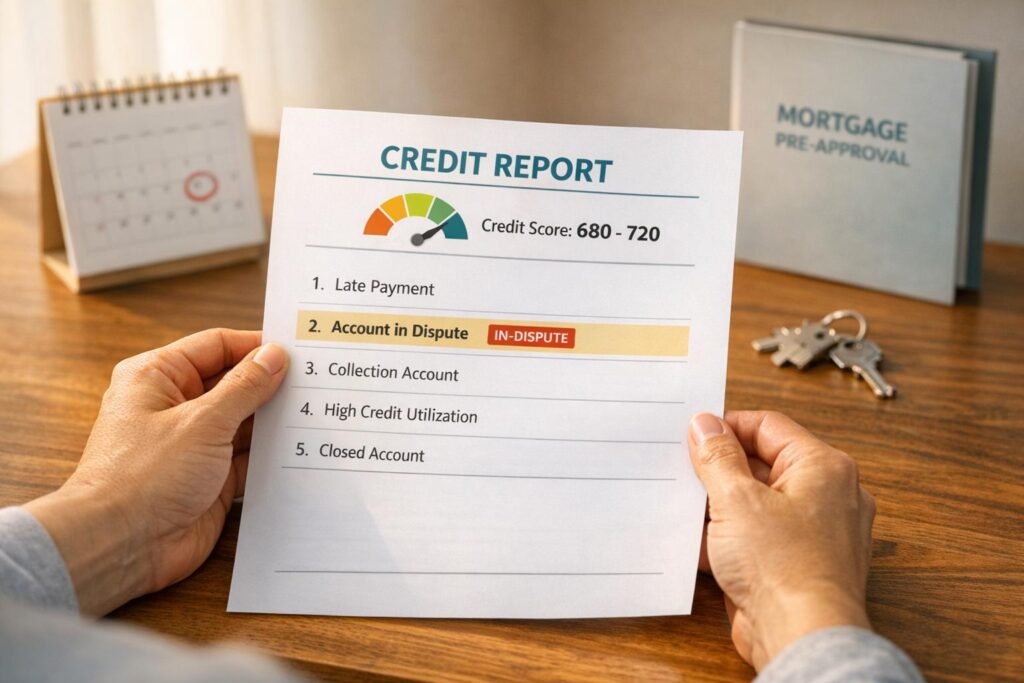
When you dispute errors on your credit report, the process can lead to changes that may improve or hurt your credit score. Here’s what you need to know:
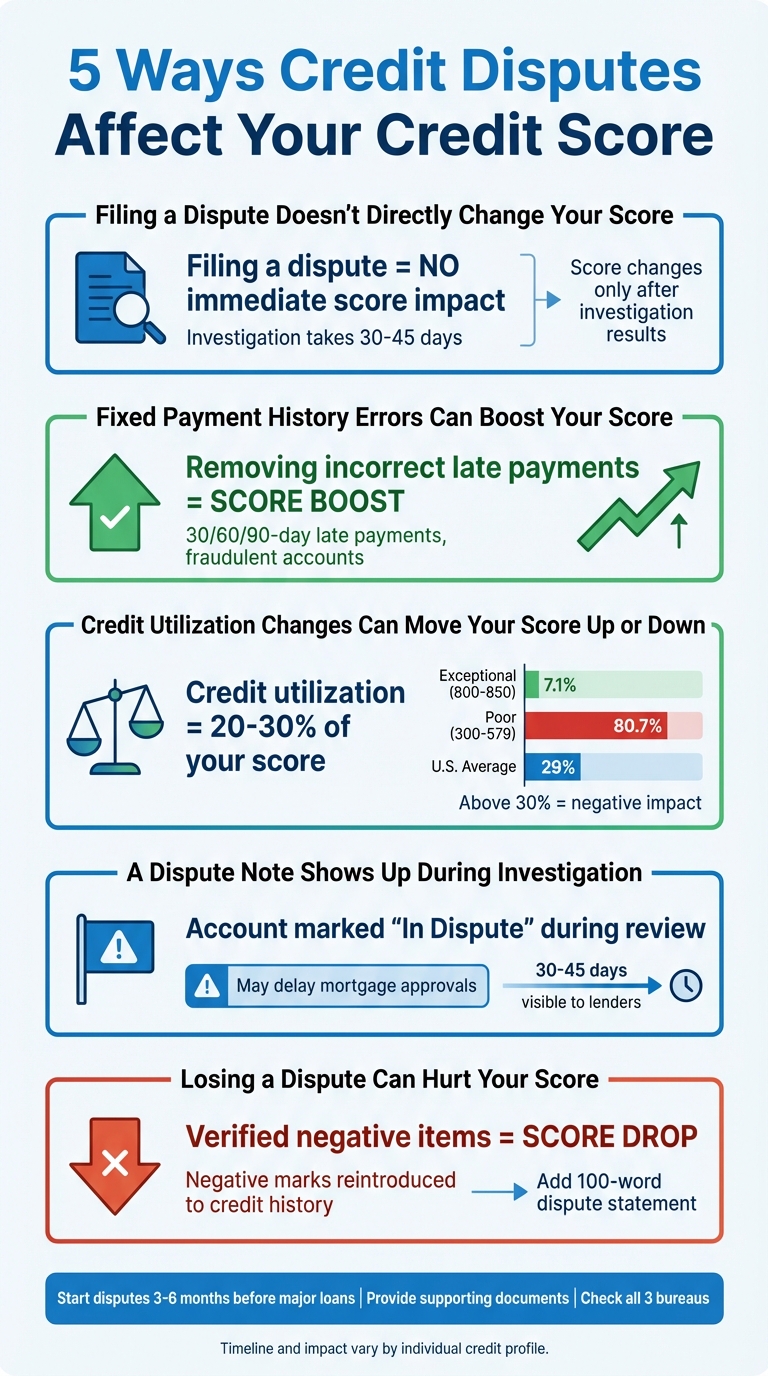
- Filing a Dispute Doesn’t Directly Change Your Score: The act of disputing itself won’t affect your score, but the outcome of the dispute might.
- Correcting Payment History Errors Can Improve Your Score: Fixing inaccurate late payments or delinquencies often results in a noticeable boost.
- Credit Utilization Adjustments Can Go Either Way: Disputes involving credit limits or balances can lower or raise your score depending on the outcome.
- Temporary “In Dispute” Notes May Impact Loan Applications: Accounts under review are flagged, which could delay loan approvals.
- Losing a Dispute May Hurt Your Score: If a dispute fails, verified negative items stay on your report and may lower your score.
Disputes typically take 30–45 days to resolve. If you’re planning a major financial move, start early to avoid delays and ensure your credit report is accurate.
5 Ways Credit Disputes Affect Your Credit Score
Do Credit Disputes Affect Your Chances of Getting A Loan?
sbb-itb-2a9374f
1. Filing a Dispute Doesn’t Directly Change Your Score
Filing a dispute won’t cause your credit score to rise or fall. Credit scoring models like FICO and VantageScore rely on factors such as payment history, credit utilization, and account age – not the act of disputing information. A dispute is simply a formal request to review an entry on your credit report, and it doesn’t immediately impact your score. Experts in the field emphasize this point.
As Jim Akin from Experian explains:
"Requesting a change or update to your credit report – a process known as filing a dispute, which you have the right to do – has no direct impact on your credit."
Here’s how it works: once you file a dispute, an investigation begins. This process usually takes about 30 days, or up to 45 days if you provide additional documents. During this time, the disputed information remains on your report. Whether your score changes depends on the outcome of the investigation. For instance:
- If the dispute leads to the removal of a late payment or correction of an incorrect balance, your score might improve.
- If the information is verified as accurate, it stays on your report, leaving your score unchanged.
It’s also worth noting that disputes involving personal details – like your name, address, or employer – have no effect on your credit score.
One thing to be aware of: many mortgage lenders may pause the loan approval process if an account is flagged as "in dispute".
2. Fixed Payment History Errors Can Boost Your Score
Your payment history plays a key role in determining your credit score, so even small errors in this area can have a big impact. If you spot an incorrect late payment on your report, disputing it could lead to a noticeable score increase. As Jim Akin from Experian puts it:
"Eliminating inaccurate late or missing payments could mean a significant boost for your scores."
Here’s how it works: once the error is corrected, your score is recalculated without that negative mark. This can lead to an immediate improvement, especially if your payment record is otherwise strong. Common issues to look out for include wrongly reported 30-, 60-, or 90-day late payments, delinquencies that were never yours, or late payments tied to fraudulent accounts.
If your dispute is successful, the bank or credit card issuer must alert all three major credit bureaus to update your reports accordingly.
To get started, gather proof like bank statements, canceled checks, or payment confirmation emails. Then, file a dispute with both the credit bureau and the creditor that reported the error. This ensures the issue is fixed at its source and that any recent users of your credit report are notified about the updates .
3. Credit Utilization Changes Can Move Your Score Up or Down
Your credit utilization ratio is calculated by dividing the amount of revolving credit you’re using by your total available credit. This ratio plays a big role in your credit score, accounting for roughly 20% to 30% of it. Disputing errors related to your credit limit or balance can lead to changes in your score.
For example, fixing an incorrectly reported high balance or low credit limit can lower your utilization ratio, which often leads to a higher credit score. However, if an account is removed during the dispute process because the data can’t be verified, you might lose that available credit. This could increase your overall utilization ratio and potentially lower your score.
The impact of credit utilization on credit scores is clear when comparing different score ranges. People with Exceptional FICO® Scores (800-850) have an average utilization ratio of just 7.1%, while those with Poor scores (300-579) average a much higher 80.7%. As of the third quarter of 2024, the average credit utilization across the U.S. stood at 29%. Louis DeNicola from Experian points out that while there’s no strict threshold, utilization above 30% generally starts to have a more noticeable negative effect on your score.
Credit scoring models evaluate both your total utilization across all accounts and the utilization rate for each individual revolving account. This means even one incorrect balance can distort your numbers. Once a dispute is resolved and your credit report is updated, it’s a good idea to check your FICO® Score to see how your utilization ratio has been affected.
To stay on top of things, regularly review your credit reports for errors in credit limits or account balances – these are valid items to dispute. If you’re planning to apply for a major loan, like a mortgage, handle disputes related to utilization well in advance. Accounts marked as "in dispute" can sometimes delay the loan approval process. Managing these adjustments carefully ensures that correcting errors also supports your overall financial goals.
4. A Dispute Note Shows Up During the Investigation
When you file a dispute, credit bureaus add a note to the specific account, marking it as "in dispute" while they review your claim. This marker stays visible during the investigation, signaling that the account is under review. It’s one of the ways disputes can temporarily impact your credit report, as outlined throughout this guide.
Experian explains:
"The account will remain on the report while it is being disputed, but may have the notation you see associated with it until the dispute is completed. The account will not be removed or ‘suppressed’ from the report while it is being disputed." – Experian Team
Lenders can see this dispute note, which might influence their decisions. The Consumer Financial Protection Bureau highlights that credit bureaus typically exclude disputed debts from score calculations during the review period. Since the final outcome is uncertain, some lenders may hold off on extending credit until the matter is resolved.
This can be particularly problematic during key financial moments, like applying for a mortgage. Gayle Sato from Experian points out:
"Having an account in dispute on your credit report during the mortgage application process, for example, can prevent you from being approved for the loan until the dispute process is complete".
Credit bureaus are required to wrap up their investigation within 30 days, though the timeline can stretch to 45 days if additional documentation is submitted.
To avoid complications, keep an eye on your report to ensure dispute notes are removed once the process concludes. If the dispute doesn’t go in your favor, you can add a "statement of dispute" to your file, giving future lenders your side of the story.
5. Losing a Dispute Can Hurt Your Score
Disputing an item on your credit report doesn’t always lead to a positive outcome. Once the credit bureau investigates your claim, they reach out to the lender or creditor to verify the information you’ve challenged. If the creditor confirms the data is accurate, the bureau will label the item as "Verified" or "Remains" on your report. Unfortunately, this verification can negatively impact your credit score.
During the dispute process, the debts in question are temporarily excluded from your credit score calculations. But if the dispute is resolved in favor of the creditor, the negative item is reintroduced into your credit history. This means your score might drop because the confirmed information – such as a late payment, a collection, or another derogatory remark – is now a permanent part of your record. As Jim Akin from Experian explains:
"The company reporting the information has certified to Experian that the information is accurate, so the item has not changed."
If your dispute doesn’t succeed, you still have options. You can contact the lender directly to request a correction or add a personal dispute statement to your credit file. The Consumer Financial Protection Bureau highlights this option:
"If the investigation doesn’t resolve your dispute, you can still have the dispute noted on your credit report by submitting a statement describing your dispute, but the debt will be used for credit scoring and lenders may consider it along with your statement."
While this won’t remove the negative item, it gives you the chance to explain your perspective to potential lenders.
Conclusion
Disputing errors on your credit report can safeguard your financial health, but it requires careful planning and realistic expectations. While filing a dispute itself doesn’t lower your credit score, the results – whether an item is corrected, removed, or verified – can influence your credit in various ways. Fixing inaccurate negative marks, like late payments or fraudulent accounts, can lead to noticeable improvements. On the flip side, removing an older account might unintentionally shorten your credit history or raise your credit utilization ratio.
Timing is key. If you’re gearing up for a major loan, such as a mortgage, check your credit reports from Experian, Equifax, and TransUnion at least three to six months before applying. This timeframe allows you to address disputes before lenders review your credit, as accounts labeled "in dispute" can delay or even complicate your application process. Keep in mind that dispute investigations typically take 30 to 45 days to complete.
Ensure your dispute is backed by solid evidence. Credit bureaus may dismiss disputes as "frivolous" if you don’t include supporting documents like bank statements, canceled checks, or creditor correspondence. If your dispute is denied and you still believe the information is wrong, consider contacting the data furnisher directly or adding a 100-word dispute statement to your file.
If you’re tackling both credit errors and debt, Steps To Be Debt Free can help simplify the process. The site offers a free debt review to evaluate your balances, payment history, and potential strategies for managing or reducing your debt. By pairing accurate credit reporting with a clear debt relief plan, you can strengthen your credit profile while moving closer to financial independence.
FAQs
How long does it usually take to resolve a credit report dispute?
Resolving a credit report dispute usually takes 30 to 45 days, though the exact timing can depend on the credit bureau and how complex the issue is. After you file a dispute, the bureau will investigate and confirm the details with the source of the information.
If the dispute is resolved in your favor, the corrections will appear on your credit report. However, timelines might shift slightly depending on the nature of the issue or if additional documents are needed. It’s a good idea to keep an eye on your report for updates throughout the process.
Can disputing an item on my credit report affect my chances of getting a loan?
Yes, disputing an item on your credit report can temporarily impact your ability to secure a loan. During the dispute process, the account in question may be flagged as "in dispute," which can lead to delays in credit approval or influence how lenders assess your report.
That said, filing a dispute to correct an error doesn’t directly lower your credit score. However, if you’re planning a significant financial move, like applying for a loan or mortgage, it’s smart to settle any disputes first to avoid unnecessary hold-ups.
What should I do if my credit dispute is denied?
If your credit dispute gets denied, the information you challenged will remain on your credit report and could still affect your credit score. But don’t worry – there are steps you can take to address the situation.
Start by requesting a free copy of your credit report. This allows you to carefully review the details and double-check for any errors or inconsistencies. If you’re confident the decision was wrong, you can file another dispute, this time with additional supporting evidence. Another option is to reach out directly to the creditor to try resolving the issue at the source.
You can also add a personal statement to your credit report. This note explains your side of the situation, giving future lenders some context when they review your report.
By staying on top of your credit and taking these steps, you can work toward minimizing the impact of an unresolved dispute.
