

If you’re overwhelmed by debt, two common solutions are debt forgiveness and debt settlement. While they sound similar, they work differently:
- Debt Forgiveness: A lender cancels part or all of your debt, often due to financial hardship. Examples include federal student loan forgiveness or hospital charity programs.
- Debt Settlement: You negotiate with creditors (or hire a company to do so) to pay a lump sum that’s less than what you owe. Creditors accept this to recover part of the debt instead of none.
Both methods focus on unsecured debts like credit cards or medical bills but come with trade-offs, including impacts on your credit score and potential tax liabilities. Below is a quick comparison to help you choose the right option.
Quick Comparison
| Feature | Debt Forgiveness | Debt Settlement |
|---|---|---|
| Who Initiates It | Lender or program | You or a third-party company |
| Payment Required | Often none | Lump-sum payment (40–60% of the debt) |
| Credit Impact | Varies; can be neutral | Negative due to missed payments |
| Tax Consequences | Forgiven debt over $600 is taxable | Settled debt over $600 is taxable |
| Time to Resolve | Depends on the program | 12–48 months |
| Legal Risk | Low | High (potential lawsuits) |
| Fees | Usually none | 15–25% of enrolled debt |
Both options can help reduce debt, but understanding their risks and benefits is critical. Read on for a detailed breakdown of how they work, their costs, and their impact on your finances.
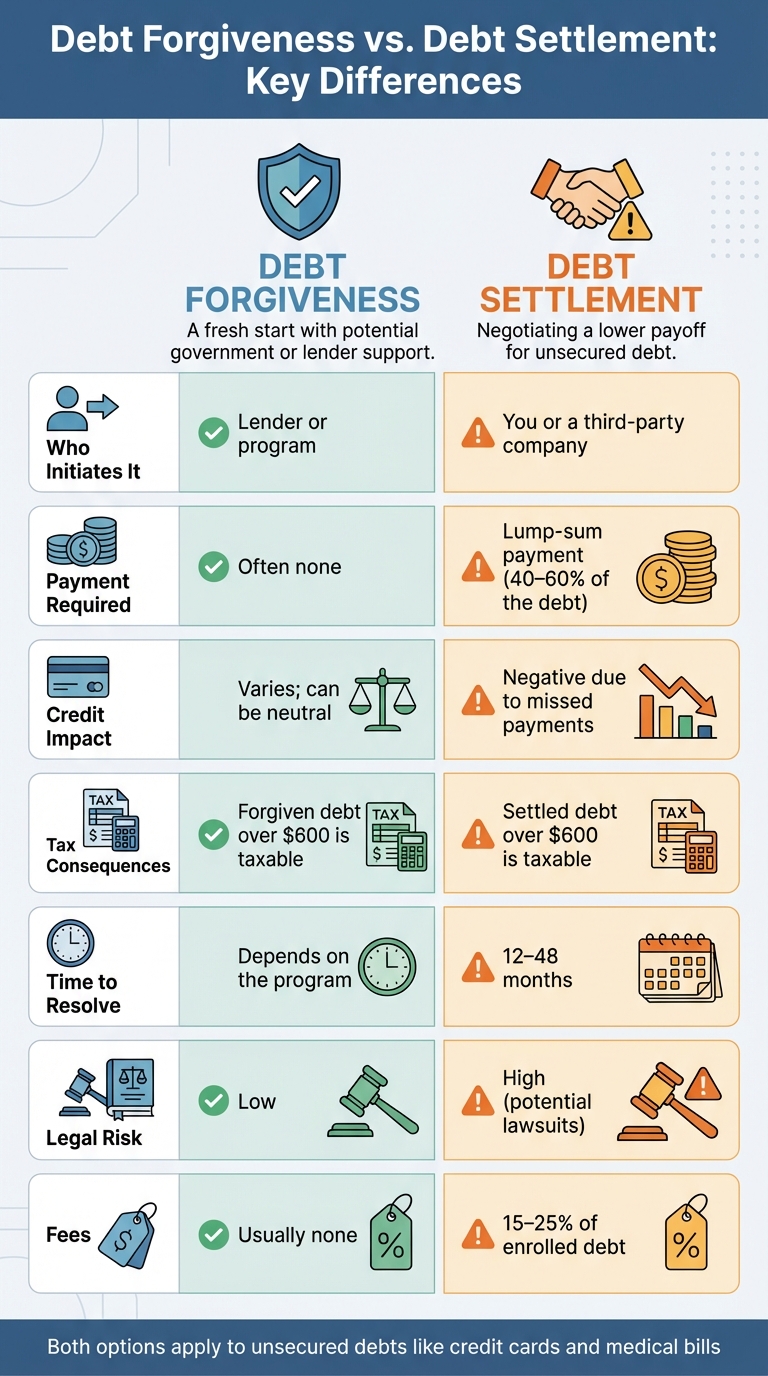
Debt Forgiveness vs Debt Settlement Comparison Chart
Debt Relief Program Pros and Cons (2025)
sbb-itb-2a9374f
What is Debt Forgiveness?
Debt forgiveness happens when a lender cancels all or part of a debt. It’s not something lenders offer lightly – they typically reserve it for people facing serious financial challenges, like losing a job or dealing with large medical bills.
This option is generally available for unsecured debts such as credit cards, personal loans, medical bills, or federal student loans. Secured debts, like mortgages or car loans, are rarely forgiven because they’re tied to collateral.
"If your creditor agrees to reduce or fully forgive your balance, ask them for a debt forgiveness letter. This letter confirms you no longer owe the full balance and documents your agreement."
It’s worth noting that creditors don’t have to forgive any debt. You can try negotiating directly, work with a nonprofit credit counselor, or hire a debt settlement company for assistance. However, as Priyanka Trivedi explains:
"Lenders are in the business of making money, so they won’t erase your balance just because you ask."
Let’s dive into how the debt forgiveness process works.
How Debt Forgiveness Works
To start, you’ll need to show your creditor that repaying the full amount is beyond your means. Lenders will review your income, assets, debts, and essential expenses to assess whether full repayment is realistic. Be prepared to provide documents like pay stubs, medical bills, or proof of unemployment.
Creditors are typically more open to negotiating once your account is seriously overdue but hasn’t yet been written off or sold to a collection agency. If they agree to forgive part or all of your debt, get it in writing. A "debt forgiveness letter" ensures you’re protected from future collection efforts on the forgiven balance.
There are several examples of debt forgiveness in action:
- Many U.S. hospitals (over 50%) offer charity care programs.
- Public Service Loan Forgiveness (PSLF) can cancel federal student loans after 10 years of qualifying payments.
- The IRS Offers in Compromise program helps with tax debt, though it requires detailed documentation and has low approval rates.
Now, let’s look at how debt forgiveness affects your credit and taxes.
Impact on Credit and Taxes
Debt forgiveness can have two major effects: one on your credit score and another on your taxes.
First, your credit score may take a hit. Forgiven debts are usually marked on your credit report as "settled" or "paid for less than the full balance", and this can stay on your record for up to seven years. This can make it harder to get approved for new credit, rent an apartment, or even secure certain jobs.
Second, there are tax implications. The IRS treats forgiven debt over $600 as taxable income. If this applies to you, your lender will send both you and the IRS a Form 1099-C. The amount of tax you owe depends on your tax bracket. For instance, if $10,000 in debt is forgiven and you’re in the 22% tax bracket, you could owe about $2,200 in federal taxes.
There are exceptions, though. If you’re "insolvent" (your debts exceed your assets at the time of forgiveness), you might not have to pay taxes on the forgiven amount. To qualify, you’d need to file IRS Form 982. Additionally, federal student loan discharges are currently tax-free, but this benefit is set to expire on December 31, 2025, unless extended by Congress.
Pros and Cons of Debt Forgiveness
| Pros | Cons |
|---|---|
| Reduces or eliminates your debt burden | Can harm your credit score for up to seven years |
| Stops collection calls and legal actions | Forgiven amounts are often considered taxable income |
| Often available through hardship programs, like those at hospitals | Creditors are not obligated to forgive any debt |
Before deciding on debt forgiveness, it’s a good idea to consult with a tax professional or nonprofit credit counselor. They can help you better understand how it might affect your finances and credit score. You might also want to look into alternatives like debt consolidation or management plans, which can have less severe consequences for your credit.
What is Debt Settlement?
Debt settlement involves negotiating with your creditor to pay a lump sum that’s less than the total amount you owe. This differs from debt forgiveness, where a lender cancels part of your debt outright. Essentially, you’re offering a reduced payment, and creditors often agree because receiving a partial payment is better than getting nothing at all.
This approach is typically used for unsecured debts like credit cards, medical bills, or personal loans. Secured debts, like mortgages or car loans, are rarely eligible since lenders can recover their losses by repossessing the collateral.
A study by Hemming Morse reveals that debt settlement saves consumers an average of $2.64 for every $1 spent on fees, with 98% of settlements resulting in a net reduction in total debt after fees. However, it’s important to weigh the risks before diving in. Let’s break down how this process works.
How Debt Settlement Works
The process of debt settlement generally follows a structured path. First, you stop making payments on your debts, signaling financial hardship. During this time, you deposit money into a dedicated, FDIC-insured escrow account until you’ve saved about 40% to 50% of your total debt amount. Once the account has enough funds, the negotiation process begins. Either you or your debt settlement company offers the creditor a one-time lump sum to settle the account for less than you owe.
When a creditor agrees to the terms, it’s crucial to secure a written settlement agreement to ensure they won’t pursue further collection efforts. Howard Dvorkin, CPA and Chairman of Debt.com, explains:
"Lenders will want their customers to pay back as much of the debt as possible, but with the right help, a person could negotiate a lower settlement amount."
In some cases, creditors might offer "term settlements," allowing you to make structured payments over time instead of requiring a lump sum. This option is helpful if you have steady income but limited savings.
Debt settlement typically takes between 12 and 48 months. Most clients settle at least one account within the first four to six months of starting the program. However, by the 36th month, only about 43% of enrolled accounts are successfully settled.
You can negotiate directly with creditors to avoid service fees, but this requires persistence and the ability to handle aggressive collection tactics. If you choose to work with a debt settlement company, ensure they are accredited by organizations like the American Fair Credit Council (AFCC) or the Association for Consumer Debt Relief (ACDR). Remember, it’s illegal for these companies to charge fees before successfully settling a debt.
Impact on Credit and Taxes
Debt settlement can have a major impact on your credit score. When you stop making payments, your score could drop by over 100 points. Additionally, the settled account will remain on your credit report for seven years from the date of the original delinquency. Since payment history makes up 35% of your FICO score, the damage can be substantial, with average score reductions ranging from 100 to 125 points.
There are also tax implications. If the forgiven amount exceeds $600, it will be reported on Form 1099-C as taxable income. For instance, if you settle a $20,000 debt for $10,000 and fall in the 22% tax bracket, you’d owe roughly $2,200 in federal taxes on the forgiven $10,000 balance.
However, you might qualify for an exception if you’re "insolvent", meaning your total debts exceed your total assets at the time of settlement. To claim this, you’ll need to file IRS Form 982.
Matt Schulz, Chief Consumer Finance Analyst at LendingTree, offers this caution:
"If you’re unaware that the statute of limitations on your debt has passed, but you make a payment or agree in writing to make a payment, it could ‘restart the clock’ on you, making that debt collectable again."
Before negotiating, verify that the debt is valid and hasn’t surpassed the statute of limitations.
Pros and Cons of Debt Settlement
| Pros | Cons |
|---|---|
| Reduces your total debt owed | Can severely damage your credit for up to seven years |
| Avoids paying the full balance | Creditors may still sue or garnish wages during negotiations |
| Faster resolution compared to some repayment plans (12–48 months) | Fees range from 15% to 25% of the enrolled debt |
| Most settlements save more than the service fees | Forgiven debt is considered taxable income |
| 75% of clients settle an account within 4–6 months | Only 43% of accounts are settled by the 36th month |
Debt settlement companies typically charge 15% to 25% of your total enrolled debt, while others charge 15% to 35% of the forgiven amount. You may also face monthly maintenance fees for your escrow account.
It’s crucial to understand that enrolling in a debt settlement program does not shield you from lawsuits or wage garnishment during negotiations. Additionally, some major credit card companies refuse to work with third-party debt settlement agencies, which could leave you negotiating on your own or seeking alternative solutions.
Key Differences Between Debt Forgiveness and Debt Settlement
Both debt forgiveness and debt settlement aim to reduce your debt, but they operate in entirely different ways. Debt forgiveness is typically initiated by a lender or through a program, such as Public Service Loan Forgiveness, where part or all of your debt is erased. This often happens due to financial hardship or meeting specific program criteria. On the other hand, debt settlement is a process where you (or a third-party company) negotiate with creditors to pay a lump sum that’s less than your total debt.
The main distinction lies in who initiates the process. Debt forgiveness usually requires meeting eligibility criteria, such as working in public service or proving financial hardship. Debt settlement, however, involves you stopping payments to gain leverage for negotiations.
Comparison Table
| Feature | Debt Forgiveness | Debt Settlement |
|---|---|---|
| Who Initiates It | Lender or government program | Consumer or third-party company |
| Payment Requirement | Often no further payment required | Requires a lump-sum payment of 40–60% of the balance |
| Credit Impact | Varies; can be neutral in formal programs | Often severely negative due to delinquencies |
| Tax Consequences | Forgiven amounts over $600 are taxable | Settled amounts over $600 are taxable |
| Time to Resolution | Depends on the program; may be immediate or take years | Typically 24–48 months |
| Legal Risk | Low; follows program rules | High; creditors may pursue lawsuits during negotiations |
| Fees | Usually none for forgiveness itself | 15% to 25% of the total debt enrolled |
These differences highlight how each option provides distinct methods of financial relief.
How Each Option Provides Relief
Debt forgiveness works by canceling part or all of your debt based on hardship or eligibility. For example, hospital charity care programs or IRS Offers in Compromise may erase your balance without requiring you to fall behind on payments. If you meet the criteria, creditors voluntarily forgive the debt.
Debt settlement, on the other hand, focuses on negotiation. You stop making payments and save money in a dedicated account to offer as a lump-sum settlement. This approach pressures creditors to accept less than the full balance rather than risk not being paid at all. However, as Martin Lynch, President of the Financial Counseling Association of America, points out:
"Debt settlement is a repayment strategy that carries significant risks for consumers. Creditors are not obligated or required to accept a settlement offer on any account."
Understanding these methods helps clarify the financial and legal risks involved.
Cost and Risk
The financial and legal risks tied to these options are vastly different. Debt forgiveness programs, especially federal ones, usually don’t involve service fees, though some – like IRS Offers in Compromise – may charge non-refundable application fees. In contrast, debt settlement companies typically charge hefty fees, ranging from 15% to 25% of the total enrolled debt, and you still need to save enough for the lump-sum payment.
Both forgiveness and settlement may lead to tax consequences. If the forgiven or settled amount exceeds $600, it’s reported on Form 1099-C and may be taxable. However, you might qualify for an insolvency exception by filing IRS Form 982 if your liabilities exceeded your assets at the time.
Debt settlement also comes with higher legal risks. Since it involves halting payments, creditors can file lawsuits, obtain judgments, or garnish wages before a settlement is reached. Debt forgiveness programs, by contrast, follow established guidelines and carry minimal legal risks, as they don’t require you to default on payments.
Choosing the Right Option
When deciding between debt forgiveness and debt settlement, your financial situation will heavily influence the best course of action. Factors like how much you owe, whether you’re current on payments, your credit score goals, income stability, and overall risk tolerance all come into play.
The features of forgiveness and settlement, as outlined earlier, provide a framework for your decision-making. Now, let’s dig into the specific factors that can help guide you toward the right option.
Factors to Consider
The total amount of debt you owe is a key factor. Debt settlement is typically more practical if your unsecured debt – such as credit cards, medical bills, or personal loans – exceeds $10,000. However, secured debts like mortgages or auto loans usually don’t qualify, as lenders can seize the collateral.
Your payment status is another critical consideration. If you’re keeping up with payments but struggling with high interest rates, a debt management program or consolidation loan might help you reduce costs without harming your credit. On the other hand, if you’re already behind on payments or have accounts in collections, settlement may be a more realistic option. As Brad Reichert, Founder and Managing Director of Reichert Asset Management LLC, puts it:
"When it comes to evaluating the cost differences between debt settlement and other forms of debt relief, it’s usually best to look at your choices based on your current debt level and credit situation and the optimal outcome you want from pursuing solutions."
Your credit score goals are also important. For example, if you’re planning to apply for a mortgage or car loan soon, avoid debt settlement – it can negatively impact your credit report for up to seven years. Debt management plans, on the other hand, often maintain or even improve your score since you repay the full principal. If you’re considering a personal consolidation loan, keep in mind that you’ll likely need a credit score of at least 720 to qualify.
Income stability plays a big role as well. High earners may not meet the hardship requirements for debt settlement, while those dealing with job loss or medical emergencies might find settlement a better fit.
Finally, weigh the total cost versus the total repayment. Debt settlement might allow you to pay only 40% to 80% of your principal, but it comes with service fees ranging from 15% to 25% and potential tax liabilities on forgiven amounts over $600. Debt management, on the other hand, requires full repayment of the principal but can drastically reduce or even eliminate interest charges.
Tips for a Successful Resolution
- Get everything in writing. Don’t rely on verbal agreements. Always secure written confirmation of settlement terms, including the amount, payment schedule, and how the account will be reported (e.g., "settled" or "paid").
- Avoid upfront fees. It’s illegal for debt settlement companies to charge fees before settling at least one of your debts. Legitimate companies only collect their fees – typically 15% to 25% – after a creditor accepts a settlement offer.
- Plan for taxes. Be prepared for a potential tax bill, as canceled debts over $600 are considered taxable income by the IRS, and creditors may issue a 1099-C form.
- Verify accreditations. Check that the provider is licensed in your state and accredited by trusted organizations like the Association for Consumer Debt Relief or the Better Business Bureau.
- Monitor your credit reports. Regularly review your credit reports to ensure they accurately reflect your debt resolution efforts. Errors can further harm your credit score.
Using Resources Like Steps To Be Debt Free
Before committing to a specific strategy, consider using Steps To Be Debt Free (https://debtloansrelief.com) for a free debt review. This tool provides a structured assessment of your debt levels, payment history, and overall financial health, helping you identify whether debt forgiveness, settlement, or an alternative like a debt management plan is the best fit.
Using this resource before contacting creditors or settlement companies can give you an edge during negotiations. It also connects you with certified credit counselors who can perform a free debt analysis and determine if your creditors work with third-party settlement companies. Keep in mind that some creditors refuse to negotiate with these companies.
Conclusion
Grasping the distinctions between debt forgiveness and debt settlement is key to selecting the right debt relief option. Both approaches can ease financial strain, but they come with trade-offs like credit score impacts, potential legal risks, and associated costs.
The best choice depends on your circumstances. For instance, if you’re keeping up with payments but struggling with high interest rates, debt management might be a better fit. On the other hand, if you’re falling behind or dealing with collections, settlement could be a last-ditch effort to regain control.
Tax considerations also come into play. Forgiven or settled debt exceeding $600 is considered taxable income, and settlement fees – ranging from 15% to 25% – can cut into your savings. It’s essential to partner with an accredited company that avoids illegal upfront fees, ensuring you’re working with a trustworthy service.
Take the time to evaluate your situation thoroughly. Consider factors like your total debt, payment history, credit objectives, and income stability. For personalized advice, you can check out Steps To Be Debt Free (https://debtloansrelief.com) for a free consultation with certified credit counselors. As Howard Dvorkin, CPA and Chairman of Debt.com, wisely puts it:
"Being in debt doesn’t make you a bad person. Ever… I never judge anyone harshly for getting into debt. I do judge them for ignoring their debts or not learning how to fix the problem."
Taking action – whether through forgiveness, settlement, or another method – can help you regain financial control and set the stage for future stability.
FAQs
Which debts can be forgiven or settled?
Debts that can qualify for forgiveness or settlement typically include credit card debt, student loans, and installment loans. The extent of forgiveness – whether full or partial – depends on the specific program or agreement in place. It’s essential to carefully review the eligibility criteria and terms before moving forward with any option.
Will I owe taxes after forgiveness or settlement?
Yes, forgiven or settled debt is generally treated as taxable income by the IRS. That said, there are exceptions. For instance, if you’re insolvent – meaning your liabilities exceed your assets – or if you’ve filed for bankruptcy, you might not owe taxes on the forgiven amount. It’s crucial to evaluate your personal financial situation to understand any potential tax responsibilities.
Can creditors sue me during debt settlement?
Yes, creditors can take legal action against you during the debt settlement process if the debt isn’t resolved. While debt settlement aims to negotiate and lower what you owe, the risk of a lawsuit depends on the details of your situation and the creditor’s approach.
