

When dealing with overwhelming debt, credit counseling and debt settlement are two common options. Here’s the key difference:
- Credit counseling helps you repay your debt in full through a structured Debt Management Plan (DMP). This approach typically lowers interest rates, avoids missed payments, and has a minimal impact on your credit score. However, you must close your credit card accounts, which might temporarily lower your score due to increased credit utilization.
- Debt settlement allows you to pay less than what you owe, but it requires you to stop payments, leading to delinquencies and a significant drop in your credit score. Forgiven debt may also be taxed, and the negative marks on your report can last up to seven years.
Key Highlights:
- Credit Counseling: Maintains a positive payment history, fees range from $25–$75 setup and $20–$70 monthly, no tax on forgiven debt.
- Debt Settlement: Reduces total debt by 40–60%, but credit scores can drop by 100–200+ points, and forgiven debt over $600 may be taxable.
Choosing between these methods depends on your financial situation and credit goals. If you can afford to repay your debt in full with reduced interest, credit counseling is a safer option for your credit. If you’re already severely delinquent or can’t afford full repayment, debt settlement might offer faster relief at the cost of credit damage.
Quick Comparison:
| Criteria | Credit Counseling | Debt Settlement |
|---|---|---|
| Impact on Credit Score | Minor, temporary dip; can improve over time | Significant drop (100–200+ points) |
| Payment History | Positive (on-time payments) | Negative (delinquencies required) |
| Debt Reduction | None (repay full principal) | 40–60% of total debt forgiven |
| Fees | $25–$75 setup + $20–$70 monthly | 15–25% of settled amount |
| Tax Implications | None | Forgiven debt over $600 taxable |
| Timeline | 3–5 years | 2–4 years |
| Credit Report Notation | "Paid as agreed" | "Settled for less than full balance" |
| Best For | Steady income, manageable debt | Severe delinquency, inability to repay full |
Bottom Line: Credit counseling is better for preserving your credit, while debt settlement offers partial debt relief at the expense of credit damage. Choose based on your current financial and credit situation.
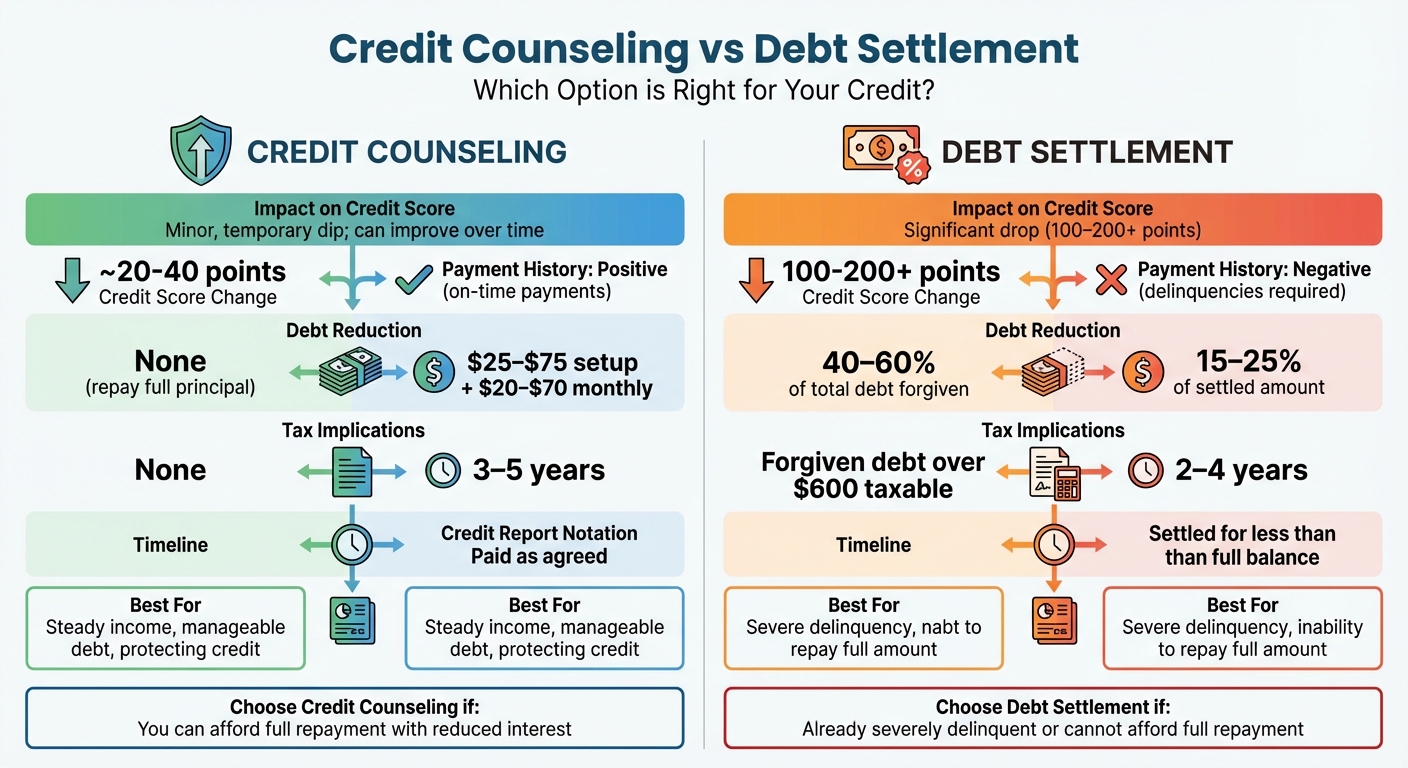
Credit Counseling vs Debt Settlement Comparison Chart
How Credit Counseling Affects Your Credit Score
What Credit Counseling Is and How It Works
Nonprofit credit counseling agencies, certified by organizations like the NFCC or FCAA, provide guidance to help manage your finances. A certified counselor will analyze your income, expenses, debts, and spending habits to craft a budget tailored to your situation. If you’re overwhelmed by credit card debt, they may suggest a Debt Management Plan (DMP).
A DMP involves the agency working with your creditors to negotiate better terms – such as reduced interest rates, waived late fees, and removal of over-limit charges. Instead of managing multiple payments, you’ll make a single monthly payment to the counseling agency, which then distributes the funds to your creditors. Fees for setting up a DMP typically range between $25 and $75, with monthly fees from $20 to $70. In cases of severe financial hardship, these fees might be waived.
Immediate Effects on Your Credit Score
One requirement of enrolling in a DMP is closing the credit card accounts included in the plan. This action can cause your credit utilization ratio to increase because your available credit decreases while your balances remain the same. Since credit utilization makes up 30% of your FICO Score, this shift can lead to a temporary drop in your score.
Additionally, closing accounts halts their contribution to the length of your credit history, which accounts for 15% of your FICO Score. However, the positive payment history from these accounts will stay on your credit report for up to 10 years.
Creditors may also add a note to your credit report indicating that an account is being paid through a DMP. While future lenders can see this, it doesn’t negatively affect your FICO score. As credit expert John Ulzheimer explains:
"Going into a debt management program is benign to your credit scores. While the credit card issuer is being paid through the program, they will report you to the credit bureaus as being ‘paid as agreed,’ which is also good for your credit scores."
Although these initial changes might seem concerning, they pave the way for potential long-term improvements.
Effects on Your Credit Score Over Time
While your score might dip initially, sticking to the DMP can lead to gradual improvements. Over the 3 to 5 years it typically takes to complete the program, consistent payments have a positive impact. Since payment history makes up 35% of your FICO Score, on-time payments through the DMP play a major role in boosting your score.
As you pay down balances, your credit utilization ratio improves, which further supports score recovery. Some creditors may even "re-age" your accounts after several consecutive on-time payments, updating delinquent accounts to show as "current." This adjustment can provide a significant boost if you were previously behind on payments.
Financial writer Ben Luthi highlights this process:
"A debt management plan can temporarily negatively impact your FICO® Scores. But in the long run, obtaining a form of debt relief and paying off your balances over time can have a much more significant positive impact on your finances."
sbb-itb-2a9374f
How Debt Settlement Affects Your Credit Score
What Debt Settlement Is and How It Works
Debt settlement is a process where you negotiate with creditors to accept a lump-sum payment that’s less than the total amount you owe. Typically, creditors wait until accounts are significantly delinquent before considering settlements. To prepare for this, debt settlement companies often advise clients to stop making payments, allowing funds to accumulate for a future settlement while creating leverage for negotiations. These companies generally charge fees between 15% and 25% of the enrolled debt total.
When a settlement is finalized, the creditor usually closes the account. This action reduces your available credit, which negatively affects your credit utilization ratio – a key factor in credit scoring. Additionally, any forgiven debt may be considered taxable income by the IRS, potentially leading to an unexpected tax bill. From the start, missed payments and account closures begin to reflect on your credit report, impacting your credit profile.
Immediate Effects on Your Credit Score
The short-term effects of debt settlement on your credit score can be severe. Stopping payments results in delinquencies, which heavily impact the payment history component of your FICO score – this factor alone makes up 35% of your overall score.
Bruce McClary of the NFCC describes the issue:
"Debt settlement typically requires you to miss months of payments on your debts intentionally, forcing your accounts to fall farther behind."
A study conducted in July 2022 by Freedom Debt Relief found that the median credit score for clients dropped by 161 points, reaching an average of 485 within six months of starting the program. The damage is even more pronounced for those with excellent credit. For example, someone with a score of 780 may see a drop of 140 to 160 points, while a person with a 680 score might experience a decrease of 45 to 65 points.
When creditors agree to a settlement, they often report the account with notations like "settled for less than full balance" or "paid settled." While these are better than an unpaid charge-off, they still signal to future lenders that the original debt wasn’t fully repaid. This is less favorable than an account marked as "paid in full".
Allison Sanka, an Accredited Financial Counselor, shares her perspective:
"Debt settlement services have impacted my clients in mostly negative ways… many have found themselves in deeper financial turmoil due to the associated fees, penalties, negative impacts to their credit scores."
Effects on Your Credit Score Over Time
While the initial impact on your credit score is harsh, recovery is possible with time and effort. Negative items like missed payments and settled accounts can remain on your credit report for up to seven years from the date of the first missed payment. However, their influence diminishes gradually as newer, positive information becomes a larger part of your credit profile. Many people notice improvements within one to two years of completing a settlement program if they adopt good credit habits. According to the Freedom Debt Relief study, six years after settling, the median client score rose to about 676.
Steven Brachman of United Settlement explains:
"The impact typically comes from missed or reduced payments before a settlement is reached, not from the settlement itself."
To speed up recovery, focus on maintaining on-time payments for active accounts, keeping credit utilization below 30% (and ideally under 10%), and using tools like secured credit cards to build a positive payment history.
It’s worth noting that over 90% of consumers enrolled in debt settlement programs do not settle all their debts, with only 43% of debts resolved by the third year.
Credit Counseling vs. Debt Settlement: Direct Comparison
How Each Method Affects Credit Score Factors
Credit counseling and debt settlement impact your credit in very different ways. With credit counseling, specifically through a Debt Management Plan (DMP), your payment history remains positive. Creditors report your accounts as "paid as agreed" throughout the program, which is a favorable mark on your credit report. On the other hand, debt settlement often requires you to stop making payments, leading to delinquencies that harm your credit score. Once a settlement is reached, accounts are marked as "settled for less than full balance", a negative note that stays on your credit report for seven years from the date of the first missed payment.
Both approaches usually involve closing your accounts. This can reduce your total available credit, which may impact your credit utilization ratio and the average age of your accounts. While being part of a DMP might be noted on your credit report, it doesn’t factor into your FICO score calculation.
John Ulzheimer, a Credit Expert at Credit Sesame, highlights the advantage of credit counseling:
"Going into a debt management program is benign to your credit scores. While the credit card issuer is being paid through the program, they will report you to the credit bureaus as being ‘paid as agreed,’ which is also good for your credit scores."
Next, let’s look at how these differences affect the timeline for credit score recovery.
Credit Score Recovery Timelines
The time it takes to recover your credit score varies widely depending on which method you choose. Credit counseling allows for gradual improvement during the 3–5 year repayment period, thanks to consistent, on-time payments. While closing accounts may cause a slight, temporary dip, the impact is generally manageable.
Debt settlement, however, has a much steeper hill to climb. While it may resolve your debt in 2–4 years, the credit recovery process is significantly longer. Missed payments and the "settled for less" notation can cause your score to drop by 60 to 125 points almost immediately when payments stop. These negative marks stick around for seven years, and true recovery often begins only after settlements are fully reported as resolved. For some, rebuilding their credit can take over a decade.
Martin Lynch, President of the Financial Counseling Association of America (FCAA), underscores the risks involved:
"Debt settlement is a repayment strategy that carries significant risks for consumers. Creditors are not obligated or required to accept a settlement offer on any account."
Now, let’s weigh the financial trade-offs of these two approaches.
Total Cost vs. Credit Damage Trade-Offs
The financial implications of credit counseling and debt settlement come down to your priorities and how much credit damage you’re willing to accept. Credit counseling involves repaying the full principal amount, along with modest fees. It helps protect or even improve your credit profile, and there are no tax consequences tied to the repayment.
Debt settlement, on the other hand, focuses on reducing your total debt. Creditors may agree to accept just 40% to 60% of what you originally owed. However, settlement companies typically charge fees ranging from 15% to 25% of the enrolled debt. Additionally, the IRS treats forgiven debt over $600 as taxable income, which could lead to a hefty tax bill. Combined with the credit damage, this can make future borrowing more expensive due to higher interest rates.
Keith L. Rucinski, CPA and Chapter 13 Bankruptcy Trustee, highlights this hidden cost:
"Debt settlement requires the consumer to have sufficient funds to pay the settlement. Please remember that debt forgiven in bankruptcy has no income tax consequences for the consumer. However, debt forgiven in a settlement can result in the consumer owing tax on the debt forgiven."
How to Choose Based on Your Credit Situation
Assessing Your Current Credit and Debt
Start by evaluating your total debt and monthly income. Credit counseling works best for individuals with a steady income who can repay the full principal within 3 to 5 years, especially when lower interest rates are available. However, if repaying the full amount isn’t feasible, even with reduced rates, you might need to explore debt settlement or bankruptcy.
If your credit score is still relatively strong, credit counseling is a safer choice since it has a lesser impact on your credit. On the other hand, if your accounts are already severely delinquent or in collections, the additional credit hit from debt settlement may not be as concerning. For context, debt settlement can reduce a high credit score by roughly 125 points, while individuals with lower scores might see a drop of 60 to 75 points.
Also, check if your accounts are current or delinquent. If you’re already dealing with collection actions or lawsuits, debt settlement might provide quicker relief. By carefully assessing your financial standing, you can choose an option that aligns with both your immediate needs and long-term credit goals.
To narrow down your choice, consider the following questions.
Questions to Ask Before Deciding
Before choosing a path, ask yourself these key questions:
- Can I afford a single monthly payment that covers my full debt principal over 3 to 5 years? If yes, credit counseling may be the best route.
- Can I handle a drop of about 125 points if my credit score is high? If not, debt settlement might not be the right fit.
- Do I have a lump sum or the ability to save into an escrow account to fund settlements? This is often required for debt settlement.
- Can I manage the tax liability from forgiven debt over $600? This is an important consideration.
- Do my creditors work with debt management programs? Not all creditors collaborate with counseling agencies.
Debt settlement usually resolves debt within 2 to 4 years, whereas credit counseling programs can take 3 to 7 years. It’s worth noting that only about 55% to 70% of people who begin a debt management program see it through to completion.
Using a Structured Plan to Protect Your Credit
Once you’ve answered these questions, it’s time to follow a structured plan to protect your credit. A well-organized debt relief process helps you make informed decisions while minimizing credit damage. For a detailed debt review, consider visiting Steps To Be Debt Free (https://debtloansrelief.com) to evaluate your debt levels and create a personalized plan.
Working with a certified nonprofit credit counselor can provide additional benefits, such as budgeting support and financial education to help you avoid falling into debt again. Make sure to choose an agency certified by trusted organizations like the National Foundation for Credit Counseling (NFCC) or the Financial Counseling Association of America (FCAA).
Lori Pollack, Executive Director of FCAA, highlights the importance of this approach:
"When a consumer calls, a non-profit counselor isn’t thinking, ‘How do I monetize this?’ They are focused on what is best for the consumer. They take a big-picture, human approach to reviewing each person’s financial situation."
A structured plan allows you to balance the total cost of debt resolution with potential credit damage, helping you choose the best option to protect your long-term financial health.
Credit Counseling vs Debt Settlement
Conclusion
Deciding between credit counseling and debt settlement depends largely on your financial situation and credit goals. Credit counseling works best if you can repay your debt in full over three to five years while benefiting from lower interest rates and maintaining positive credit reporting. On the other hand, debt settlement reduces your total debt – often to 40% to 60% of what you owe – but requires halting payments, which can lower your credit score by 100–200 points.
The long-term effects of these options are very different. Credit counseling helps preserve a positive payment history, a key factor in your FICO score (making up about 35% of it). Debt settlement, however, leaves a negative mark on your credit report that can last up to seven years. If you’re planning to apply for new credit soon, these differences are critical to consider.
For those with accounts already delinquent or in collections, the additional credit damage from debt settlement may not be as impactful. However, if your credit is still in good shape, credit counseling might be the better option to protect it.
Before deciding, think about whether you can realistically manage full repayment, handle potential tax consequences on forgiven debt, and deal with a potential credit score drop. Reaching out to a certified nonprofit credit counselor, such as those from the National Foundation for Credit Counseling (NFCC) or the Financial Counseling Association of America (FCAA), can help you make an informed choice.
Ultimately, the decision comes down to balancing immediate debt relief with long-term credit health. Credit counseling offers a slower but credit-friendly path, while debt settlement provides faster relief at the cost of credit damage. Carefully weigh these trade-offs to ensure your decision aligns with your financial goals. A clear plan can guide you through this process and protect your financial future.
For a detailed, step-by-step approach to managing debt while safeguarding your credit, check out the resources available on Steps To Be Debt Free.
FAQs
Will a Debt Management Plan appear on my credit report?
A Debt Management Plan (DMP) may show up on your credit report as a note indicating that you’re enrolled in such a program. However, this notation usually doesn’t have a direct impact on your credit score. While creditors might notice this detail, it isn’t included in the calculations that determine your credit score.
Can I keep any credit cards while in credit counseling?
Typically, when you enroll in a credit counseling plan, most credit cards need to be closed. However, whether you’re allowed to keep any active cards depends on the terms of your agreement with the credit counselor. It’s important to bring this up during your consultation so you can understand exactly how it will affect your situation.
Will I owe taxes on debt that gets settled?
Yes, forgiven or canceled debt through settlement is usually treated as taxable income by the IRS. However, there are exceptions or exclusions, like insolvency, that might apply. To navigate this properly, it’s a good idea to consult a tax professional who can assess your specific situation.
