

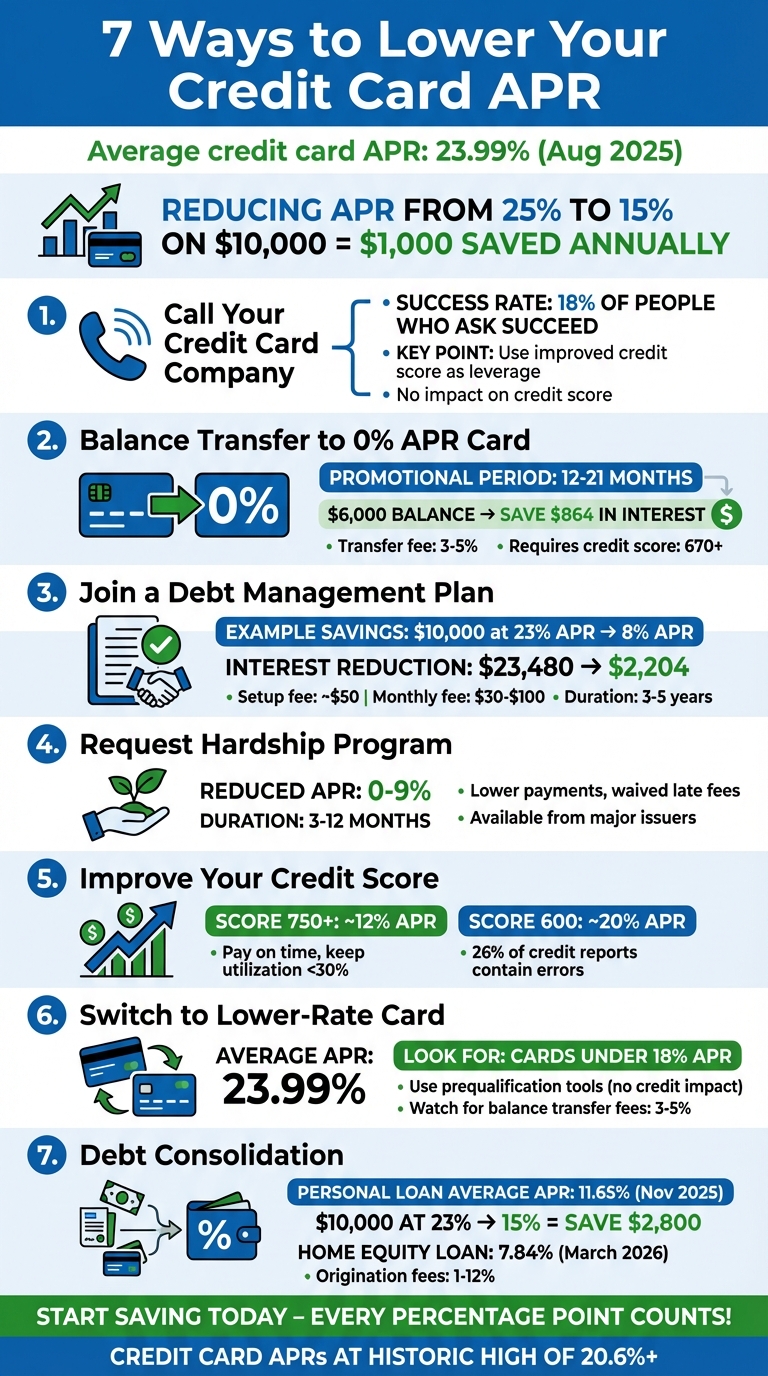
Want to save money on credit card interest? Start by lowering your APR. High APRs can cost you hundreds or even thousands of dollars in extra interest every year. If you’re carrying a balance, reducing your APR can make a big difference in paying off debt faster. Here’s how you can take control:
- Call your credit card company: Ask for a lower rate and use your improved credit score or competitor rates as leverage.
- Transfer your balance: Use a 0% APR card to pay down debt without interest during the promotional period.
- Join a Debt Management Plan (DMP): Consolidate multiple debts into one payment with reduced interest rates.
- Request a hardship program: If you’re facing financial challenges, ask your issuer for temporary relief with lower rates.
- Improve your credit score: Better scores often qualify for lower APRs. Pay bills on time, reduce balances, and check for errors on your credit report.
- Switch to a lower-rate card: Look for cards with lower ongoing APRs or 0% introductory offers.
- Consolidate debt: Use a personal loan or other options to combine balances at a lower interest rate.
Each of these strategies can save you money and make debt repayment easier. Start by calling your credit card issuer or exploring balance transfer options today. The sooner you act, the more you’ll save.
7 Proven Strategies to Lower Your Credit Card APR and Save Money
How to negotiate a better credit card interest rate
sbb-itb-2a9374f
1. Call Your Credit Card Company and Ask for a Lower Rate
One of the simplest ways to tackle high credit card interest rates is to pick up the phone and call your credit card company. As Louis DeNicola, a Personal Finance Writer at Experian, puts it:
"Negotiating your interest rate is a perfectly reasonable thing to do."
Before you make that call, take a moment to prepare. Start by reviewing your latest statement to confirm your current APR. If your credit score has improved recently, use that as leverage. It also helps to research what other banks are offering – if a competitor is advertising a 17.49% rate and you’re stuck at 24%, bring that up during the conversation.
When you speak with customer service, emphasize your loyalty and history of on-time payments. If the representative isn’t able to help, politely ask to speak with a supervisor, as they might have the authority to approve a rate reduction.
If a permanent rate cut isn’t an option, inquire about temporary promotional rates or hardship programs that might be available.
And if the answer is still no, don’t get discouraged. Keep making your payments on time, and try again in a few months. Once you’ve explored this option, you can move on to other strategies to lower your APR, which we’ll cover in the next tips.
2. Move Your Balance to a 0% APR Card
If negotiating your APR hasn’t worked, a balance transfer card might be the next best option to cut down on interest. These cards typically offer 0% interest for a set promotional period – usually between 12 and 21 months – so your payments go directly toward reducing the principal. It’s a practical way to manage your debt alongside other strategies for tackling high APRs.
Here’s an example: Say you transfer a $6,000 balance to a card with a 3% transfer fee (adding $180 to your total balance) and a 15-month 0% APR period. To pay off the entire balance within that timeframe, you’d need to budget around $412 per month. This could save you approximately $864 in interest compared to sticking with a high-APR card.
Marine Lafitte, Lead Financial Commentator at Millions Pro, explains the value of this approach:
A balance transfer isn’t a cure-all but a strategic tool that works powerfully when paired with discipline, a clear payment schedule, and a commitment to behavioral change.
Before diving in, make sure the balance transfer fee – usually 3% to 5% – is less than the interest you’d otherwise pay. Also, check your credit score; most of these offers require a score of at least 670 to qualify. Keep in mind, you generally can’t transfer balances between cards from the same bank (e.g., moving a balance from one Chase card to another Chase card).
Once approved, calculate your monthly payment by dividing your total balance by the number of months in the promotional period. Setting up autopay can help you stay on track and avoid missing payments, which could trigger a penalty APR.
Lastly, avoid using the new card for purchases. The 0% APR offer typically applies only to the transferred balance. Stick to paying off the debt – about 40% of people still carry a balance after the promotional period ends, which can undo the benefits of this strategy.
3. Join a Debt Management Plan
If juggling multiple high-interest accounts feels overwhelming, a debt management plan (DMP) might offer relief. This approach consolidates your debts into a single monthly payment by working with creditors to lower interest rates, waive late fees, and stop penalty charges. Instead of tracking various due dates and payments, you’ll make one payment to the agency managing your plan, and they’ll distribute the funds to your creditors.
The potential savings on interest can be substantial. For instance, reducing the APR on a $10,000 balance from 23% to 8% slashes total interest costs from $23,480 to $2,204. As Tim Maxwell, a Personal Finance Writer, puts it:
A debt management plan streamlines several unsecured credit accounts into one account with one payment. It could also lower your interest costs and put you on a path toward wiping out your debt completely.
To begin, look for accredited nonprofit agencies such as those listed by the National Foundation for Credit Counseling (NFCC), the Financial Counseling Association of America (FCAA), or the U.S. Department of Justice’s approved counselor list. Most agencies offer a free initial consultation, during which you’ll need to provide details about your income, monthly expenses, and outstanding debts. Expect setup fees to average around $50, with monthly maintenance fees typically ranging from $30 to $100 [20,21].
However, there are some trade-offs. Most creditors will require you to close accounts included in the DMP, which can temporarily limit your available credit and lower your credit score. It’s also worth noting that creditors are not legally required to participate in a DMP. To stay on track, avoid opening new accounts while enrolled, as plans generally last three to five years.
If you’re managing multiple high-interest debts, you can explore whether a debt management plan fits your situation by visiting Steps To Be Debt Free for a free debt review.
4. Request a Hardship or Relief Program
If you’re dealing with unexpected financial challenges like a job loss, medical emergency, or divorce, reaching out to your credit card issuer about a hardship program could help lower your APR and make payments more manageable.
These programs are designed to temporarily adjust your terms, offering relief when you need it most. To get started, call the number on the back of your card and ask to speak with the "hardship", "financial assistance", or "customer assistance" department. Front-line representatives might not have the authority to make changes, so be sure to request the appropriate team. Before calling, have a clear summary of your income, essential expenses, and what you can realistically afford to pay.
Many major issuers, such as Chase, Bank of America, American Express, Citibank, Discover, U.S. Bank, and Wells Fargo, provide hardship programs. For instance, in February 2026, Chase offered programs with single-digit APRs, reduced minimum payments, and waived late fees for 3–6 months. Similarly, Bank of America provided plans lasting 6–12 months with comparable benefits. Typically, these programs reduce rates to somewhere between 0% and 9%.
Adem Selita from The Debt Relief Company highlights the reasoning behind these programs:
Issuers would rather modify your terms temporarily than have you stop making payments entirely, which costs them far more in the long run.
Keep in mind that enrolling in a hardship program may freeze your account, meaning you won’t be able to make new purchases. Be sure to clarify how it will affect your credit report and get all terms in writing before agreeing to the program.
For a more comprehensive plan to tackle credit card debt, check out the step-by-step guide available on Steps To Be Debt Free.
5. Work on Raising Your Credit Score
Improving your credit score can play a big role in lowering your APR. Lenders rely heavily on your credit score when deciding the rates they offer. For instance, borrowers with scores of 750 or higher often qualify for APRs around 12%, while those in the 600 range might face rates of 20% or more. That gap can translate into hundreds – or even thousands – of dollars in extra interest costs each year.
The most important factor in your credit score is your payment history. Consistently paying your bills on time signals to lenders that you’re dependable. On the flip side, even one missed payment can hurt your score and lead to higher APRs. As Ivana Pino, Senior Writer at Yahoo Finance, explains:
Your credit history is an indicator of how likely you are to pay off your credit card balance in full and by the due date each month. Lenders use it as a gauge when setting your APR.
Another key factor is credit utilization. Keeping your balances below 30% of your credit limit can boost your score. To achieve this, you could either pay down existing balances or request a credit limit increase. Additionally, making payments twice a month instead of waiting for your statement due date can help keep your reported balances low.
It’s also smart to regularly check your credit reports for errors. You can access free reports weekly from Equifax, Experian, and TransUnion through 2026 by visiting AnnualCreditReport.com. According to a Federal Trade Commission study, 26% of participants found at least one error on their reports that could make them appear riskier to lenders. Common issues include incorrect late payments, duplicate accounts, or accounts that don’t belong to you. If you spot any inaccuracies, dispute them immediately with the credit bureaus. Use certified mail and include supporting documents to strengthen your case.
Improving your credit score doesn’t just help you qualify for lower APRs – it also complements the debt relief strategies we’ve covered in this guide. Once your score improves, consider using it to negotiate a better rate. Cynthia Paez Bowman, Contributor at CNET, suggests:
If your credit score has improved since you initially applied for the card, you could use that as justification for asking for a lower rate now.
Reach out to your credit card issuer, share your updated score, and request a lower APR.
For more tips on managing your credit and tackling debt, check out the step-by-step guide at Steps To Be Debt Free.
With an improved credit profile in hand, you’ll be ready to explore better card options in Tip 6.
6. Compare and Switch to a Lower-Rate Credit Card
If your credit card issuer won’t budge on lowering your APR, switching to a card with a lower rate can be a straightforward way to cut interest costs. As of August 2025, the average credit card interest rate stood at 23.99%. However, there are plenty of cards out there offering better terms – especially if your credit score has improved since you opened your current account.
Start by using prequalification tools on major credit card issuers’ websites. These tools let you check potential APRs without impacting your credit score. Keep an eye out for balance transfer cards with 0% introductory APR periods or low-interest cards with ongoing rates under 18%. Once you’ve narrowed down your options, calculate the total cost to make sure the savings outweigh any fees.
Balance transfer fees, for example, usually range from 3% to 5% of the amount you’re transferring. Let’s say you’re moving a $5,000 balance – this fee could range from $150 to $250. While that might sound steep, the overall savings from a lower APR could easily make up for it. Even a small reduction in your interest rate can lead to noticeable savings over time.
Be mindful of what happens after any promotional period ends. Michele Raneri, Vice President of U.S. Research and Consulting at TransUnion, offers this advice:
It’s best to only use these cards to the extent there is confidence they can be paid off relatively soon, as interest can pile on quickly.
To avoid surprises, confirm that the standard variable APR after the introductory period is still lower than your current rate.
If you’re carrying a balance, prioritize finding a card with a lower APR over one with flashy rewards. Cards offering perks like cash back or airline miles often come with higher interest rates. When you’re paying 20% or more in interest, those rewards won’t make much of a dent in your costs. Instead, focus on cards with $0 annual fees and the lowest possible APR to help you chip away at your debt more effectively.
7. Look Into Debt Consolidation
Debt consolidation can be a smart way to lower your overall APR and make managing payments easier. If you’re juggling multiple credit card balances with sky-high interest rates, this method can simplify things. Essentially, debt consolidation involves taking out a new credit product to pay off your existing balances. The result? A single monthly payment and, ideally, a lower interest rate.
Here’s an example: consolidating $10,000 of debt from a 23% APR to 15% could save you more than $2,800 in interest. As of November 2025, the average APR for personal loans was 11.65%, which is much lower than the typical credit card APRs, often ranging from 18% to 25% or more.
Sarah Sharkey from The Penny Hoarder sums it up well:
Ideally, the goal is to walk away with one monthly payment to manage and one interest rate to worry about. Ideally, that interest rate is lower than what you were paying before.
To get started, take a close look at the consolidation options available and see which one aligns with your financial goals. Your credit score and repayment timeline will play a big role in this decision. For example, personal loans often provide structured repayment terms between two and seven years. If you’re a homeowner, you might explore a home equity loan. As of March 4, 2026, the average interest rate for a five-year home equity loan was 7.84%.
Keep in mind, though, that there are fees involved. Balance transfer fees usually range from 3% to 5% of the amount transferred, while loan origination fees can vary from 1% to 12%. Be sure to calculate whether the potential interest savings outweigh these upfront costs.
One crucial tip: after consolidating, avoid using your old credit cards. This helps prevent adding more debt on top of what you’re already working to pay off.
For tailored advice, check out Steps To Be Debt Free. They offer a free debt review to help you find the best consolidation strategy for your situation.
Conclusion
Taking steps to lower your APR can have a big impact on your financial health. Whether you negotiate with your credit card issuer, transfer your balance to a 0% APR card, work on improving your credit score, or consolidate your debt, these efforts can save you real money. For instance, reducing your APR from 25% to 15% on a $10,000 balance could save you $1,000 in interest over a year. That’s money you could use to pay off your balance faster or build up an emergency fund. These strategies, from simple negotiations to debt consolidation, help you take control of your finances.
Here’s another encouraging fact: about 18% of people who ask their credit card company for a lower APR succeed. And negotiating won’t hurt your credit score, so there’s no downside to trying. Every percentage point you lower your APR means less money spent on interest and more money staying in your pocket.
With credit card APRs averaging over 20.6% – a historic high – it’s important to act quickly. The longer you wait, the more interest you’ll pay. Take time to review your rate, work on raising your credit score, and leverage competitive offers to negotiate better terms.
If you’re unsure where to begin or need personalized guidance, Steps To Be Debt Free provides a free debt review. They can help you map out a plan tailored to your situation, covering everything from negotiating lower rates to improving your credit and consolidating debt. Start today to save on interest and strengthen your financial future.
FAQs
What should I say when asking my card issuer to lower my APR?
When asking for a lower APR, it’s important to be clear and direct about your situation. Mention your consistent on-time payments or strong credit history to support your request. For instance, you might say, "I’ve maintained a solid record of on-time payments as a loyal customer. Could you consider reducing my interest rate to help me better manage my finances?" Being polite and emphasizing your loyalty to the company can make a positive difference.
Will a balance transfer hurt my credit score?
A balance transfer has the potential to affect your credit score in different ways. On the positive side, it can help improve your score over time if you manage it effectively. By lowering your overall debt and cutting down on interest payments, you might see gradual improvements in your credit profile.
However, there are some short-term downsides to consider. Opening a new account for the transfer or increasing your credit utilization can temporarily cause your score to dip. It’s important to weigh these factors carefully and plan your balance transfer strategy to minimize any negative effects.
How do I choose between a DMP and debt consolidation?
Choosing between a Debt Management Program (DMP) and debt consolidation comes down to your specific financial situation and goals.
A DMP, typically offered through credit counseling agencies, provides a structured plan to repay unsecured debts. These programs often include negotiated lower interest rates, making them a good fit if you’re dealing with significant unsecured debt and need guidance to stay on track.
On the other hand, debt consolidation merges multiple debts into a single loan or credit line, often at a reduced interest rate. This option offers more flexibility but requires you to manage the repayment independently. It’s crucial to carefully review the loan terms to ensure it’s the right choice for your financial health.
