

Wage garnishment can feel overwhelming, but you have rights to protect your income. Whether it’s a court-ordered garnishment or one initiated by government agencies, there are legal safeguards in place to ensure you’re not left financially stranded. Here’s a quick breakdown of the top protections you should know about:
- Federal Limits (CCPA): Creditors can’t garnish more than 25% of your disposable earnings or leave you with less than $217.50 per week.
- Protected Income: Social Security, VA benefits, unemployment, and more are often exempt from garnishment.
- State Laws: Some states, like Texas and Pennsylvania, completely ban wage garnishment for consumer debts.
- Head of Household Exemption: If you financially support dependents, you may qualify for reduced or no garnishment.
- Bankruptcy Automatic Stay: Filing for bankruptcy can immediately stop most garnishments.
- Challenge Garnishment: You can object to improper garnishments in court.
- Limits on Multiple Garnishments: Federal law caps garnishment amounts even if you have multiple orders.
Understanding these protections can help you take control of your financial situation and stop wrongful garnishments. Read on for detailed steps to safeguard your income.
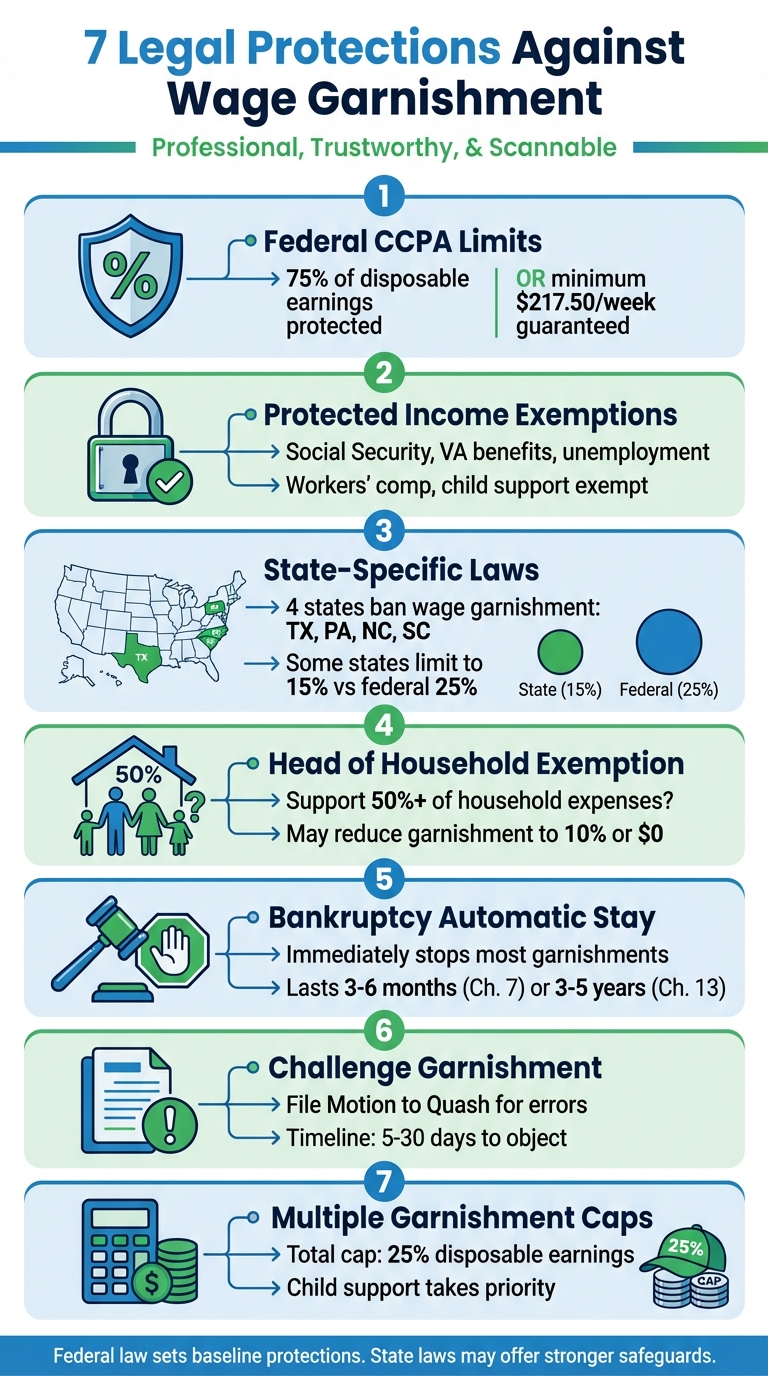
7 Legal Protections Against Wage Garnishment
How to Stop Wage Garnishment (Even If It Already Started)
sbb-itb-2a9374f
1. Federal CCPA Garnishment Limits
The Consumer Credit Protection Act (CCPA) establishes federal limits on how much creditors can garnish from your paycheck. This law ensures that, even with debts, you still have enough income left to cover essential expenses like rent and food. Without these protections, creditors could potentially leave you struggling to meet basic needs.
Under federal law, 75% of your disposable earnings are protected from garnishment. Alternatively, if 75% of your earnings would leave you with less than a specific minimum, the law guarantees you keep at least 30 times the federal minimum wage per week – currently $217.50.
Disposable earnings refer to the amount left after mandatory deductions, such as taxes, Social Security, and retirement contributions. This protection applies to most income earned through personal services, including wages, salaries, commissions, bonuses, and pension or retirement income. However, tips are generally not included in this category.
Additionally, the CCPA prohibits employers from firing you if your wages are garnished for a single debt. This safeguard helps ensure job security during financial difficulties. It’s important to note that while these protections set a federal baseline, many states offer even stronger measures. Up next, we’ll explore how to claim exemptions for income that’s protected from garnishment.
2. Claim of Exemption for Protected Income
Federal garnishment laws provide limits, but you can take an extra step to safeguard your income by filing a Claim of Exemption.
Certain types of income are protected from garnishment, even if you owe money. These include Social Security benefits (like Retirement, SSI, and SSDI), Veterans Affairs (VA) benefits, unemployment benefits, workers’ compensation, and child or spousal support. If a creditor tries to garnish these funds, you can stop the process by filing a Claim of Exemption.
For federal benefits that are directly deposited, banks are required to automatically protect up to two months’ worth of these funds. This ensures you can still access at least that amount. However, if you need to protect additional funds – especially if your income is mixed with other deposits – you’ll need to file a formal claim with the court that issued the garnishment order.
Timing is crucial. In many states, you must file your Claim of Exemption within 5 to 10 days. Start by getting the Claim of Exemption form from the court clerk. Be prepared to provide supporting documents like benefit award letters, bank statements, or pay stubs.
Once filed, you’ll need to serve copies to both the creditor and the levying officer. The creditor typically has about 10 days to object. If they don’t, your exemption is usually approved automatically. If they do contest it, a judge will schedule a hearing where you can present evidence showing why your income qualifies for protection.
To make things easier, keep protected income in a separate bank account. Mixing these funds with other deposits can make it harder to prove they’re exempt.
3. State-Specific Wage Protection Laws
While federal laws set the groundwork for wage garnishment limits, state laws can sometimes offer even stronger protections. These state-specific rules are designed to provide additional safeguards for your income. If your state law imposes stricter garnishment limits than federal law, the state regulations take precedence.
For instance, four states – North Carolina, Pennsylvania, South Carolina, and Texas – prohibit wage garnishment for most consumer debts. This means creditors cannot take your wages for common debts like credit card balances or personal loans. However, garnishment for obligations such as child support or taxes may still apply.
Some states also set lower garnishment caps or higher income thresholds. In Delaware, garnishment is capped at 15% of disposable earnings, compared to the federal limit of 25%. Similarly, Massachusetts and Illinois limit garnishment to 15% of gross wages, reducing the amount creditors can take from your paycheck. California protects wages up to 40 times the state minimum wage (currently $640 per week), while Arizona safeguards up to $861 per week.
"If state law provides greater protection (results in less garnishment) than federal law, the state law must be followed. If state law is less protective, federal law prevails." – RemoteLaws
When you receive a garnishment notice, it should include details about your rights under state law. To fully understand your protections, visit your state’s Department of Labor website or consult with the court clerk. These resources can help clarify how state laws may shield your earnings.
4. Head of Household Exemption
If you provide more than half of your household’s financial support for a child or dependent, you might qualify for the head of household exemption, which can significantly reduce wage garnishment. Depending on your state, this exemption could mean your wages are entirely protected from creditors, or garnishment could be capped at just 10% of your disposable income.
State laws determine the level of protection. For example:
- California: Protects up to 50% of disposable earnings.
- Florida: Offers higher allowances for each dependent.
- New York: Adjusts garnishment limits based on family size.
- Illinois and Michigan: Provide additional exemptions if you support a spouse or dependent.
To use this exemption, you’ll need to act quickly. File a "head of household affidavit" with the court soon after receiving notice of garnishment. Be ready to prove that you cover more than 50% of your household expenses.
"If you live in a state that provides a head of household exemption, that protection might not be automatic. So, you might have to take steps to claim the exemption before you can activate the wage protection." – Stephanie Lane, Attorney
Prepare for the process by gathering documents that confirm your dependents and financial contributions. These might include tax returns, pay stubs, or bills. During a hearing, the judge will review your case and decide whether you qualify. If approved, the court will adjust or eliminate garnishment according to your state’s laws. To get started, contact your local court clerk’s office for the necessary forms and specific requirements.
Next, explore how bankruptcy can provide further protection from garnishment.
5. Bankruptcy Automatic Stay
Filing for bankruptcy can be a powerful way to address wrongful garnishment, as it immediately halts most collection activities. This is due to the automatic stay, a court order that goes into effect the moment your bankruptcy petition is filed. Governed by 11 U.S.C. § 362, the stay requires no additional court approval or hearing – it instantly stops actions like wage garnishments, foreclosures, and repossessions.
"The automatic stay is a court order that takes effect the instant your bankruptcy petition is filed with the clerk’s office. It orders every creditor in the country to stop." – AutomaticStay.org
The automatic stay applies to garnishments tied to dischargeable consumer debts, but it typically does not cover garnishments for domestic support obligations such as child support or alimony. For first-time bankruptcy filers, the stay generally lasts 3 to 6 months under Chapter 7 and 3 to 5 years under Chapter 13. However, if a bankruptcy case was dismissed within the prior year, the stay is limited to 30 days unless extended by the court.
To stop wage garnishments quickly, notify your employer’s payroll department and the creditor immediately with your bankruptcy case number, filing date, and court location. Additionally, you might be able to recover wages garnished within the 90 days leading up to the bankruptcy filing if the total garnished exceeds $600.
"Once the creditor knows of the bankruptcy, a qualifying garnishment must stop, even if the employer hasn’t received a court notification. Allowing the garnishment would violate the automatic stay." – Cara O’Neill, Attorney
If a creditor knowingly violates the automatic stay by continuing to garnish wages after being informed, they can face serious consequences, including being held in contempt of court. They may also be required to pay actual damages, attorney fees, and punitive damages. Keep detailed records of any wage garnishments that occur after filing, as these may be recoverable.
Next, consider exploring direct legal actions to challenge garnishment.
6. Motion to Quash or Challenge Garnishment
If you’re dealing with an improper garnishment, you have the option to challenge it directly in court. When a garnishment seems flawed or incorrect, you can file a formal objection. A Motion to Quash asks a judge to completely cancel the garnishment order due to procedural issues, while a Challenge to Garnishment (or objection) argues that the garnished funds are either legally protected or the amount is wrong. This process ensures that only the correct amounts, if any, are taken.
"A Motion to Quash is the legal system’s version of that spam filter. It’s a formal request you make to a judge, asking them to cancel, or ‘quash,’ a legal demand that has been sent to you." – US Law Explained
The time you have to object differs depending on the state and the type of garnishment, ranging from 5 to 30 days. For instance, in Oregon, you have up to 120 days to dispute a wage garnishment but only 30 days for a bank account garnishment. Missing these deadlines can mean losing your right to challenge the garnishment permanently.
Here are some common reasons for filing a challenge:
- Exempt income: Certain funds, like Social Security or disability benefits, are protected by law.
- Excessive garnishment: By law, garnishments cannot exceed 25% of your disposable earnings.
- Calculation errors: Mistakes such as incorrect interest rates or uncredited payments.
- Bankruptcy discharge: Debts that have already been cleared through bankruptcy.
To initiate the process, get the "Challenge to Garnishment" form from your court clerk if it wasn’t included with your garnishment notice.
You’ll need to gather documentation to support your case. This could include:
- Award letters for benefits
- Bank statements showing the source of deposits
- Pay stubs to verify your income
- Bankruptcy discharge papers
Make sure to redact sensitive details, like Social Security numbers or account numbers, before submitting these documents. At the hearing, you’ll only be able to argue issues related to the garnishment itself, such as exemptions or procedural errors. Judges typically won’t address disputes over the original debt or judgment.
Next, we’ll explore protections against multiple or excessive garnishments.
7. Protections Against Multiple or Excessive Garnishments
Federal law places strict limits on how much of your paycheck can be garnished, even if there are multiple garnishment orders. The Consumer Credit Protection Act (CCPA) establishes a maximum cap on the total amount that can be withheld from your wages, no matter how many garnishment orders your employer receives.
"The wage garnishment provisions of the CCPA set the maximum amount that may be garnished in any workweek or pay period, regardless of the number of garnishment orders received by the employer." – U.S. Department of Labor
For most debts, garnishments are limited to 25% of disposable earnings or the amount exceeding $217.50 per week, whichever is less. If a high-priority garnishment – like child support – already takes up 25% or more of your disposable income, other creditors cannot garnish additional amounts. Similarly, federal student loan garnishments are capped at 15% and are included in the overall 25% limit for ordinary debts.
Federal and state laws also establish a priority system for handling multiple garnishment orders. High-priority obligations, such as child support and tax levies, take precedence over lower-priority debts like credit card or medical bills. Employers are required to follow the law – state or federal – that results in the smallest deduction from your wages.
To protect yourself, regularly check your pay stubs to confirm that deductions stay within legal limits. States like Pennsylvania, North Carolina, South Carolina, and Texas offer even stronger protections, where wages are largely exempt from garnishment by ordinary judgment creditors. These combined safeguards ensure your income is protected from excessive or improper deductions.
Debt Relief Resources
When dealing with garnishment or the threat of it, tapping into online tools and expert advice can provide practical steps to regain financial control.
If wage garnishment has already started or is looming, personalized guidance can help turn a drawn-out financial strain into a manageable solution. Tools like Wage Garnishment Calculators and Judgment Proof Checkers are particularly useful. These resources let you assess your legal risk and determine whether your income is protected under federal or state laws. By inputting your financial details, these tools can guide you toward the most realistic options for your situation.
A platform like Steps To Be Debt Free (https://debtloansrelief.com) offers a structured approach to tackling debt. It provides a free initial review to help you evaluate your debt levels, payment status, and eligibility for exemptions. This step-by-step process can also assist in negotiating with creditors, helping you avoid expensive legal disputes and potentially halting wage garnishments.
For many creditors, a lump-sum settlement is more appealing than long-term garnishment. Often, they are willing to accept around 60% of the balance as a settlement. If you pursue this route, always request a written payoff statement to confirm the exact amount owed, as judgments typically accrue interest at rates set by the state.
If your situation is more complicated, consulting a consumer law attorney can be invaluable. A one-hour consultation may uncover state-specific exemptions or lead to motions to overturn improper judgments. Additionally, many local courts offer self-help sessions where volunteers can guide you through filing "Claim of Exemption" forms. Combining these legal resources with a solid debt reduction plan can significantly improve your chances of stopping garnishment and regaining financial stability.
Conclusion
By understanding your rights and the legal tools at your disposal, you can take action against wrongful wage garnishment. While the process may feel overwhelming, knowing your protections empowers you to fight back effectively. Federal laws place strict limits on garnishments to ensure you retain essential income, and some states, like Texas, Pennsylvania, North Carolina, and South Carolina, go even further by prohibiting private wage garnishment altogether.
This knowledge is vital because creditors often rely on individuals being unaware of their legal entitlements. For instance, federal law safeguards specific benefits, and in Florida, heads of household earning $750 or less in weekly disposable income are fully protected. Filing a Claim of Exemption or challenging improper service can halt or reduce garnishments before they take a toll on your paycheck.
Take immediate action: ensure your employer calculates garnishments based on disposable earnings, and protect any exempt income. If you notice errors or suspect illegal practices, file objections promptly and request a hearing.
"Bankruptcy isn’t the nuclear option. It’s the legal tool Congress created for exactly this situation – when debt has broken the math of your life and you need a reset."
- Steve Rhode, Consumer Debt Expert, GetOutOfDebt.org
Whether you choose to negotiate a settlement, file exemptions, or rely on bankruptcy’s automatic stay, seeking advice from a consumer law attorney or debt counselor can be the key to moving from financial hardship to stability. For detailed guidance, you can explore the step-by-step resources at Steps To Be Debt Free (https://debtloansrelief.com).
With these legal protections and expert support, you can take back control of your finances. The law is there to protect you – but only if you take the steps to use it.
FAQs
How can I tell if my wages are being garnished illegally?
Wage garnishment might violate the law if the deductions surpass the allowed limits or if there isn’t a valid court order in place. Typically, creditors are required to secure a court judgment before they can proceed with garnishing wages. It’s important to review the garnishment details carefully to confirm they meet these legal requirements.
What should I do first if I get a garnishment notice?
If you get a garnishment notice, take the time to read it thoroughly. This will help you understand how much is being taken and what rights you have. If the garnishment is incorrect or leaves you struggling to cover basic necessities, you can act quickly by filing a claim of exemption or disputing it. Other steps to consider include negotiating with the creditor, claiming any exemptions allowed by law, or consulting an attorney to explore your options further.
Can I stop a garnishment without filing bankruptcy?
Stopping a garnishment without filing for bankruptcy is possible, but it requires prompt action. You can explore several options, such as:
- Claiming legal exemptions: Certain types of income or assets may be protected from garnishment under state or federal laws. For instance, Social Security benefits or retirement funds often fall under these exemptions.
- Filing a written objection: If you believe the garnishment is incorrect or unfair, you can formally object in court. This might involve proving financial hardship or disputing the validity of the debt.
- Using specific protections: Some state or federal laws offer additional safeguards against garnishment, depending on your situation.
Taking swift steps is crucial to safeguard your finances and limit further garnishment.
