

Balance transfer credit cards are a tool to help you reduce high-interest debt. Here’s how they work:
- Purpose: Move debt from high-interest credit cards to a new one with a 0% introductory APR for 12–21 months.
- How It Saves You Money: During the 0% APR period, payments go entirely toward reducing your principal balance, not interest.
- Fees: Most cards charge a one-time transfer fee (3%–5% of the transferred amount).
- Eligibility: Usually requires a credit score of 670 or higher.
- Limitations: Transfers between cards from the same bank aren’t allowed, and the amount you can transfer is capped by your credit limit.
How To Do A Balance Transfer With A Credit Card | NerdWallet
sbb-itb-2a9374f
What Is a Balance Transfer Credit Card?
A balance transfer credit card is designed to help you manage and pay off debt by letting you move balances from high-interest accounts to a new card with a 0% introductory APR. Unlike regular credit cards meant for everyday spending, these cards focus on debt repayment, making it easier and faster to reduce what you owe. By lowering interest rates and consolidating payments, they simplify the repayment process.
Here’s how it works: when you initiate a balance transfer, the card issuer pays off your existing debt and shifts the balance – along with a one-time fee (typically 3%-5%) – to your new card. After that, you’ll make monthly payments under the new card’s terms, ideally during the 0% APR period, which usually lasts 12 to 21 months.
The benefits are clear. With reduced or no interest, more of your payment goes toward the principal balance. As Capital One puts it:
"A balance transfer credit card can help you consolidate debt from multiple cards, simplify payments and potentially pay less interest".
To put this in perspective, with the average credit card APR hovering around 16.28% – and some cards charging close to 30% – cutting out interest, even temporarily, can save you hundreds or even thousands of dollars.
However, these cards aren’t available to everyone. Most issuers require good to excellent credit, generally a score of 670 or higher. In fact, nearly 98% of all balance transfer activity is carried out by consumers with credit scores above 660. Also, you usually can’t transfer balances between cards from the same bank. For instance, moving debt from one Chase card to another Chase card isn’t allowed.
While primarily used for credit card debt, some issuers let you transfer balances from personal loans, auto loans, or even student loans. This flexibility allows you to consolidate various high-interest debts into one straightforward monthly payment.
Key Features of Balance Transfer Credit Cards
When it comes to managing debt, balance transfer credit cards offer some standout features that make them a useful tool. Let’s break down what sets them apart.
Introductory APR Periods
The 0% introductory APR period is the hallmark of these cards. For a set period – typically between 6 and 24 months, with an average of around 13 months – you won’t pay any interest on the transferred balance. This means that every payment you make during this time directly reduces your principal, helping you chip away at your debt more effectively.
But here’s the catch: once the promotional period ends, any remaining balance will be subject to the card’s regular variable APR, which is often much higher. To avoid hefty interest charges, it’s a good idea to calculate your monthly payment in advance. Take your total transferred balance (including any fees) and divide it by the number of months in the promotional period.
Of course, the savings potential also depends on understanding balance transfer fees.
Balance Transfer Fees
Most balance transfer cards charge a one-time fee of 3% to 5% of the amount you transfer, with the average fee landing around 3.28%. For example, transferring $5,000 could cost you anywhere from $150 to $250. This fee is added to your new card balance, which means it not only increases your debt but also eats into your available credit limit. For instance, if your card has a $2,000 limit and charges a 5% fee, you’ll only have room to transfer about $1,900, as the fee takes up the rest.
Some cards sweeten the deal by offering lower promotional fees if you act quickly. The Citi Simplicity® Card, for example, charges just 3% for transfers made within the first four months, but the fee jumps to 5% after that. Additionally, issuers often set a minimum fee – typically $5 to $10 – if the percentage-based fee would otherwise be lower.
Once you’ve factored in the fees, it’s time to think about transfer limits and other restrictions.
Transfer Limits and Restrictions
The amount you can transfer is capped by your credit limit, minus the balance transfer fee. For example, with a $10,000 limit and a 5% fee, you could transfer roughly $9,520, as the fee uses up the rest of your available limit.
Another important rule to note: most banks don’t allow balance transfers between their own cards. So, you can’t transfer debt from one Chase card to another, for instance. Additionally, many promotional offers require you to initiate the transfer within a specific timeframe – usually within 60 to 120 days of opening the account – to qualify for the 0% APR.
Lastly, make sure to keep up with the minimum payments on your original card until the transfer is fully processed. This can take anywhere from 7 to 21 days, and missing a payment could result in late fees or even damage your credit score.
Understanding these limits and restrictions is key to making the most of your balance transfer card and staying on track with your repayment plan.
How to Transfer a Balance: Step-by-Step
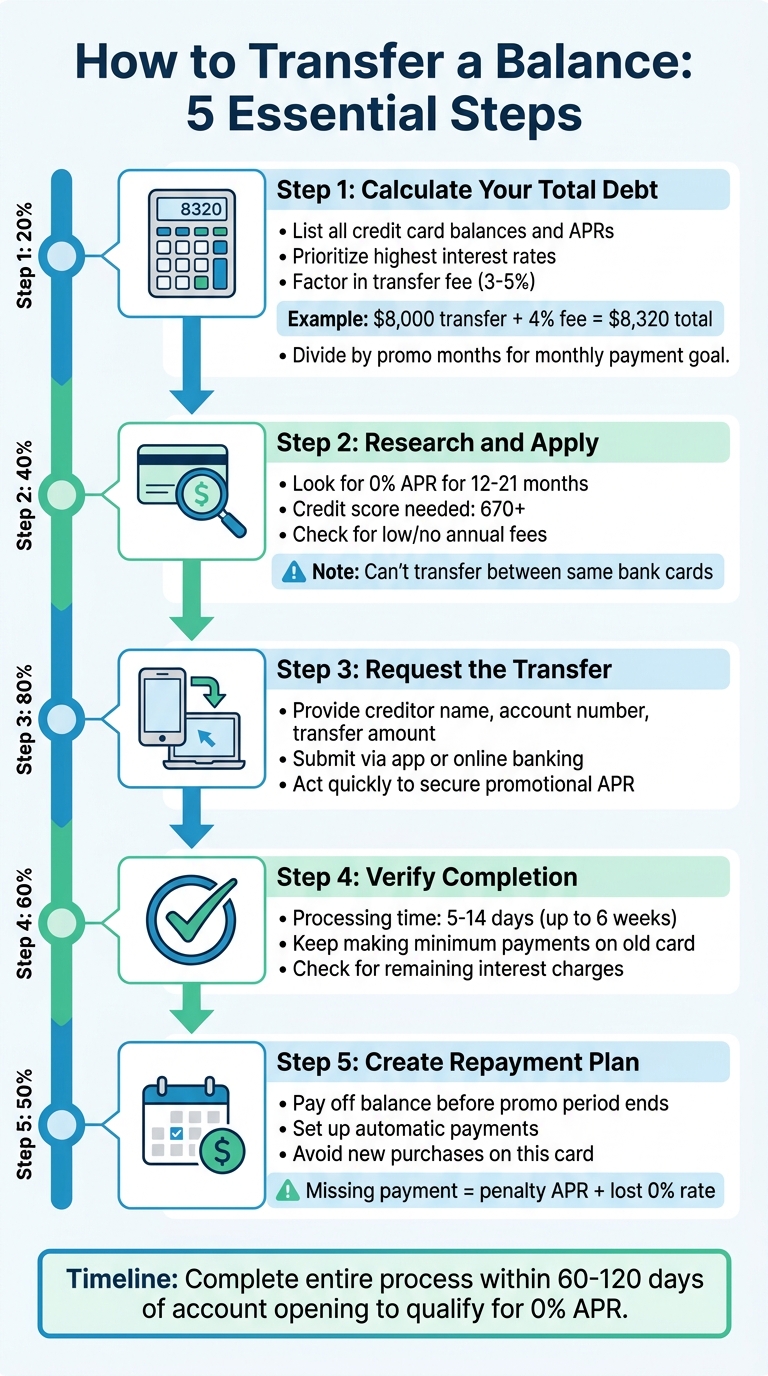
5-Step Balance Transfer Process: From Debt Calculation to Repayment
If you’re ready to tackle your debt with a balance transfer card, here’s a clear guide to help you manage the process smoothly.
Step 1: Calculate Your Total Debt
Start by listing all your credit card balances along with their APRs. This will allow you to figure out which debts to transfer – prioritize those with the highest interest rates. Don’t forget to factor in the balance transfer fee, which typically ranges from 3% to 5%. For instance, transferring $8,000 with a 4% fee will add $320 to your new card balance. Once you know your total, divide it by the number of months in the promotional period to set a realistic monthly payment goal.
With these numbers in hand, you’re ready to choose the right card.
Step 2: Research and Apply for a Balance Transfer Card
Look for cards offering a 0% introductory APR for 12 to 21 months, ideally with low or no annual fees. Keep in mind that most of these offers require a credit score of 670 or higher, so checking your score before applying is a smart move. Also, be aware that most banks won’t allow balance transfers between their own cards.
Step 3: Request the Balance Transfer
Once approved, initiate the balance transfer. You’ll need to provide details like your creditor’s name, account number, and the amount to transfer. Many issuers make this easy by allowing you to submit the request through their mobile app or online banking platform. Act quickly to take advantage of the promotional APR.
Step 4: Verify the Transfer Is Complete
Balance transfers usually take anywhere from 5 to 14 days to process, though in some cases it can take up to six weeks. During this time, continue making at least the minimum payments on your old card to avoid late fees. After the transfer is complete, check your original account for any remaining interest charges that might have accrued between your last statement and the transfer date.
Once everything is confirmed, it’s time to focus on paying off your balance.
Step 5: Create a Repayment Plan
The goal is to pay off your transferred balance before the promotional period ends. Set up automatic monthly payments based on the amount you calculated in Step 1, and avoid making new purchases on the card. Missing even a single payment can lead to penalty APRs and cancel your 0% introductory rate – so use reminders or autopay to stay on track.
Understanding Costs and Fees
Balance transfers come with fees, and knowing how these fees work is essential to figuring out whether a transfer is worth it.
How Balance Transfer Fees Are Calculated
Balance transfer fees are usually a percentage of the amount you transfer, typically between 3% and 5%. This fee is added to the new card’s balance once the transfer is processed. For instance, transferring $5,000 with a 3% fee will cost you $150, while a 5% fee will cost $250.
Some cards also have a minimum fee, often between $5 and $10, even for small transfers. On average, the fee is about 3.28%. Certain issuers may offer reduced fees if you act quickly. For example, the Citi Double Cash® Card charges a 3% fee for transfers completed within the first four months, while the Wells Fargo Reflect® Card charges 5% but offers a longer 21-month promotional period.
"Transferring a balance usually incurs a fee equal to 3% or 5% of the amount transferred (3.28% on average)."
– John S Kiernan, Managing Editor, WalletHub
Being aware of both these fees and any post-promotional costs can help you plan your repayment effectively.
What Happens After the Promotional Period Ends
Once the 0% APR promotional period ends – usually lasting around 13.05 months – any remaining balance starts accruing interest at the card’s standard variable APR. This rate is often much higher, averaging 21.66%, but it can range from approximately 14.99% to 28.49%, depending on your credit score and the card issuer.
Interest is calculated daily on any unpaid balance. Missing a payment could trigger a penalty APR, which is even higher. Additionally, carrying a balance from a transfer might cause you to lose the grace period on new purchases. Unless new purchases are covered by a 0% APR offer, they will start accruing interest immediately.
Comparing Savings to Costs
To determine whether a balance transfer is worthwhile, compare the upfront fee to the interest savings during the promotional period. Here’s an example for a 15-month promotional period with a 20% APR:
| Transfer Amount | Fee Percentage | Fee Cost | Interest Saved (15 months at 20% APR) | Net Savings |
|---|---|---|---|---|
| $5,000 | 3% | $150 | ~$625 | $475 |
| $5,000 | 5% | $250 | ~$625 | $375 |
| $10,000 | 3% | $300 | ~$1,096 | $796 |
| $10,000 | 5% | $500 | ~$1,096 | $596 |
"A balance transfer fee can be worth it if the amount you can save on interest exceeds the balance transfer fee – and if you commit to paying off the balance before the card’s low introductory APR expires."
– Karen Axelton, Senior Personal Finance Writer, Experian
The bottom line? Balance transfers can save you money, but only if you pay off the balance before the promotional period ends. Otherwise, the high standard APR could wipe out your savings quickly.
How to Repay Your Balance Transfer
Paying off your balance transfer before the promotional period ends is key to avoiding high interest rates. Here’s how you can tackle it effectively.
Pay More Than the Minimum
Minimum payments often barely touch the principal, focusing instead on interest. If you stick to just the minimum, you could wind up with a hefty balance once the 0% APR period ends – and that balance could start racking up interest at rates as high as 29.99%.
To stay on track, calculate your monthly payment by dividing the total balance (including fees) by the number of months in your promotional period. For example, if you transferred $6,000 and paid a 3% fee, your total balance would be $6,180. With an 18-month promo period, you’d need to pay about $343 per month to clear the debt before interest kicks in.
"Only making minimum monthly payments will prolong your debt’s lifespan, which means that interest charges will apply once the promotional period [ends]."
– American Express
Set up automatic payments to avoid late fees, and consider aiming to pay off your balance a month early. This gives you a cushion in case of unexpected expenses or processing delays.
Avoid New Purchases
Using your balance transfer card for new purchases can throw off your repayment plan. Why? Most new charges don’t qualify for the 0% introductory APR and may start accruing interest right away. Plus, many issuers apply your payments to the balance with the lowest interest rate first. This means your transferred balance might take longer to pay off.
"Your balance transfer card can be a new start for solidifying better spending behaviors, so focus on paying down your existing balance, not spending."
– Liv Gillespie, Author, American Express Credit Intel
To stay disciplined, reserve your balance transfer card strictly for repaying debt. Use a separate card for everyday expenses, and make sure you can pay it off in full each month.
Plan for the Standard APR
If you’re approaching the end of the promotional period with a remaining balance, be ready for the standard APR to kick in. These rates, often between 17% and 29%, can quickly add up. For instance, carrying a $2,000 balance at a 24% APR could cost you around $480 in interest over a year if you only make minimum payments.
"A balance transfer is only a tool; lowering your debt still takes work. Commit to budgeting for your payments and reducing your debt as much as possible while you’re not accruing interest."
– Kendall Little, Senior Writer, Yahoo Finance
If you’re struggling to pay off the balance in time, consider alternatives like a personal loan with a lower interest rate to help manage the remaining debt.
Steps To Be Debt Free
Once you’ve set up a balance transfer strategy, the Steps To Be Debt Free process helps you create a solid repayment plan. This platform offers a structured, cost-free debt review to design a personalized plan. It starts by identifying your high-interest balances and current interest rates to figure out which debts should take priority for a transfer. This step-by-step approach builds directly on the balance transfer strategies discussed earlier.
A key feature is the personalized repayment calculation. By dividing your total balance (including fees) by the promotional period, the guide calculates a fixed monthly payment. This gives you a clear target to pay off your debt before the 0% APR period expires.
The process also emphasizes payment status verification. It recommends keeping up with your current payments during the transfer processing period to avoid fees and protect your credit score.
In line with earlier advice about qualifying for the best offers, Steps To Be Debt Free incorporates credit eligibility into its assessment. Generally, a credit score of 670 or higher is needed to access the most effective 0% APR offers. This upfront evaluation ensures you understand whether a balance transfer is a viable option for you before applying, which helps prevent unnecessary credit inquiries.
The platform also includes balance transfer calculators. These tools allow you to input your balances, APRs, and payments to calculate exact interest savings and determine a specific payoff timeline. They help you weigh the cost of the one-time transfer fee against potential savings, giving you a clear look at your financial future.
Conclusion
Balance transfer credit cards provide an effective way to tackle high-interest debt by consolidating it onto a card with a 0% introductory APR. These promotional rates typically last between 12 and 21 months, giving you a window to focus on reducing your principal balance without the burden of interest. The process is simple: calculate your total debt, apply for a card with favorable terms, initiate the transfer, and commit to a structured repayment plan. During the introductory period, every dollar you pay directly reduces your debt instead of going toward interest.
However, success hinges on responsible financial habits. Timely payments are crucial, as even one late payment can lead to losing the promotional rate and facing a penalty APR. With the average credit card interest rate at 20.75% and U.S. credit card debt exceeding $1.1 trillion, setting a realistic monthly payment goal and sticking to it is essential. Andrea Agostini Ferrer from Money highlights the importance of planning:
"Your plan to pay off the debt is critical, because after the 0% APR period is over, the balance will start accruing regular interest".
When used wisely, balance transfer cards can lead to substantial savings, but only if the balance is paid off within the promotional timeframe. Treat this period as an opportunity to make meaningful progress toward debt reduction. With discipline and focus, these cards can be a valuable tool in your journey to financial freedom.
FAQs
How do I know if a balance transfer will actually save me money?
Figuring out if a balance transfer is worth it comes down to a few key factors:
- Promotional Period: Look at how long the 0% APR or low interest rate is available. The goal should be to pay off the balance within this timeframe to maximize savings.
- Fees: Most balance transfers come with a fee, often between 3% and 5% of the transferred amount. Compare this fee to the interest you’d avoid paying to see if the transfer makes financial sense.
- Your Payment Plan: Be realistic about your ability to pay off the balance before the promotional rate expires. If you can’t, you might end up with higher interest charges later.
By carefully weighing these factors, you can decide if a balance transfer is the right move for your situation.
Can I transfer more than my new card’s credit limit?
No, you usually can’t transfer an amount that exceeds your new credit card’s credit limit. Most card issuers set the maximum transfer amount equal to the available credit limit on the new card. It’s a good idea to review your card’s terms to understand any specific rules or restrictions.
Will a balance transfer hurt my credit score?
When you initiate a balance transfer, your credit score might dip slightly at first. This happens because of a hard inquiry on your credit report and the potential impact on your average account age. However, over time, a balance transfer can actually work in your favor. By reducing your credit utilization ratio and making it easier to tackle your debt, it could help boost your credit score in the long run.
