

Want to understand how credit card interest works? Here’s the short version:
Credit card interest is calculated daily, based on your Annual Percentage Rate (APR) and your balance. If you carry a balance, you’ll be charged interest, which compounds daily, making it more expensive over time. To calculate your interest:
- Determine Your Daily Periodic Rate (DPR): Divide your APR by 365 (or 360 for some issuers).
- Find Your Average Daily Balance (ADB): Add up your daily balances for the billing cycle and divide by the number of days.
- Calculate Total Interest: Multiply your DPR, ADB, and the number of days in your billing cycle.
For example, with a 20.24% APR, an ADB of $4,808, and a 25-day billing cycle, your interest would be $66.11. Paying off your balance in full within the grace period avoids interest entirely.
Key Tip: Make payments earlier or multiple times a month to reduce your ADB and save on interest costs.
4 Steps To Calculate Credit Card Interest | NerdWallet
sbb-itb-2a9374f
Key Terms and Credit Card APR Basics
To calculate credit card interest accurately, it’s essential to understand some key terms. One of the most important is Annual Percentage Rate (APR), which reflects the yearly interest rate applied to unpaid credit card balances. According to Bank of America:
"APR, or annual percentage rate, represents the annual cost of borrowing money, including fees, expressed as a percentage; for credit cards, APR is generally just interest".
What is APR and How Does it Work?
APR represents the cost of carrying a balance from month to month. The higher the APR, the more interest you’ll pay on any unpaid balance. For credit cards, the APR is generally the same as the interest rate – it shows the annual borrowing cost. However, even though it’s labeled as an annual rate, issuers usually calculate and apply interest daily. This daily compounding means that interest is added to your balance each day, which then affects the next day’s interest calculation.
How to Calculate the Daily Periodic Rate (DPR)
Since interest is charged daily, credit card companies convert your APR into a Daily Periodic Rate (DPR). To find the DPR, divide the APR by 365 days. For instance, if your APR is 17.99%, the calculation would be: 17.99% ÷ 365 = 0.0492% per day. This percentage is used to determine daily interest charges. Some issuers use 360 days instead of 365, which slightly increases the daily rate. As Capital One explains:
"Knowing the daily periodic rate for your credit cards can give you a clearer view of how credit card interest works".
Different Types of APR on Your Statement
Your credit card statement likely lists several APRs, each tied to specific types of transactions. Here’s a breakdown:
- Purchase APR: Applies to everyday purchases and often includes a grace period if you pay your balance in full.
- Cash Advance APR: Higher than the purchase APR and starts accruing interest immediately – no grace period.
- Balance Transfer APR: May feature promotional 0% rates to encourage moving debt from another card.
- Penalty APR: Activated if a payment is over 60 days late, and it can be nearly double your regular APR.
- Introductory APR: Temporary promotional rates (often 0%) for new accounts; federal law requires these rates to last at least six months.
You’ll find these APR details in the "Interest Charge Calculation" section of your statement. Understanding these distinctions is key to managing your credit card effectively.
Finding the Right Information on Your Statement
Before diving into interest calculations, it’s crucial to identify the key details on your credit card statement. These details help ensure your calculations are accurate and save you from any surprises.
Where to Find Your APR and Billing Cycle Dates
Your credit card’s APR (Annual Percentage Rate) can be found in two main places: the account opening disclosures and every monthly statement. On your statement, look for the "Interest Charge Calculation" section. This area breaks down transaction categories – like purchases, cash advances, and balance transfers – along with their corresponding APRs and balance amounts.
Billing cycle dates, often listed as "Statement Period" or "Billing Period", indicate the timeframe covered by your statement, typically 28–31 days (most often 30 days). These dates mark the start and end of your billing cycle. Federal regulations require at least 21 days between the cycle’s closing date and the payment due date. Knowing these dates is essential for calculating your average daily balance.
Grace Periods and When Interest Starts
The grace period is the time between your billing cycle’s end and your payment due date. Capital One explains:
"If you pay your statement balance by the due date, you typically won’t be charged interest on new purchases from the last billing cycle."
This grace period only applies to new purchases and can disappear if you carry over a balance from the previous month. Cash advances and balance transfers follow different rules. According to Capital One:
"Interest typically begins accruing as soon as you request the cash advance."
Understanding when interest starts is critical to avoiding unexpected fees. For example, even if you pay off your balance in full, you might still encounter "residual interest" on your next statement if you carried a balance during the previous cycle and missed the grace period.
With these details in hand, you’re all set to calculate your credit card interest step by step.
How to Calculate Credit Card Interest Step by Step
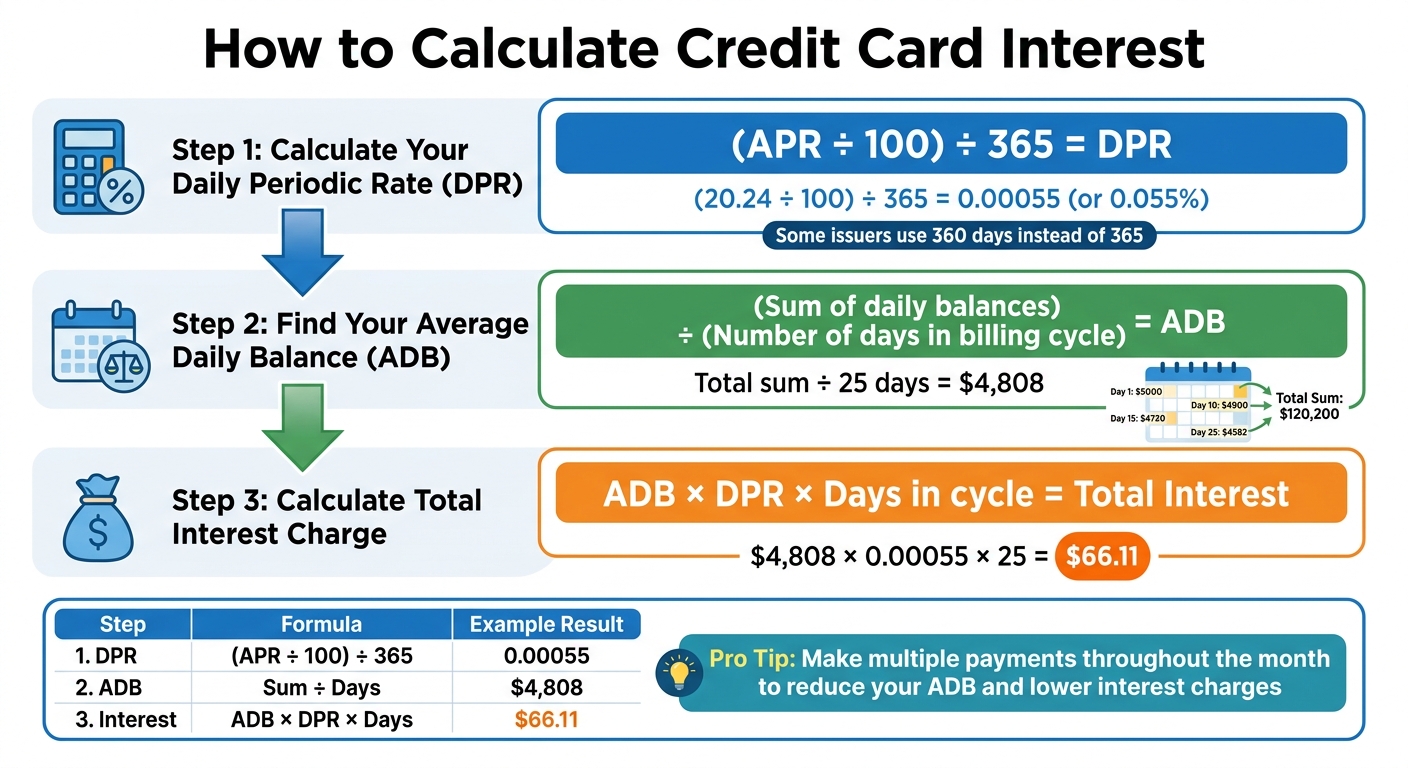
How to Calculate Credit Card Interest in 3 Steps
If you want to calculate your credit card interest manually, you’ll need to follow three main steps. These steps work together to determine the total interest charged for your billing cycle.
Step 1: Calculate Your Daily Periodic Rate
Start by converting your Annual Percentage Rate (APR) into a Daily Periodic Rate (DPR). Most credit card companies divide the APR by 365 days, though some use 360 days instead.
Here’s how to calculate it: Convert your APR into a decimal and divide by 365. For instance, if your APR is 20.24%, the calculation would look like this:
(20.24 ÷ 100) ÷ 365 = 0.00055 (or 0.055%)
If your credit card has different APRs for specific balance types (like purchases or cash advances), calculate the DPR separately for each type.
Once you have your DPR, you’re ready to move on to the next step: finding your average daily balance.
Step 2: Find Your Average Daily Balance
The Average Daily Balance (ADB) is the average of your daily balances throughout the billing cycle. To calculate it, add up all your daily end-of-day balances and divide by the number of days in the cycle.
Here’s the formula:
(Sum of daily balances during the billing cycle) ÷ (Number of days in the billing cycle)
For example, CNBC Select explains a scenario with a 25-day billing cycle. A cardholder starts with a $0 balance, makes a $2,500 purchase on day 1, a $300 purchase on day 2, and other charges throughout the month. Adding up these daily balances and dividing by 25 results in an average daily balance of $4,808.
To calculate your daily balance, take the previous day’s balance, add any new purchases or fees, and subtract payments or credits. If your credit card compounds interest daily, you’ll also need to include the previous day’s interest charge in this calculation.
Now, with your ADB and DPR ready, you can calculate the total interest.
Step 3: Calculate the Total Interest Charge
Finally, multiply your Average Daily Balance by the Daily Periodic Rate and the number of days in the billing cycle.
Using the CNBC Select example with an ADB of $4,808, a DPR of 0.00055, and a 25-day cycle:
$4,808 × 0.00055 × 25 = $66.11
This $66.11 represents the total interest charged for the billing cycle. The steps are summarized in the table below:
Interest Calculation Summary
| Step | Formula | Example (20.24% APR, $4,808 ADB, 25-day cycle) |
|---|---|---|
| 1. DPR | (APR ÷ 100) ÷ 365 | (20.24 ÷ 100) ÷ 365 = 0.00055 |
| 2. ADB | Sum of daily balances ÷ Days in cycle | Total sum ÷ 25 = $4,808 |
| 3. Total Interest | ADB × DPR × Days in cycle | $4,808 × 0.00055 × 25 = $66.11 |
Pro tip: Making multiple payments throughout the billing cycle can reduce your ADB – and lower your total interest charge as a result.
Different Methods Credit Card Companies Use
Credit card issuers don’t all calculate interest the same way. While the Average Daily Balance method is the most common, other approaches can lead to different interest charges. Each method has its own rules, and understanding them can help you better manage your account.
The Daily Balance method calculates interest based on your balance at the end of each day. The issuer multiplies that day’s balance by the Daily Periodic Rate (DPR) to determine the interest for the day. Since most issuers compound interest daily, the next day’s interest is calculated on the new balance, which includes the previous day’s interest.
Less common methods include the Adjusted Balance and Previous Balance approaches. The Adjusted Balance method calculates interest based on the previous cycle’s ending balance, subtracting any payments or credits made during the current cycle – new purchases are not factored in. On the other hand, the Previous Balance method ignores payments made during the current cycle and charges interest based solely on the balance at the end of the last billing cycle.
Here’s an example: American Express uses the "Average Daily Balance (including new purchases)" method, while Citibank employs a "Daily Balance (including current transactions)" method.
Interest Calculation Methods Comparison Table
| Method Name | Calculation Method | Purchases Included? | Formula Overview |
|---|---|---|---|
| Average Daily Balance | Sum of daily balances divided by the number of days in the billing cycle | Yes (usually) | (Avg. Daily Balance × Daily Periodic Rate) × Days in Cycle |
| Daily Balance | The actual balance on the account for each specific day | Yes | Daily Balance × Daily Periodic Rate for each day |
| Adjusted Balance | Balance at the end of the previous cycle minus payments/credits made during the current cycle | No | Adjusted Balance × Monthly Periodic Rate |
| Previous Balance | Balance at the end of the previous billing cycle | No | Previous Balance × Monthly Periodic Rate |
Knowing which method your issuer uses is key. Check your cardmember agreement to see how your interest is calculated, and compare it with your own manual calculations for accuracy.
Conclusion and Next Steps
Understanding how interest is calculated can be a game-changer when it comes to managing debt. Once you know your daily rate, you can make smarter choices about which debts to prioritize and how to adjust your spending habits. As Paul Kim, Senior Associate Editor at Business Insider, explains:
"Understanding your credit card payoff timeline is a crucial component of responsible personal finance management."
To avoid interest charges, aim to pay your full balance within the grace period. If paying in full isn’t possible, consider making multiple payments throughout the month. This can lower your average daily balance, which in turn reduces the interest you owe. Another effective approach is the debt avalanche method – focus extra payments on the card with the highest APR while continuing to make minimum payments on your other accounts. This strategy helps cut down on long-term interest costs.
For high-interest credit card debt, you might explore additional options. A balance transfer to a card offering 0% introductory APR for 12 to 18 months can provide temporary relief. If you’ve maintained a strong payment history, you could also ask your card issuer for a lower APR.
If managing your debt feels overwhelming, resources like Steps To Be Debt Free offer free consultations and personalized advice to help you create a clear plan. Calculating your daily rate and average daily balance is a practical way to tailor these strategies to your unique financial situation. With these tools in hand, you’re better prepared to take meaningful steps toward reducing your credit card debt.
FAQs
Why do I still get interest after paying my card in full?
Even if you pay off your credit card in full, you might still end up with interest charges. Why? Because credit card interest is usually calculated daily based on your average daily balance during the billing cycle. If you carry over a balance from a previous cycle, miss paying the full statement balance by the due date, or make new purchases that aren’t completely paid off by the next cycle, interest can still sneak in.
How do multiple payments in a month reduce my interest?
Making more than one payment each month can help cut down on your interest charges by reducing your average daily balance. Since credit card interest is calculated based on this balance, paying off portions of your balance earlier in the billing cycle lowers the amount on which interest is applied. The result? Less daily interest adds up, meaning you’ll owe less in total interest for that billing period.
How can I tell which interest method my card issuer uses?
To figure out how interest is calculated on your credit card, take a close look at your credit card agreement or billing statement. Many credit card companies use the daily balance method, which involves multiplying your average daily balance by the daily periodic rate (a figure based on your APR). However, some issuers might calculate interest differently, such as using your statement balance or applying separate rates for different types of transactions. Make sure to carefully review your statement to understand the specific method and rates applied to your account.
