

Credit counseling helps people manage debt by providing expert guidance, creating budgets, and offering repayment plans like Debt Management Plans (DMPs). These plans consolidate unsecured debts (e.g., credit cards, medical bills) into a single monthly payment, often with reduced interest rates and waived fees. Here’s how it works:
- Initial Session: A certified counselor reviews your financial situation and helps you create a budget.
- Debt Management Plan (DMP): If suitable, the counselor negotiates with creditors to simplify payments and reduce costs.
- Progress Tracking: Agencies monitor your repayment progress and assist with adjustments if financial circumstances change.
Credit counseling also teaches long-term money management skills, helping you stay debt-free after completing a DMP. It’s a structured, reliable way to regain financial stability.
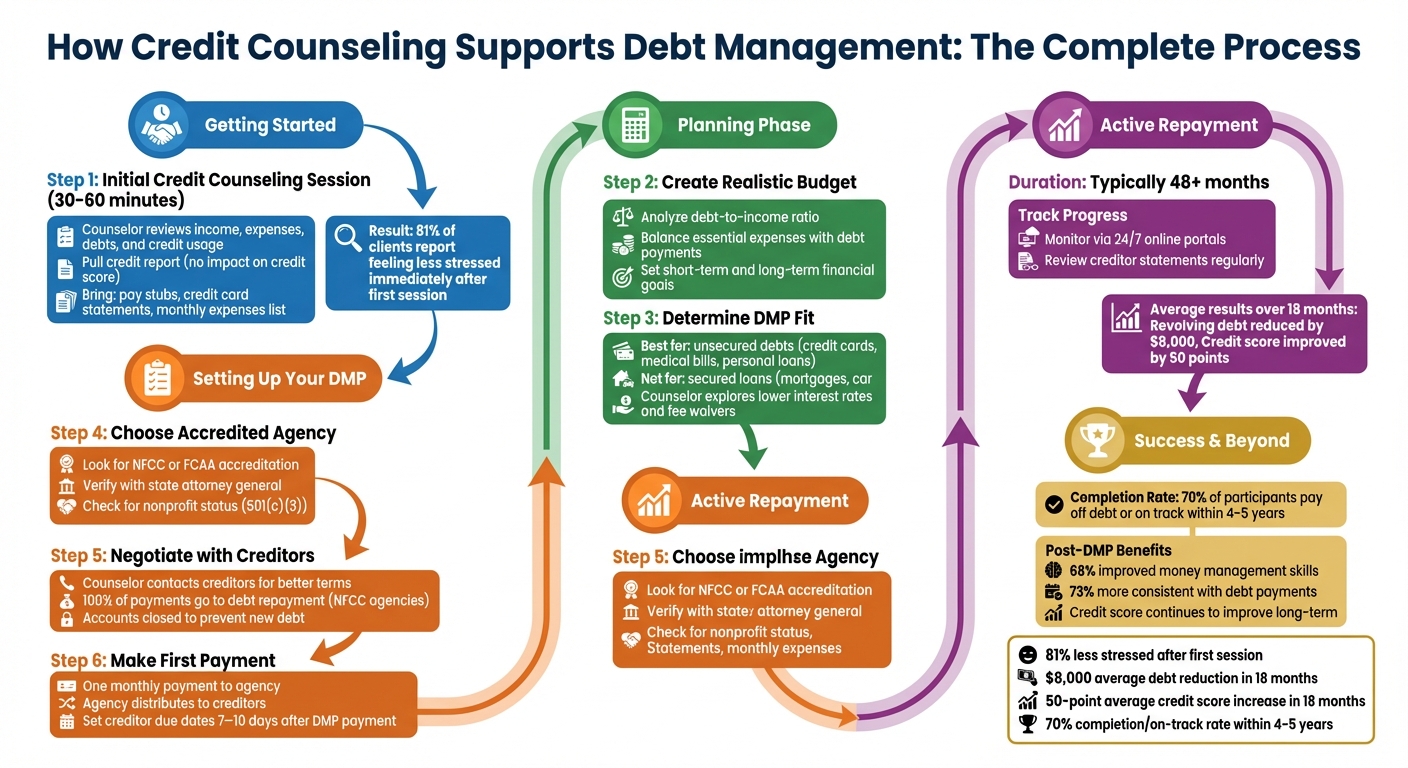
How Credit Counseling and Debt Management Plans Work: A Step-by-Step Guide
How Credit Counseling Prepares You for Debt Management
Your First Credit Counseling Session
This initial session, which lasts about 30–60 minutes, can take place in person, over the phone, or online. During the meeting, your counselor will take a close look at your income, expenses, debts, and credit usage. With your consent, they might also pull your credit report to spot any errors or negative marks. Don’t worry – this process won’t impact your credit score.
To make the most of this free or low-cost consultation, come prepared. Bring along pay stubs, recent credit card statements, and a detailed list of your monthly expenses, like rent, utilities, and groceries. As Courtney Nagle from the National Foundation for Credit Counseling (NFCC) puts it:
"The goal of the session is to take an inventory of your current financial circumstances and to discuss your goals moving forward."
Be open about your financial situation, including any expected changes in your income. This honesty helps your counselor craft a plan that fits your needs. The session lays the groundwork for building a realistic budget.
Creating a Realistic Budget
After reviewing your financial details, your counselor will create a monthly budget designed to balance your essential expenses with your debt payments. They’ll analyze documents like pay stubs, loan statements, and utility bills to pinpoint areas where you might cut costs. They may also calculate your debt-to-income ratio to understand how much of your income is already tied up in debt.
Debt Management Plans (DMPs) require a long-term commitment, so the budget must be practical and sustainable. According to the NFCC, 81% of clients report feeling less stressed immediately after their first counseling session. This process also includes setting financial goals – both short-term and long-term – to ensure your repayment plan supports your future stability. Once your budget is finalized, your counselor will assess whether a DMP is the right fit for you.
Determining If a Debt Management Plan Fits Your Situation
Your counselor will determine if a DMP aligns with your financial situation, considering your debt type, income, and personal goals. DMPs are particularly effective for unsecured debts like credit cards, medical bills, and personal loans. However, they generally don’t apply to secured loans, such as mortgages or car loans. The counselor will also explore whether your creditors can offer perks like lower interest rates or fee waivers to make the DMP more effective.
A trustworthy counselor won’t recommend a DMP without first conducting a thorough financial analysis. As the NFCC explains:
"A dedicated NFCC-certified, nonprofit credit counselor can also help you determine if entering into a Debt Management Plan is the best option for you, and if not, lay out all your available options."
Setting Up a Debt Management Plan with Credit Counseling
Choosing a Credit Counseling Agency
Finding the right credit counseling agency takes some research, but it’s worth the effort. Start by exploring databases from the National Foundation for Credit Counseling (NFCC) or the Financial Counseling Association of America (FCAA) to locate accredited organizations. These agencies typically employ certified counselors who specialize in consumer credit, budgeting, and financial education. Most operate as nonprofits, focusing on helping consumers rather than making a profit.
It’s important to verify the agency’s reputation. Check with your state attorney general or local consumer protection agency to confirm their standing. Ask key questions, such as:
- Is the agency licensed in your state?
- What free educational resources do they provide?
- How do they handle fees if you’re unable to pay?
A trustworthy agency should provide basic service information without asking for your personal financial details upfront. As the Consumer Financial Protection Bureau advises:
"A reputable credit counseling organization should be willing to send you free information about its services without requiring you to provide details about your situation."
Be cautious of red flags. Avoid agencies that pay their employees commissions for enrolling clients, refuse to assist if you can’t pay their fees, or push a Debt Management Plan (DMP) before fully reviewing your financial situation. Always get a written quote for setup and monthly fees before committing to anything. For example, Money Management International (MMI) is a well-regarded agency with an A+ rating from the Better Business Bureau and an "Excellent" rating on Trustpilot. Taking these steps ensures you choose an agency that aligns with your financial goals.
Creating Your DMP
Once you’ve selected a reputable agency, the process of setting up your Debt Management Plan can begin. Your counselor will carefully review your financial situation and contact your unsecured creditors – such as credit card companies, medical providers, or personal loan lenders – to negotiate better terms. This could include lower interest rates, waived late fees, or the removal of over-limit charges.
Based on your financial review, your counselor will create a single monthly payment that fits your income and essential expenses while addressing your debt. When working with an NFCC-accredited agency, creditors receive 100% of the payments allocated for debt repayment. However, most creditors require you to close your accounts while enrolled in a DMP to prevent further debt accumulation. Keep in mind that creditor approval is necessary before the plan can officially take effect.
Making Your First DMP Payment
Once your Debt Management Plan is finalized, the next step is making your first payment. After your creditors formally accept the plan, you’ll start sending one monthly payment to your credit counseling agency. They will then distribute the funds to your creditors according to the agreed terms. To ensure everything runs smoothly, it’s a good idea to set creditor due dates 7–10 days after your DMP payment to allow time for processing.
Most agencies charge a one-time setup fee and a modest monthly administrative fee to maintain the plan. However, reputable nonprofits should offer fee waivers if you genuinely can’t afford these charges. As the Consumer Financial Protection Bureau emphasizes:
"If an organization won’t help you because you can’t afford to pay, look elsewhere."
Your first payment marks the start of a structured journey toward financial freedom. From this point on, the agency will handle all communication with your creditors, simplifying your financial obligations into a single, predictable monthly payment.
Managing a Debt Management Plan Over Time
Tracking Your Progress
Your credit counseling agency will keep a close eye on your progress throughout the repayment process, which usually takes 48 months or more to complete. Many agencies even offer 24/7 online portals where you can track payment distributions, monitor your declining balances, and see how far you’ve come.
It’s a good habit to regularly review your creditor statements. If you notice a payment applied incorrectly or an unexpected fee, report it right away. Your counselor ensures that every dollar you send is properly credited to your accounts and verifies that creditors are honoring agreed interest rate reductions and fee waivers.
The impact of these plans is clear. Around 70% of consumers enrolled in NFCC-member debt management plans either paid off their debt or were on track to do so within four to five years. On average, participants saw their revolving debt shrink by $8,000 over 18 months, while their credit scores improved by about 50 points during that time. Staying engaged with your plan helps you stay on the structured path to financial freedom.
Adjusting Your Plan When Circumstances Change
Life happens, and when it does, your debt management plan (DMP) may need adjustments. If you experience job loss, a divorce, medical bills, or any other major financial change, reach out to your credit counselor immediately – don’t wait until you miss a payment. Acting quickly allows your counselor to help before things spiral.
If your financial situation changes, your counselor can reassess your payment schedule. They might renegotiate with creditors to lower your monthly payments or extend the repayment timeline, ensuring the plan remains manageable. If you’re unable to make the full payment, pay as much as you can, and your counselor can guide you on which creditors to prioritize to keep them from dropping out of the plan.
In cases where a DMP is no longer feasible due to extreme financial hardship, your counselor can help you explore other options, such as debt settlement or bankruptcy counseling. Keeping the lines of communication open is crucial. When reaching out, have your most recent pay stubs, updated expense estimates, and current debt balances ready to make the process smoother.
Your Responsibilities During a DMP
While your agency handles creditor negotiations, your role is just as important. Making on-time payments every month is non-negotiable – a single missed payment can void your DMP and reinstate original fees and interest rates. To avoid this, consider setting up automatic payments or reminders.
Avoid taking on new unsecured debt while on the plan. This means no new credit cards, personal loans, or lines of credit, as doing so could violate your agreement with creditors and cause them to withdraw from the plan. Additionally, all credit card accounts included in your DMP will be closed to prevent further debt accumulation.
Stay vigilant by monitoring your statements to ensure payments and terms are being applied correctly. This habit not only protects you from potential errors but also keeps you on track to successfully complete your plan.
sbb-itb-2a9374f
Building Long-Term Financial Habits After Completing a DMP
Learning Money Management Skills
Finishing a Debt Management Plan (DMP) is a significant milestone, but it’s just the start of your financial journey. Many nonprofit credit counseling agencies provide free workshops and educational materials to help you continue building your budgeting skills. These resources often address critical topics like creating an emergency fund, steering clear of high-interest traps such as payday loans, and preparing for major life changes.
Statistics show that 68% of DMP participants improved their money management, and 73% became more consistent with debt payments. Tools like budget worksheets, cost-cutting analysis forms, and spending trackers – often supplied by your counselor – can help you stay disciplined. By tracking every dollar, even small recurring expenses, you can catch potential financial issues before they grow into larger problems. These habits lay the groundwork for rebuilding your credit and securing long-term financial stability.
Rebuilding Your Credit Score
Once you’ve mastered money management, the next challenge is improving your credit score. While your credit may temporarily dip during the DMP due to account closures, the long-term benefits are promising. Many participants see steady improvements in their credit scores as they implement better financial practices. Bruce McClary, Vice President of Communications at the NFCC, explains:
"When you have completed your payments, the fact that you did repay your debt in full and according to plan, may help you re-establish credit".
After completing your DMP, schedule a credit review to develop a tailored strategy for rebuilding your score. A counselor can help you dispute inaccuracies on your credit report and explain how factors like credit utilization impact your score. One of the most important habits to adopt is paying all bills on time. If you decide to use credit cards again, keep balances low and pay them off in full each month. This demonstrates responsible use while avoiding new debt.
Staying Debt-Free
Staying out of debt requires ongoing effort and vigilance. With credit card debt levels in the U.S. remaining high, it’s essential to stay proactive. Use tools like self-assessment checklists and budget calculators to monitor your progress.
If you find yourself needing extra support, resources like Steps To Be Debt Free offer structured plans to evaluate your debt levels and payment progress. These tools reinforce the financial habits you developed during your DMP. The key is to address warning signs early – whether it’s relying on credit cards for daily expenses or neglecting your emergency fund contributions. If these issues arise, don’t hesitate to reach out to your counselor for guidance before the situation escalates.
How Credit Counseling Works | NFCC
Conclusion
Combining multiple debts into one simplified payment makes managing your finances much easier. Credit counseling, particularly through Debt Management Plans (DMPs), helps by negotiating reduced interest rates and waiving fees with creditors. These plans usually span several years, with nearly 70% of participants either completing or actively paying off their debts within four to five years. This structured repayment process not only makes debt more manageable but also helps you develop crucial financial skills along the way.
But credit counseling isn’t just about paying down debt. As the Consumer Financial Protection Bureau explains:
"Credit counseling organizations can advise you on your money and debts, help you with a budget, develop debt management plans, and offer money management workshops".
This comprehensive approach tackles the underlying causes of debt while equipping you with the tools to maintain financial stability long after you’ve completed your DMP.
Getting started is key. Trusted nonprofit agencies – typically 501(c)(3) organizations accredited by groups like the NFCC or FCAA – offer free initial consultations to evaluate your financial situation. They can help you craft a realistic budget, determine whether a DMP is the right fit, and provide support to keep you on track and avoid falling into new debt.
If you’re ready to take control of your finances, resources like Steps To Be Debt Free can guide you through the process and help you take those first steps toward lasting financial stability. When paired with professional credit counseling, these tools can transform financial stress into a path toward freedom. Don’t wait – taking action now can speed up your journey to a more secure financial future.
FAQs
How do I find a trustworthy credit counseling agency?
To choose a reliable credit counseling agency, start by confirming that the organization operates as a reputable nonprofit offering clear, low-cost, or free services. Be cautious of agencies that demand upfront fees or suggest "voluntary contributions" before assisting you. A trustworthy agency should also provide free written details about their programs without requiring personal information upfront.
It’s important to verify that the counselors are certified by respected organizations like the National Foundation for Credit Counseling (NFCC). Certification ensures the counselors have undergone thorough training to guide you effectively. Also, check if the agency offers an initial consultation at no cost – these sessions typically last 30 minutes to an hour. Any fees for a debt management plan (DMP) should be reasonable and transparently disclosed.
When comparing agencies, consider their counseling options – whether they offer sessions in person, over the phone, or online. Take time to read customer reviews, investigate complaints through the Better Business Bureau, and confirm they provide a free budget or credit report review upfront. Following these steps can help you find a dependable agency to assist with managing your debt.
What should I do if my financial situation changes while I’m on a Debt Management Plan (DMP)?
If your financial situation shifts while you’re on a Debt Management Plan (DMP), it’s crucial to contact your credit counselor right away. They can work with you to reevaluate your budget and adjust your plan to fit your new financial reality.
Whether it’s a drop in income, surprise expenses, or even a boost in earnings, these changes can influence your ability to follow the original plan. Staying in touch ensures your DMP stays practical and keeps you moving toward your goal of becoming debt-free.
How does credit counseling impact my credit score?
Credit counseling doesn’t directly impact your credit score – either positively or negatively. However, if you enroll in a Debt Management Plan (DMP) through a certified counselor, it can influence your score over time. By making a single, on-time monthly payment to the agency, which then distributes the funds to your creditors, you can avoid missed payments – one of the biggest factors that hurt credit scores. Many people notice their credit stabilizing or gradually improving as they stick to the plan.
Keep in mind, though, that accounts included in a DMP are often reported as "managed" rather than "open." This can cause a slight, temporary dip in your score. But this minor effect pales in comparison to the damage caused by charge-offs, collections, or repeated late payments. Over time, credit counseling can shield your score from further harm and create a clear pathway to improvement by encouraging consistent repayment and better financial habits.
