
If you’re worried about identity theft, you have two main tools to protect your credit: credit freezes and fraud alerts. Both are free and can help stop scammers from opening accounts in your name, but they work differently:
- Credit Freeze: Completely locks your credit report, blocking lenders from accessing it. You must contact all three credit bureaus to set it up. It stays in place until you lift it.
- Fraud Alert: Adds a warning to your credit report, requiring lenders to verify your identity before approving credit. You only need to contact one bureau, which notifies the others. It’s temporary (1 year or 7 years for identity theft victims).
Quick Overview:
- Use a credit freeze if you’re not applying for new credit soon and want maximum protection.
- Choose a fraud alert if you still need access to credit but want an extra layer of security.
Both options can be used together for stronger protection. Neither prevents fraud on existing accounts, so monitor your statements regularly.
Fraud Alert vs Credit Freeze: Which One Should I Use?
sbb-itb-2a9374f
What is a Fraud Alert?
A fraud alert is a warning added to your credit report that prompts lenders to confirm your identity before approving any new credit requests. As Equifax puts it:
"A fraud alert is a notice that is placed on your credit report that alerts credit card companies and others who may extend you credit that you may have been a victim of fraud, including identity theft. Think of it as a ‘red flag’ that encourages companies to take steps to verify your identity before extending credit in your name."
When a lender reviews your credit report and notices the alert, they are required to contact you directly to confirm the application. This added layer of security can block identity thieves from opening accounts in your name, even if they have access to personal details like your Social Security number.
It’s important to note that a fraud alert doesn’t lock your credit report like a credit freeze does. Lenders can still view your report but must take extra steps to verify your identity. Another advantage is that when you request a fraud alert with one of the three major credit bureaus – Equifax, Experian, or TransUnion – that bureau will notify the other two automatically. Setting up a fraud alert is free and has no impact on your credit score.
There are different types of fraud alerts tailored to specific situations, which are outlined below.
Types of Fraud Alerts
Fraud alerts come in three variations, each suited for a particular need:
Initial Fraud Alert stays active for 1 year and is a good option if you think your personal information might be at risk. You don’t need to prove fraud to use this alert. It’s helpful in scenarios like a stolen wallet, a data breach, or even just a general concern about your security. With this alert, you’re entitled to one free credit report from each bureau so you can check for any unauthorized activity.
Extended Fraud Alert offers protection for 7 years and is meant for victims of confirmed identity theft. To activate it, you’ll need to provide a copy of a police report or an FTC Identity Theft Report. This alert also gives you two free credit reports from each bureau during the first year and removes your name from pre-screened credit and insurance offers for 5 years.
Active Duty Military Alert lasts for 1 year and is designed to protect service members while they are deployed. You’ll need to show proof of military status to set it up. This alert also removes you from marketing lists for 2 years, reducing the risk of identity theft while you’re away and unable to monitor your credit closely.
| Alert Type | Duration | Who Can Use It | Documentation Required | Marketing Opt-Out |
|---|---|---|---|---|
| Initial | 1 year | Anyone concerned about fraud | None | 6 months (Experian) |
| Extended | 7 years | Identity theft victims | Police or FTC report | 5 years |
| Active Duty | 1 year | Deployed service members | Proof of military status | 2 years |
To ensure the alert works effectively, make sure your contact phone number is up to date with the credit bureaus. Lenders will use it to reach you for identity verification. Keep in mind that fraud alerts may cause delays for instant credit approvals, such as those offered at retail stores, since manual verification is required.
What is a Credit Freeze?
A credit freeze, sometimes called a security freeze, is a way to block access to your credit report. According to the Consumer Financial Protection Bureau:
"A credit or security freeze prevents prospective creditors from accessing your credit file."
By preventing lenders from viewing your credit report, a freeze makes it nearly impossible for them to approve new credit in your name, creating a strong safeguard against fraud.
Importantly, a credit freeze doesn’t affect your credit score or your ability to use existing credit accounts. You can still access your own credit report, but new lenders will be locked out. To set up a freeze, you’ll need to contact each of the three major credit bureaus – Equifax, Experian, and TransUnion – individually.
Thanks to federal law, placing, lifting, or removing a credit freeze is entirely free at all three bureaus. If you request a freeze online or by phone, it must be activated within one business day. For mail requests, the freeze will be in place within three business days.
Key Features of a Credit Freeze
A credit freeze gives you more control over your credit file while offering a high level of protection. When you set up a freeze, you’ll receive a PIN or password. Keep this information secure, as you’ll need it to lift or remove the freeze.
The freeze stays active indefinitely until you decide to remove it. If you need to apply for new credit, you can temporarily lift the freeze for a specific period or lender. Requests made online or by phone are processed within an hour, while mail requests take up to three business days.
Even with a freeze in place, certain entities can still access your credit report. These include your current creditors, their debt collectors, child support agencies, and companies you’ve hired for credit monitoring. Government agencies may also access your report when responding to court orders or subpoenas. However, most new lenders will remain blocked until you lift the freeze.
With these features, a credit freeze provides a powerful way to take control of your credit file and protect yourself from unauthorized activity.
Credit Freeze vs. Fraud Alert: Side-by-Side Comparison
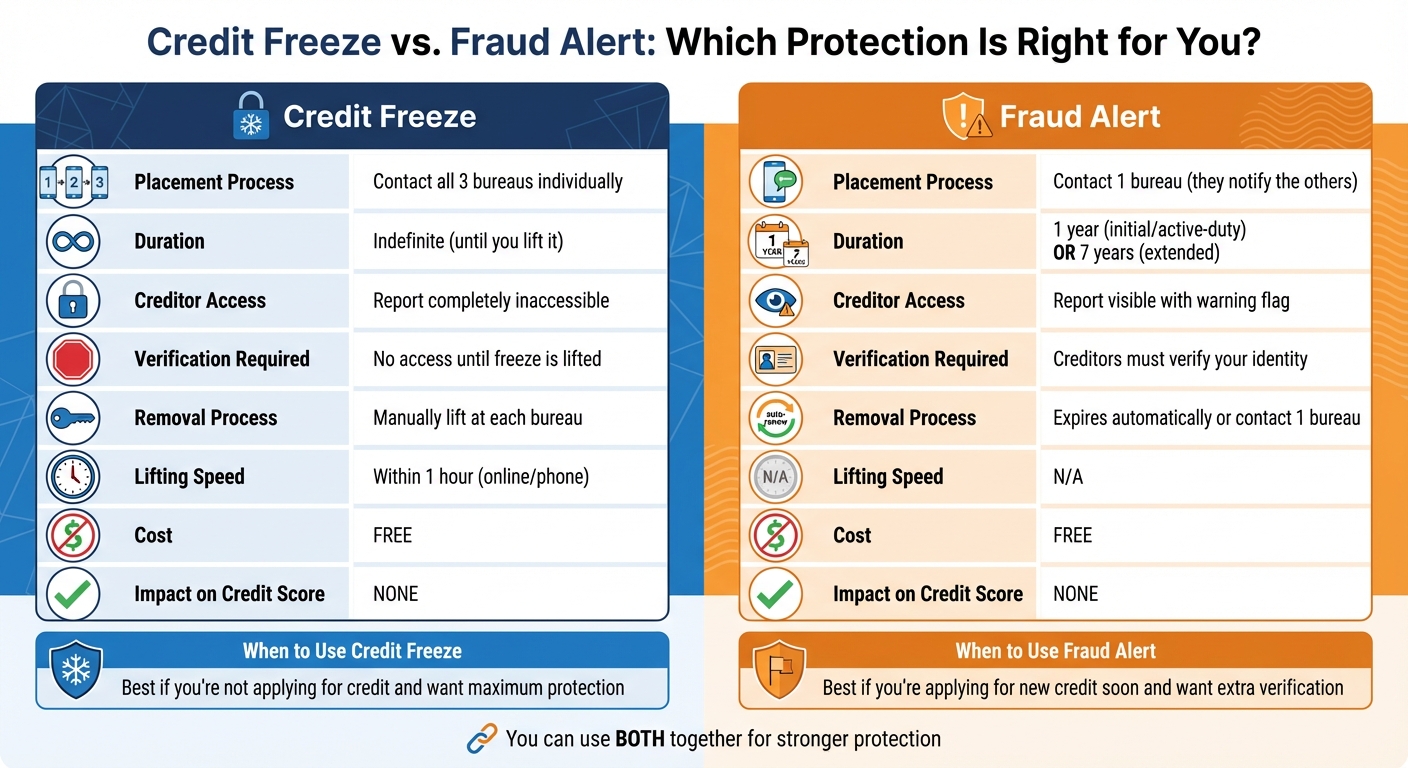
Credit Freeze vs Fraud Alert Comparison Chart
Knowing the differences between a credit freeze and a fraud alert is key to picking the best option for protecting your credit. Here’s the main distinction: Fraud alerts require you to contact just one credit bureau, which will then notify the others. In contrast, credit freezes demand that you reach out to all three bureaus separately. Plus, the duration of fraud alerts can vary, as explained below.
A fraud alert keeps your credit report accessible but adds a warning flag. This flag signals creditors to verify your identity before approving any new accounts.
A credit freeze, however, goes a step further by completely locking your credit report. As NerdWallet explains, "A fraud alert requires lenders to contact you before moving forward with a credit application, while a credit freeze locks down your credit reports… so new credit accounts cannot be opened in your name". Unlike fraud alerts, a freeze stays in place indefinitely until you choose to lift it.
Here’s a quick breakdown of how fraud alerts and credit freezes compare:
| Feature | Fraud Alert | Credit Freeze |
|---|---|---|
| Placement Process | Contact one bureau; they notify the others | Must contact all three bureaus individually |
| Duration | 1 year (initial/active-duty) or 7 years (extended) | Indefinite; remains until lifted |
| Creditor Access | Report remains visible with a warning flag | Report remains inaccessible to new creditors |
| Verification Required | Creditors must verify your identity | No access to the report until the freeze is lifted |
| Removal Process | Expires automatically or can be removed by contacting a bureau | Must be manually lifted at each bureau |
| Lifting Speed | N/A | Within 1 hour if requested online or by phone |
| Cost | Free | Free |
| Impact on Credit Score | None | None |
This table highlights the practical differences, making it easier to decide which option suits your needs.
When to Use a Fraud Alert vs. a Credit Freeze
Deciding between a fraud alert and a credit freeze depends on your current situation and credit needs. If you’re planning to apply for new credit – like a mortgage or auto loan – a fraud alert is the better choice. It allows lenders to verify your identity without the inconvenience of lifting a freeze, making it a smoother process when you’re actively seeking credit.
On the other hand, a credit freeze is ideal if you’re not looking to open new credit accounts. It offers strong, long-term protection, making it especially useful for individuals like children or older adults who are less likely to need new credit.
If you suspect your personal information has been compromised, start with an initial fraud alert to keep an eye on your credit activity. For confirmed cases of identity theft, an extended fraud alert provides longer-term protection. Active-duty service members may want to use a specific active-duty alert during deployment. This alert lasts for one year and can be renewed as needed.
You can use both fraud alerts and credit freezes at the same time, but remember – neither will prevent fraudulent charges on your existing accounts. That’s why it’s crucial to regularly review your account statements for unusual activity. Ready to take action? Up next, we’ll discuss how to set up these protections.
How to Place a Fraud Alert
Setting up a fraud alert is simple, free, and only requires contacting one of the major credit bureaus. Once you notify one bureau, they are required by law to inform the other two, saving you the trouble of reaching out to all three individually.
You can get in touch with any of the following bureaus:
- Equifax: 800-685-1111 or 800-525-6285
- Experian: 888-397-3742
- TransUnion: 888-909-8872 or 800-680-7289
All three offer online options for setting up a fraud alert instantly. When you contact them, you’ll need to provide some basic details, including your full name, address, Social Security number, and contact information. The Federal Trade Commission explains the process clearly:
"You may place a fraud alert in your file by calling just one of the three nationwide consumer reporting agencies. As soon as that agency processes your fraud alert, it will notify the other two, which then also must place fraud alerts in your file." – Federal Trade Commission
Once the alert is active, you’ll receive confirmation from all three bureaus.
If you decide to remove the alert before it expires, you’ll need to contact each bureau separately, as they don’t automatically notify one another about removals. Keeping your contact information up to date is essential for quick identity verification, which is a key part of protecting your credit.
How to Place a Credit Freeze
Now that you know what a credit freeze is, let’s talk about how to set one up. Unlike fraud alerts, you’ll need to contact each of the three major credit bureaus – Equifax, Experian, and TransUnion – individually to freeze your credit reports. Freezing your credit with one bureau doesn’t automatically apply to the others, so you’ll have to handle each separately.
To get started, visit each bureau’s website or call their customer service line. If you make your request online or by phone, they are required to process it within one business day. If you opt to mail in your request, it may take up to three business days. During the process, you’ll need to verify your identity by providing your Social Security number and, if requested, a photo ID and proof of address. This step is crucial to ensure the freeze is securely activated.
"A credit freeze limits access to your credit report so no one, including you, can open new accounts until the freeze is lifted. To be fully protected, you must place a freeze with each of the three credit reporting agencies." – Lisa Weintraub Schifferle, Attorney, FTC, Division of Consumer & Business Education
Once your freeze is in place, each bureau will give you a PIN or password. Keep this information in a safe place – you’ll need it to lift or remove the freeze in the future. Many bureaus now offer password-protected online accounts, making it easier to manage your freeze without relying solely on a PIN. However, if you lose your PIN, be prepared for a delay, as resolving identity verification issues can take a few business days.
Thanks to federal law that went into effect on September 21, 2018, placing, lifting, or removing a credit freeze is completely free at all three bureaus. If you’re applying for credit, you’ll need to temporarily lift the freeze. To save time, confirm which bureau your lender uses and lift the freeze only there. Requests to lift a freeze made online or by phone must be completed within one hour.
Can You Use Both at the Same Time?
Yes, you can use a credit freeze and a fraud alert simultaneously – and doing so creates a strong, two-layer shield against identity theft. The Federal Trade Commission confirms this:
"Even if you already have a credit freeze in place, you can also place a fraud alert."
Here’s how they work together: A credit freeze acts as a firm barrier, preventing lenders from accessing your credit report without your explicit permission. Meanwhile, a fraud alert stays active even if you temporarily lift the freeze to apply for credit. It requires lenders to take an extra step by verifying your identity before approving any new credit. This combination is particularly helpful if your personal details have been exposed in a data breach or if you’re dealing with verified identity theft.
To set them up, keep in mind the process: activating a credit freeze means reaching out to Equifax, Experian, and TransUnion individually. On the other hand, placing a fraud alert is simpler – you only need to notify one credit bureau, which will then alert the others. Both options are free under federal law and won’t impact your credit score. Together, they provide a complementary defense, giving you peace of mind while you safeguard your financial identity.
Conclusion
Deciding between a credit freeze and a fraud alert comes down to your financial situation and how much security you need. If you’re not planning to apply for new credit anytime soon, a credit freeze is your go-to option – it blocks all access to your credit report entirely. On the other hand, if you want your credit to remain accessible but with an extra layer of identity verification, a fraud alert is the better choice. One key difference to keep in mind: a credit freeze requires you to contact Equifax, Experian, and TransUnion separately, while a fraud alert only needs a single call. The credit bureau you contact will notify the other two for you.
Take a close look at your financial needs, recent exposure to data breaches, and credit activity to decide which tool – or combination of tools – works best for you. Remember, you can use both a credit freeze and a fraud alert together for stronger protection against identity theft.
No matter what you choose, make it a habit to monitor your existing accounts regularly. Neither a credit freeze nor a fraud alert can stop unauthorized charges on accounts you already have. By staying proactive and understanding how these tools work, you can take control of your credit and protect your financial identity.
FAQs
Can I use both a credit freeze and a fraud alert at the same time?
Yes, you can use a credit freeze and a fraud alert at the same time to boost the security of your credit reports. A credit freeze blocks access to your credit file, ensuring that lenders or other entities can’t view it without your explicit consent. On the other hand, a fraud alert signals creditors to take extra precautions, like verifying your identity, before approving new accounts in your name.
Combining these two measures can offer an added layer of protection, particularly if you’re dealing with fraud concerns or identity theft. However, each comes with its own setup process and requirements, so it’s important to familiarize yourself with how they work before implementing them.
How can I temporarily lift a credit freeze to apply for new credit?
To temporarily lift a credit freeze, you’ll need to reach out to each credit bureau where the freeze is in place. This can be done online, over the phone, or through the mail. Be sure to provide the specific dates you’d like the freeze lifted – it will automatically go back into effect once that time frame ends. Don’t forget to have your PIN or password ready, as it’s essential for completing the request.
What steps should I take if I think my identity might be stolen?
If you think your identity has been stolen, your first step should be to report it to the Federal Trade Commission (FTC) through IdentityTheft.gov. This site will guide you in creating an official Identity Theft Report and provide a tailored recovery plan. The plan outlines actionable steps, such as contacting creditors and disputing fraudulent charges.
To safeguard your credit, place a fraud alert with one of the three major credit bureaus – Equifax, Experian, or TransUnion. A fraud alert remains active for 12 months and requires lenders to confirm your identity before approving new accounts. If you want even tighter security, opt for a credit freeze, which completely restricts access to your credit reports until you decide to lift it.
Also, take time to carefully review your bank, credit card, and online account statements for any unusual activity. If you spot unauthorized transactions, notify the financial institution immediately to dispute the charges and request new account numbers or updated passwords. If you have solid proof of fraud, filing a police report can be helpful when working with creditors or debt collectors to resolve the issue.
