

When it comes to unpaid credit card debt, there’s a legal time limit for creditors to sue you, known as the statute of limitations (SOL). This period varies by state, typically ranging from 3 to 10 years, with most states falling between 4 to 6 years. Once the SOL expires, the debt becomes "time-barred", meaning creditors lose the right to sue, but they can still contact you for voluntary repayment.
Key points to know:
- SOL starts when you miss your first payment or breach the agreement.
- Actions like partial payments or acknowledging the debt can restart the clock.
- Even after the SOL expires, the debt can stay on your credit report for up to 7 years.
- Credit card agreements may include choice-of-law clauses, which could apply a different state’s SOL.
If sued for a time-barred debt, you must actively respond in court and cite the expired SOL as a defense. Ignoring the lawsuit could lead to a default judgment. Protect yourself by understanding your state’s laws and avoiding actions that reset the SOL.
What is the Statute of Limitations – Credit Card Debt?
sbb-itb-2a9374f
What Is the Statute of Limitations on Credit Card Debt?
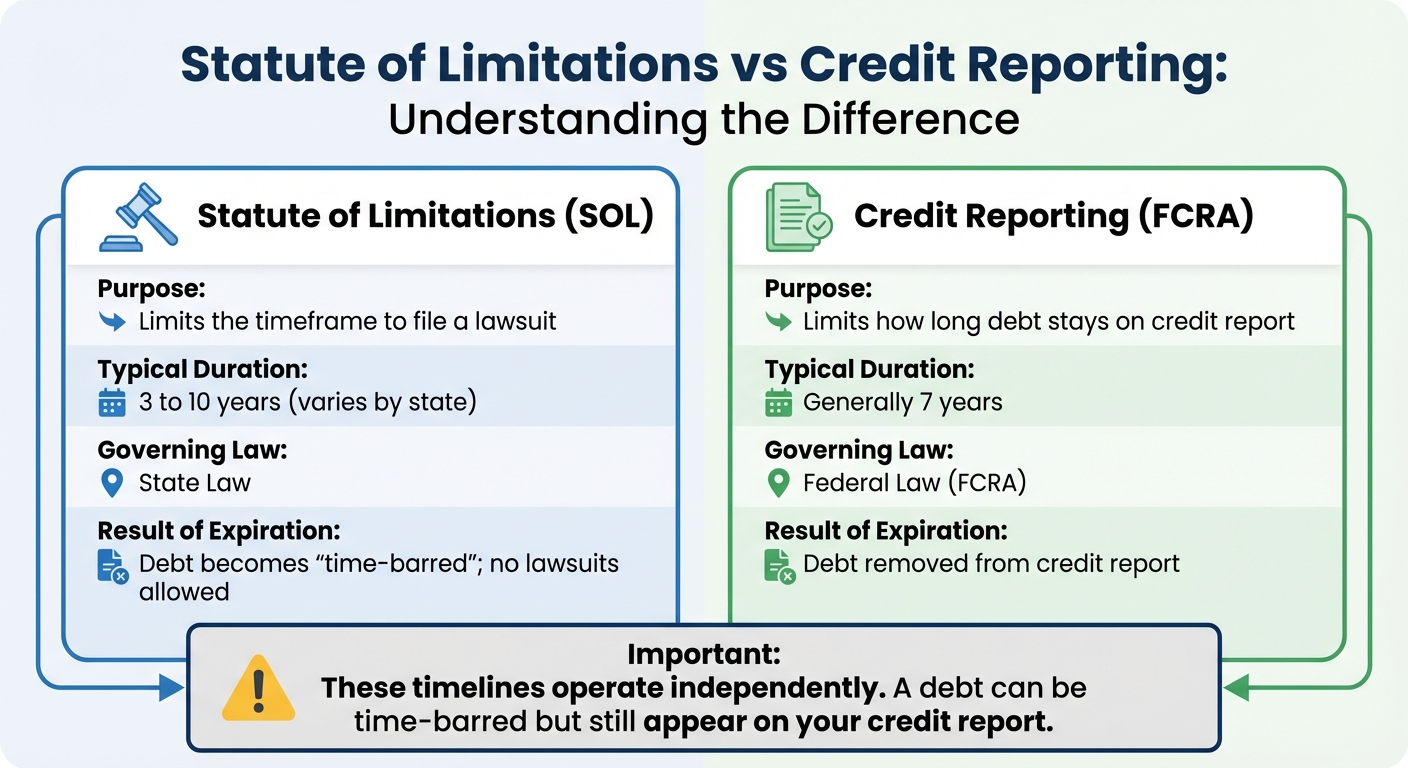
Statute of Limitations vs Credit Reporting Timeline for Credit Card Debt
The statute of limitations (SOL) refers to the legal deadline by which a creditor or debt collector can file a lawsuit to recover unpaid debt. This deadline doesn’t erase the debt itself – it simply prevents creditors from taking legal action after the timeframe has passed.
Once the statute of limitations expires, the debt is considered "time-barred." As attorney Amy Loftsgordon explains, "Once the statute of limitations on a debt has expired… collectors lose their legal right to pursue you in court for repayment. However, the debt itself doesn’t disappear". Even though lawsuits are no longer an option, collectors in most states can still contact you through phone calls or letters to request payment voluntarily.
How the Statute of Limitations Works
While the statute of limitations blocks creditors from filing lawsuits, it doesn’t stop all collection efforts. After the deadline passes, creditors lose access to legal tools like wage garnishment, bank account levies, and property seizure. However, they can still attempt to collect through non-legal means, such as sending letters or making phone calls.
It’s also worth noting that the statute of limitations doesn’t automatically protect you in court. If you’re sued for a time-barred debt, you need to actively respond and cite the expired statute of limitations as a defense. Ignoring the lawsuit could result in a default judgment, allowing the creditor to pursue actions like garnishing your wages or freezing your bank accounts.
Additionally, the federal Fair Debt Collection Practices Act (FDCPA) offers protection by barring debt collectors from suing or even threatening to sue over time-barred debt. As Nolo explains:
"A statute of limitations usually doesn’t eliminate the debt; it just limits the collector’s ability to win a court case".
Federal vs. State Laws
The statute of limitations for credit card debt is determined by state laws, not federal ones. Each state sets its own timeframe, typically ranging between 3 and 10 years. For instance, about 13 states have a short 3-year statute of limitations for credit card debt.
While state laws dictate how long creditors have to sue, federal laws like the FDCPA regulate how creditors and collectors can interact with you. The FDCPA prohibits harassment, false claims, and lawsuits on expired debts.
| Concept | Statute of Limitations (SOL) | Credit Reporting (FCRA) |
|---|---|---|
| Purpose | Limits the timeframe to file a lawsuit | Limits how long debt stays on credit report |
| Typical Duration | 3 to 10 years (varies by state) | Generally 7 years |
| Governing Law | State Law | Federal Law (FCRA) |
| Result of Expiration | Debt becomes "time-barred"; no lawsuits allowed | Debt removed from credit report |
It’s important to note that the statute of limitations and credit reporting timelines operate independently. Even if a debt is time-barred, it can still remain on your credit report for up to 7 years. Understanding how these timelines work together can help you navigate the legal and financial implications of unpaid credit card debt.
How the Statute of Limitations Varies by State
The statute of limitations for credit card debt isn’t one-size-fits-all – it changes depending on where you live. Across the U.S., these timeframes typically fall between 3 to 10 years. For instance, 13 states stick to a 3-year limit, while just 2 states extend it to 10 years. How a state classifies credit card debt also matters. Some treat it as an open-ended account (with shorter deadlines), while others see it as a written contract (which usually means more time).
State-by-State Timeframes
Where you live has a big impact on the legal timeline for credit card debt. For example, California and Texas enforce a 4-year limit, while Delaware, Maryland, and North Carolina cap it at 3 years. At the far end, Rhode Island allows up to 10 years. Notably, New York recently reduced its statute to 3 years under the Consumer Credit Fairness Act.
Some states have unique quirks. Georgia, for example, reclassified credit card debt in 2008, shifting it from an open-ended account to a written contract. That change extended the statute of limitations from 4 to 6 years, a decision later upheld in the case of Phoenix Recovery Group, Inc. v. Mehta.
"It’s important that you understand the laws based on the state where you reside. As a consumer, you have rights and do not want to concede them to collection activity that’s not legal".
Choice-of-Law Clauses in Credit Agreements
State laws are just part of the picture. Many credit card agreements include choice-of-law clauses, which let issuers decide which state’s rules apply. This can override local statutes. For example:
- Chase uses Delaware law (3 years).
- American Express follows Utah law, and Citi opts for South Dakota law – both generally enforce a 6-year limit.
- Capital One applies Virginia law (3 years), unless the cardholder’s state has a longer timeframe.
This means that even if your home state’s statute of limitations has expired, the debt might still be collectible under the terms of your credit agreement if it references a state with a longer limit. Understanding these clauses is key to knowing your rights.
When Does the Statute of Limitations Begin?
The statute of limitations kicks off when you breach your credit agreement – this usually happens when you stop making the required payments. At that point, creditors gain the legal right to sue for the unpaid balance.
Date of Last Payment vs. First Missed Payment
The exact moment the clock starts ticking can depend on your state’s laws and the terms of your credit card agreement. For instance, it might begin on the due date of your first missed payment, the date of your last payment, or even the date of your most recent purchase on the account. In many states, the first missed payment’s due date is the starting point. However, some states delay the countdown until six months after your last payment.
"The statute of limitations clock starts ticking when a cause of action ‘accrues.’ This usually means when you ‘breach,’ or break, the contract by not doing something you agreed to, such as not making a payment."
- Amy Loftsgordon, Attorney, Nolo
Because state laws often define these trigger dates differently, it’s crucial to understand your local regulations. Knowing when the clock starts is essential, but keep in mind that certain actions can reset it entirely.
How to Restart the Clock
Certain actions can reset the statute of limitations, essentially starting the countdown over again:
- Making a partial payment
- Acknowledging the debt, either in writing or verbally
- Agreeing to a new payment plan
"Any new activity on it could re-age it and make it more collectable. You’re better off ignoring a call about an ancient debt. It’s best to send them a letter saying I don’t recognize this or please verify it."
- Lauren Saunders, Managing Attorney, National Consumer Law Center
Before engaging with collectors about old debts, confirm the date of your last payment or transaction. Avoid acknowledging the debt or making any payments until you’re sure the statute of limitations hasn’t already expired.
What Happens After the Statute of Limitations Expires?
When the statute of limitations on a debt expires, creditors lose their legal right to sue for repayment, but the debt itself doesn’t just disappear. Instead, it becomes unenforceable in court, meaning creditors can no longer use lawsuits to collect it. However, the debt remains valid, and creditors can still request voluntary payment.
Debt Collection Efforts After Expiration
Even though a debt is time-barred, collection agencies may still contact you through phone calls, letters, or emails. The Fair Debt Collection Practices Act (FDCPA) protects you from certain actions during this time:
"The federal FDCPA prohibits a debt collector from bringing or threatening to bring a legal action against a consumer to collect a time-barred debt." – 12 C.F.R. § 1006.26(b)
If a collector files a lawsuit for an expired debt, it’s crucial to respond in court and assert the expired statute of limitations as your defense. Ignoring the lawsuit could lead to a default judgment against you. In some states, like Mississippi, North Carolina, and Wisconsin, once the statute expires, the debt is completely extinguished, and collectors must cease all efforts to collect it.
A common issue arises when old debts, often referred to as "zombie debts", are sold to third-party collectors. These collectors buy debts for pennies on the dollar – sometimes as little as 2 cents per dollar – and attempt to collect, often banking on the fact that consumers may not know the debt is no longer enforceable. If a collector threatens legal action over a time-barred debt, you can report them to the Consumer Financial Protection Bureau (CFPB) or your state’s attorney general for violating the law.
Impact on Credit Reports
The expiration of the statute of limitations doesn’t erase the debt from your credit report. Debt and credit reporting follow separate timelines. For example, unpaid credit card debt typically stays on your credit report for 7 years from the date of your first missed payment, regardless of whether the debt is legally enforceable.
Even after the statute of limitations has expired, collectors can report the debt to credit bureaus under the Fair Credit Reporting Act (FCRA). However, be on the lookout for illegal practices like "re-aging", where collectors alter the original delinquency date to keep the debt on your credit report longer than permitted. If you notice this happening, dispute it with the credit bureaus immediately to protect your credit score.
How to Protect Yourself from Debt Collector Violations
Understanding your rights under the Fair Debt Collection Practices Act (FDCPA) is the first step in defending yourself against illegal or overly aggressive debt collection practices. The Federal Trade Commission explains:
The Fair Debt Collection Practices Act (FDCPA) makes it illegal for debt collectors to use abusive, unfair, or deceptive practices when they collect debts.
When dealing with time-barred debt, taking specific actions can protect your financial well-being and help you navigate potential legal challenges.
Using the Statute of Limitations as a Defense
If you’re sued for time-barred debt, you must raise the statute of limitations as your defense. Courts don’t automatically dismiss these cases. The Consumer Financial Protection Bureau emphasizes:
A court may still award a judgment against you if you don’t show up and raise the statute of limitations as a defense. Ordinarily, it’s the responsibility of the person being sued to point out that the statute of limitations has expired.
Ignoring a lawsuit – even for an old debt – can lead to a default judgment, which might allow collectors to garnish your wages or seize funds from your bank account. To avoid this, file an answer with the court and provide proof of your last payment or account activity to show the debt is time-barred. If you successfully bring an FDCPA case against a collector, a judge could award you up to $1,000 in damages, even without evidence of financial harm .
Once you’ve addressed the lawsuit, focus on securing written confirmation of the debt.
Requesting Debt Validation
You have the right to request a debt validation letter within 30 days of the collector’s initial contact. This letter must include details such as the amount owed, the name of the creditor, and instructions for disputing the debt. If you dispute the debt in writing, the collector must halt collection efforts until they provide written verification.
To protect yourself, send your dispute or validation request via certified mail with a return receipt. This creates a record proving the collector received your request, which can be essential if you need to demonstrate an FDCPA violation later. Additionally, if a collector asks whether you acknowledge the debt, remember that they are required to truthfully answer if you inquire whether the debt is time-barred, though they might choose not to respond.
Avoiding Actions That Restart the Clock
Certain actions can unintentionally restart the statute of limitations, as highlighted in the "When Does the Statute of Limitations Begin?" section. Avoid these common pitfalls:
| Action | Impact on the Statute of Limitations |
|---|---|
| Partial payment | Restarts the clock |
| Verbal or written acknowledgment | May reset the period |
| New charge on open account | Resets the clock |
| Signing a waiver document | Forfeits your defense right |
NerdWallet cautions:
Making even a single payment on time-barred debt can be the lightning bolt that brings it back from the dead and resets the statute of limitations.
Before engaging with a collector, confirm the debt’s age. Avoid making small payments just to stop collection calls, as this could unintentionally reset the statute of limitations. If you’re unsure about your rights or next steps, consult a consumer rights attorney before making promises or signing agreements with a collector.
Understanding Time-Barred Debt and Your Options
When the statute of limitations on your credit card debt runs out, you’re faced with a decision. While the debt doesn’t just vanish – you still owe it – creditors lose the legal ability to sue you over it. Knowing your options and the potential consequences of each can help you make choices that fit your financial situation.
Options for Dealing with Time-Barred Debt
Here are four ways to handle debt that’s past its legal collection window:
- Paying nothing: Since collectors can’t sue you, you’re not legally required to pay. However, they might still contact you unless you send a cease communications letter. It’s important to note that unpaid delinquent debt can continue to impact your credit score for up to seven years from the date of the first missed payment. As Jennifer Calonia from US News explains:
The decision to pay the debt then falls on you.
- Paying the debt in full: If you choose to pay the full amount, collection efforts will stop immediately, and you’ll avoid further harm to your credit. Many people take this route, especially if they’re planning major purchases like a car or home and want to improve their credit standing.
- Negotiating a settlement: You might be able to settle the debt for less than what you owe, sometimes for as little as 30% to 50% of the original balance. Be cautious, though – making a partial payment without securing a settlement agreement could reset the statute of limitations. Always get a signed agreement confirming the payment will fully settle the debt.
- Disputing the debt: If you’re unsure about the validity of the debt, you can request verification within 30 days. This ensures the debt is accurate and belongs to you before you take any further steps.
These options can help you navigate time-barred debt, but there’s an additional wrinkle to consider if a court judgment was issued before the statute of limitations expired.
Risks of Court Judgments Beyond the Statute of Limitations
If a creditor obtained a court judgment against you before the statute of limitations ran out, the situation becomes more complicated. Judgments often extend the collection period significantly. Joey Johnston from InCharge Debt Solutions cautions:
If you don’t show up in court, you lose. Case closed. A judgment will be awarded against you.
The length of time creditors can enforce a judgment varies widely by state – from as short as 3 years in Oklahoma to as long as 21 years in Ohio. Additionally, judgments can often be renewed. For example, Maryland’s People’s Law Library notes:
A creditor can ‘renew’ a debt at any time within the 12 years following the entry of a judgment.
Judgments give creditors more aggressive collection tools, such as wage garnishment, property liens, or even asset seizure. Interest can also continue to accrue, with rates ranging from 4% above the Federal rate in Kansas to 14% in South Dakota. In Maryland, government debts tied to judgments are enforceable indefinitely.
Before deciding how to proceed, weigh the financial and personal impact of each option carefully. If you’re unsure where to start, visit Steps To Be Debt Free (https://debtloansrelief.com) for detailed resources and guidance tailored to your situation.
Conclusion
Knowing the statute of limitations on credit card debt is a key part of staying on top of your finances. This timeframe – usually between 3 and 10 years, depending on your state – dictates how long a creditor can legally sue you to recover unpaid debt. Once this period runs out, the debt becomes "time-barred", meaning collectors can no longer secure a court judgment or use measures like wage garnishment or bank levies.
To protect yourself, it’s essential to confirm the age of the debt before making any payments, respond to lawsuits (even for old debts), and avoid actions that might restart the clock. As Teresa Dodson, Debt Expert and Founder of Greenbacks Consulting, advises:
It’s important that you understand the laws based on the state where you reside. As a consumer, you have rights and do not want to concede them to collection activity that’s not legal.
Keep in mind, though, that even time-barred debts can linger on your credit report, potentially affecting your credit score for up to seven years from the date of the first missed payment.
If you’re unsure how to handle your credit card debt, consider visiting Steps To Be Debt Free (https://debtloansrelief.com). They offer a clear process to evaluate your situation and explore your options. Understanding the statute of limitations gives you the upper hand when dealing with collectors and helps you take charge of your financial future.
FAQs
How do I find out the statute of limitations on credit card debt in my state?
The time frame for the statute of limitations on credit card debt depends on the state you live in. To find out the specific rules in your area, you can reach out to your state attorney general’s office or consult with a local attorney. There are also plenty of online resources that offer state-by-state breakdowns of debt collection time limits, providing a clearer picture of your rights and responsibilities.
It’s important to note that the statute of limitations doesn’t erase your debt – it simply limits the time a creditor has to take legal action to collect it. Understanding this timeline can be a key part of making informed decisions about how to handle your credit card debt.
What activities can restart the statute of limitations on credit card debt?
Certain actions can reset the statute of limitations on your credit card debt, depending on the laws in your state. These actions include:
- Making any payment toward the debt, even a partial one
- Admitting you owe the debt, either in writing or verbally
- Agreeing to a new repayment plan or terms
When any of these happen, the clock on the statute of limitations can restart, potentially giving creditors more time to pursue legal action against you. If you’re unsure how this applies to your situation, it’s a good idea to consult a financial expert or check your state’s specific regulations.
How does the statute of limitations impact my credit card debt?
The statute of limitations determines how long creditors or debt collectors have to legally sue you over unpaid credit card debt. Once this time frame passes, they can no longer take legal action against you. However, they might still reach out or try to collect the debt through non-legal channels.
This time limit isn’t the same everywhere – it depends on your state. In most cases, it falls between 3 to 6 years, though some states allow for longer periods. Be careful if you’re dealing with old debts: making a payment or even acknowledging the debt could reset the statute of limitations, giving collectors more time to take legal action.
