
Community debt relief programs help people manage and reduce debt through strategies like lowering interest rates, consolidating payments, and renegotiating terms. These programs, often run by nonprofits and government agencies, aim to provide financial stability without profit motives. With U.S. household debt reaching $18.8 trillion by late 2025, these services have become essential for many.
Key Takeaways:
- Debt Management Plans (DMPs): Combine debts into one payment, reduce interest rates, and waive fees. Typically completed in 3-5 years.
- Debt Settlement: Negotiates reduced debt balances but may harm credit scores and result in taxable forgiven debt.
- Local Assistance Programs: Offer support for living expenses (e.g., SNAP, LIHEAP) to free up money for debt repayment.
Benefits:
- Reduced interest rates and fees.
- Consolidated monthly payments.
- Improved credit scores for many participants.
Drawbacks:
- Potential credit score impact.
- Fees for enrollment and maintenance.
- Taxable forgiven debt in some cases.
Debt relief programs offer structured solutions for those struggling with unsecured debts like credit cards or medical bills. Start by consulting a certified nonprofit credit counselor to explore your options.
Community groups help residents tackle debt and credit challenges
sbb-itb-2a9374f
Types of Community Debt Relief Programs
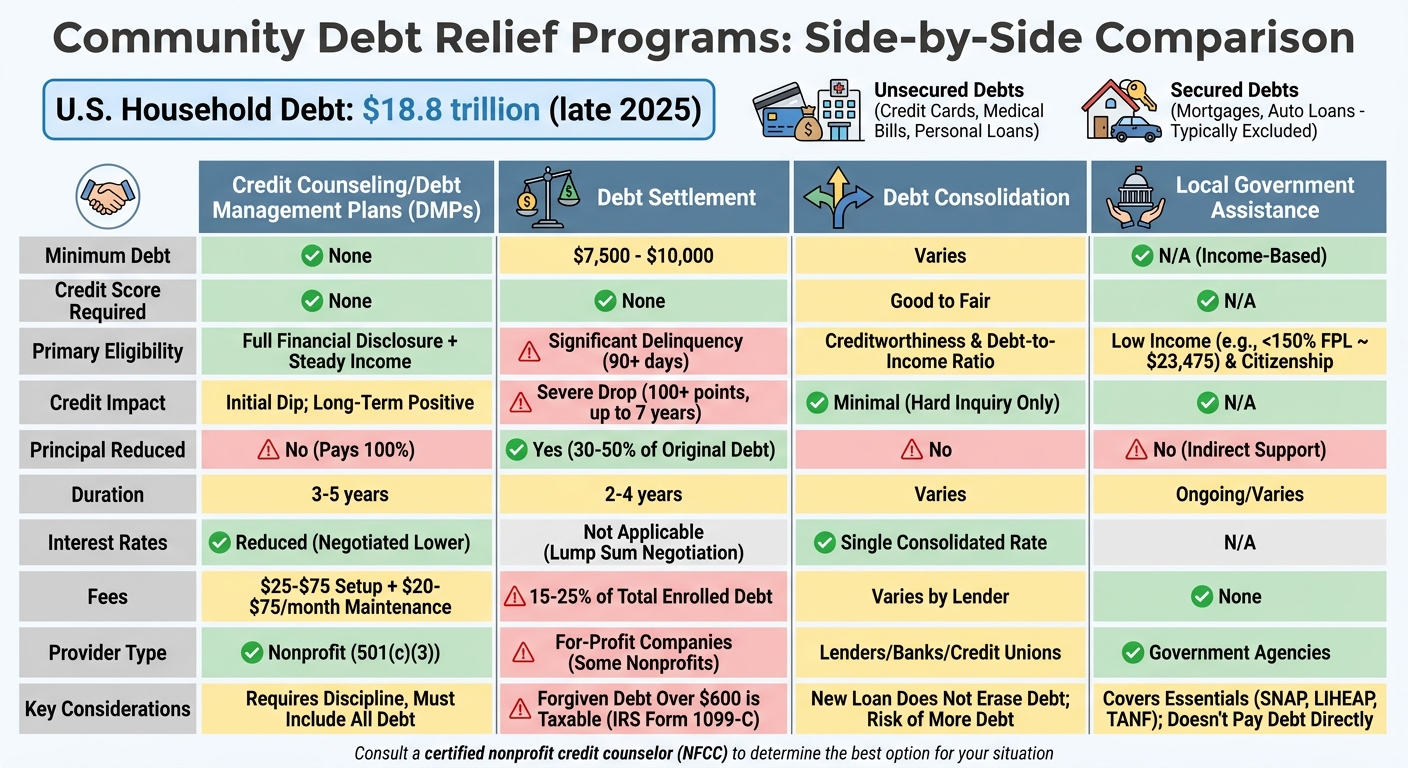
Comparison of Debt Relief Program Types: Requirements, Credit Impact, and Duration
When it comes to managing financial struggles, community debt relief programs offer several paths tailored to different needs. Let’s break down the main options available and how they work.
Credit Counseling and Debt Management Plans
Nonprofit credit counseling agencies provide free financial evaluations and connect you with certified counselors who can analyze your financial situation. If it’s a good fit, they may recommend a Debt Management Plan (DMP). Under a DMP, the agency negotiates with your creditors to reduce interest rates and waive late fees. You then make one consolidated monthly payment to the agency, which distributes the funds to your creditors over a period of 36–60 months.
One of the biggest perks of a DMP is that it focuses on paying back 100% of the principal balance while reducing interest rates. This approach is often more appealing to creditors. To ensure you’re working with a legitimate organization, confirm the agency is a 501(c)(3) nonprofit and employs counselors certified by the National Foundation for Credit Counseling (NFCC). While this option is structured and reliable, it’s worth noting that other strategies, like debt settlement, may suit different financial goals.
Debt Settlement Programs
Debt settlement is often managed by for-profit companies that charge fees ranging from 15–25% of the total debt. Some nonprofit organizations also offer programs such as "Credit Card Debt Forgiveness", where they negotiate with creditors to accept less than the full amount owed. This usually involves paying a portion of the balance over 36 fixed payments.
However, debt settlement comes with some risks. It can cause a significant drop in your credit score – sometimes by 100 points or more. On top of that, negotiations with creditors aren’t guaranteed and could lead to increased interest rates or even legal action. Another consideration: any forgiven debt might be treated as taxable income by the IRS, leading to an unexpected tax bill. Despite these drawbacks, debt settlement might be an option for those looking for immediate relief from overwhelming debt.
For those who need help with daily expenses rather than direct debt relief, local assistance programs can provide valuable support.
Local Government and Nonprofit Assistance Funds
While these programs don’t directly eliminate credit card debt, they ease financial pressure by covering essential living costs. Programs like LIHEAP (for energy assistance), TANF (Temporary Assistance for Needy Families), and SNAP (Supplemental Nutrition Assistance Program) can reduce your monthly expenses, freeing up money to put toward debt repayment. Additionally, many faith-based organizations and local governments offer resources like emergency utility payments, property tax relief, and housing vouchers for those in need.
For example, in 2026, individuals earning up to 130% of the Federal Poverty Level (around $20,345 for a single-person household) may qualify for SNAP benefits. You can check eligibility for these programs through Benefits.gov or your state’s health and human services website. These initiatives aim to tackle the root causes of financial stress, helping to create a more stable financial future.
Eligibility and Application Process for Debt Relief Programs
Common Eligibility Requirements
The first step is identifying the types of debts that qualify. Most programs focus on unsecured debts, such as credit cards, medical bills, personal loans, and private student loans. Secured debts, like mortgages and auto loans, are typically excluded from these programs.
Financial qualifications depend on the program. For Credit Counseling and Debt Management Plans, you’ll need proof of a steady, verifiable income to ensure you can make regular payments. These programs don’t typically require a minimum debt amount or credit score. On the other hand, Debt Settlement Programs often require a minimum unsecured debt balance, generally between $7,500 and $10,000. Many programs also require evidence of financial hardship, such as job loss, reduced income, divorce, or unexpected medical expenses. For government-administered programs, applicants must usually be American citizens or legal permanent residents, with their income not exceeding 150% of the federal poverty guidelines (approximately $23,475 for a single individual in 2026).
Here’s a quick breakdown of common program requirements:
| Program Type | Minimum Debt | Credit Score Req. | Primary Eligibility Factor |
|---|---|---|---|
| Credit Counseling | None | None | Willingness to provide full financial disclosure |
| Debt Management | Varies | None | Steady income for monthly payments |
| Debt Settlement | $7,500 – $10,000 | None | Significant delinquency (90+ days) |
| Debt Consolidation | Varies | Good to Fair | Creditworthiness and debt-to-income ratio |
These criteria help ensure that debt relief programs are targeted at individuals who need structured, supportive solutions for managing their financial challenges.
Step-by-Step Application Process
Once you confirm your eligibility, follow these steps to apply for a debt relief program:
- Gather Financial Records: Collect income documentation, a list of creditors, and a detailed record of your monthly expenses over 30 days. This will help you create an accurate budget.
- Schedule a Free Counseling Session: Meet with a certified financial counselor to review your finances. They’ll recommend the most suitable relief option based on your situation. Be completely transparent during this process – hiding financial details can lead to denial, especially for government-sponsored programs.
- Enroll in a Tailored Plan: Once a plan is recommended, agree to it and enroll right away. You’ll stop making direct payments to creditors and instead make a single monthly payment to the program provider. From there, they’ll negotiate with your creditors to lower interest rates, waive fees, or settle debts. This structured approach typically spans three to five years.
- Verify Accreditation: Ensure the agency you’re working with is accredited to protect your personal and financial information.
- For Government Programs: If applying for a government debt relief program, continue making your current payments while your application is processed. Skipping payments could disqualify you from the program.
Benefits and Drawbacks of Community Debt Relief Programs
Building on the eligibility and application process, let’s dive into the practical advantages and challenges these programs present.
Benefits of Debt Relief Programs
Community debt relief programs can make a real difference for individuals facing overwhelming debt. A standout benefit is the chance to secure lower interest rates and waived fees. Through Debt Management Plans (DMPs), creditors often agree to reduce rates and eliminate late charges, helping borrowers focus on paying down the principal instead of just chipping away at interest. These programs also consolidate multiple debts into a single, manageable monthly payment.
Another plus? Certified counselors provide tailored advice to help participants avoid falling back into debt. Many programs also shield participants from aggressive collection efforts, including constant calls and harassment from creditors. For those pursuing debt settlement, there’s even the possibility of debt forgiveness – in some cases, borrowers might pay only 30% to 50% of what they originally owed.
While participation in these programs can initially lower your credit score, structured repayment plans like DMPs often lead to long-term credit improvement. This is because they help establish a consistent payment history over time, typically within three to five years – a crucial factor since payment history makes up 35% of your FICO Score.
Drawbacks and Considerations
Despite the benefits, there are some downsides to consider before enrolling. For instance, debt settlement can significantly harm your credit score, sometimes dropping it by more than 100 points. These negative marks can linger on your credit report for up to seven years. Additionally, programs like DMPs often require you to close your credit card accounts, which could temporarily hurt your credit utilization ratio and limit your access to emergency funds.
Another important consideration is tax liability. The IRS treats forgiven debt as taxable income, meaning you’ll need to account for it when filing taxes. Creditors are required to report any cancelled debt over $600 using Form 1099-C. Moreover, creditors aren’t obligated to negotiate – they could choose to sue or garnish wages instead.
Costs can also add up. DMPs typically involve a setup fee ranging from $25 to $75, plus monthly maintenance fees of $20 to $75. For-profit debt settlement services are even pricier, often charging 15%–25% of the total enrolled debt. Some settlements may also come with high upfront or administrative fees, which can range from $500 to $3,000 or more. Lastly, most DMPs require a commitment of three to five years, demanding both financial discipline and a stable income to see the program through.
| Program Type | Typical Credit Impact | Principal Reduced? | Duration |
|---|---|---|---|
| Debt Management Plan | Initial dip; long-term positive | No | 3–5 Years |
| Debt Settlement | Severe drop (100+ points) | Yes | 2–4 Years |
| Debt Consolidation | Minimal (hard inquiry) | No | Varies |
How to Find and Access Local Debt Relief Resources
When you’re navigating debt relief, connecting with local programs can make a world of difference. There are plenty of free resources available to help you find certified counselors and community assistance.
Using Online Tools for Debt Assessment
Before diving into local resources, it helps to get a clear picture of your financial situation. The website Steps To Be Debt Free (https://debtloansrelief.com) offers a free debt review tool. This tool walks you through an organized assessment of your debt levels, payment history, and personal details. Based on your input, it provides tailored recommendations – whether that’s a Debt Management Plan, debt settlement, or emergency assistance options.
Completing this assessment also ensures you’re prepared with the necessary documentation for applications, which can save time during the process.
Once you’ve done your online assessment, you can use referral services to connect with community and government resources directly.
Community and Government Resources
One of the simplest ways to access local assistance is by dialing 2-1-1. This service connects you to Community Action Agencies offering help with rent, utilities, and emergencies. Case managers can guide you through eligibility requirements and applications for programs like LIHEAP and TANF.
For housing-related concerns, the Consumer Financial Protection Bureau has an interactive tool at consumerfinance.gov/find-a-housing-counselor. This tool helps you locate HUD-approved housing counseling agencies. Alternatively, you can call 800-569-4287 to speak with a HUD-certified counselor at no cost. If you’re exploring bankruptcy as an option, the U.S. Trustee Program‘s website provides a state-by-state list of approved credit counseling agencies.
For broader credit counseling needs, the National Foundation for Credit Counseling (NFCC) offers an agency finder at nfcc.org/agency-finder. With over 1,500 certified counselors, the NFCC has assisted millions of people since 2006. Before working with any organization, ask key questions like, "Are you licensed to operate in this state?" and "Do you provide free educational materials?". You can also verify credentials and check for complaints through your State Attorney General or local consumer protection agency.
| Resource Type | Organization/Tool | Contact/URL |
|---|---|---|
| Local Assistance | 2-1-1 Referral Service | Call 2-1-1 |
| Housing/Mortgage | HUD-Approved Agency List | hud.gov/program_offices/housing/sfh/hcc/hcc_home |
| Credit Counseling | NFCC Agency Finder | nfcc.org/agency-finder |
| Bankruptcy Help | U.S. Trustee Program | justice.gov/ust |
| Debt Assessment | Steps To Be Debt Free | debtloansrelief.com |
Success Stories: Real Results from Community Debt Relief Programs
Here are some real-life examples showcasing how community debt relief programs are making a difference in people’s lives.
Community debt relief programs, particularly those focused on medical debt forgiveness, have brought meaningful change to families across the U.S. Funded by initiatives like the American Rescue Plan Act, these programs don’t just eliminate debt – they improve mental health and financial stability. The following examples highlight the real-world impact of these efforts.
In Cincinnati, the Financial Freedom Blueprint pilot program made a significant difference for residents like Lois Faye from Westwood. In September 2025, Lois had $2,500 in medical debt forgiven thanks to this initiative. The program, in collaboration with Undue Medical Debt, targeted individuals earning up to 400% of the federal poverty level. Lois described the relief:
It felt like a weight was lifted off my shoulders – it improved both my credit and my peace of mind.
With a $1.45 million investment, Cincinnati managed to erase nearly $220 million in medical debt, benefiting about one-third of the city’s population.
Columbus also saw impressive outcomes. In October 2023, the city completed its Medical Debt Relief initiative, wiping out $335 million in debt for 340,660 households, averaging $984 per person. By using just $500,000 in ARPA funds for administrative costs, and with hospitals like Ohio State University Wexner Medical Center and Nationwide Children’s Hospital forgiving the debt directly, the program achieved a $1 to $670 return on investment.
Credit card debt relief programs have also proven effective. Tiana Moore, an operating room nurse from New Britain, Connecticut, found herself overwhelmed with $21,000 in credit card debt after being furloughed during the pandemic. Between 2020 and 2024, she partnered with Money Management International (MMI), which negotiated her interest rates down from 29% to 0%. Over four years, Tiana avoided bankruptcy and saved an estimated $33,000 in interest payments. Reflecting on her journey, she shared:
I actually busted out the old-school checkbook, and I’m writing out all my expenses… I feel amazing. It’s great to know that now I can invest in my future and my children’s future.
In Toledo, social worker Amber Clapsaddle received life-changing news in April 2024. A $1,500 medical bill from three years earlier was completely forgiven through the city’s partnership with Undue Medical Debt. Using $1.6 million in combined ARPA and county funds, Toledo and Lucas County eliminated $72 million in debt for 35,000 residents. On a broader scale, the program impacted 113,000 people in the region, erasing $230 million in debt.
These examples clearly show how community-driven initiatives can create lasting financial stability and peace of mind for those in need.
Conclusion: Achieving Financial Freedom through Community Support
Getting out of debt takes a mix of practical steps and focused actions that shift your financial situation from overwhelming to manageable. The strategies in this guide work because they combine expert advice, structured repayment plans, and local resources to tackle both immediate financial issues and the behaviors that may have contributed to them.
To begin, take a close look at your finances. This final review will help you determine whether you’re dealing with a temporary hurdle or a more serious issue that might need professional help. Once you’ve assessed your situation, consider meeting with a certified nonprofit credit counselor from the National Foundation for Credit Counseling (NFCC) or the Financial Counseling Association of America (FCAA). These professionals can guide you through your options.
Platforms like Steps To Be Debt Free (https://debtloansrelief.com) offer a free, step-by-step debt evaluation. This tool helps identify the best relief strategy for your situation – whether that’s a Debt Management Plan, negotiating directly with creditors, or accessing local government assistance programs. Starting with this kind of assessment sets the stage for building healthier financial habits.
Paying off debt is just one part of the equation. For long-term stability, consider setting aside $10–$25 per week to build an emergency fund and avoid using credit cards while working through your relief plan. These small but consistent habits can help ensure that once you’re out of debt, you stay out. As personal finance author Robert Shaw wisely notes:
Wishing away debt without a solid plan guarantees failure.
The combination of professional guidance and community resources is what makes these strategies effective. Programs like these offer access to creditor mediation, legal protections under the FDCPA, and support systems that address the deeper causes of financial stress. Together, these tools and resources create a comprehensive path to lasting financial freedom.
FAQs
Will I have to close my credit cards?
In many community debt relief programs, such as debt management plans, you usually don’t have to close your credit cards. Nonprofit credit counseling agencies often collaborate with your existing accounts to negotiate lower interest rates. However, some creditors might recommend closing specific accounts, especially if they’re not part of the plan or could contribute to additional debt. It’s a good idea to discuss this with your counselor to figure out the best course of action for your situation.
Which debts won’t qualify for these programs?
Community debt relief programs often don’t cover medical debts unless they fall under specific federal, state, or nonprofit forgiveness initiatives. Additionally, debts owed to private creditors who choose not to participate in these programs are usually excluded as well.
How do I avoid debt relief scams?
To steer clear of debt relief scams, keep an eye out for red flags like upfront fees or promises of quick and easy debt forgiveness. Legitimate organizations will always provide free information before diving into your financial details and will never ask for payment before resolving your debts.
Be especially wary of unsolicited calls or texts asking for personal or financial information. Instead, turn to trusted resources like credit unions or community colleges, which often provide free or low-cost financial advice. Always take the time to verify credentials, and remember – never pay for services in advance.
