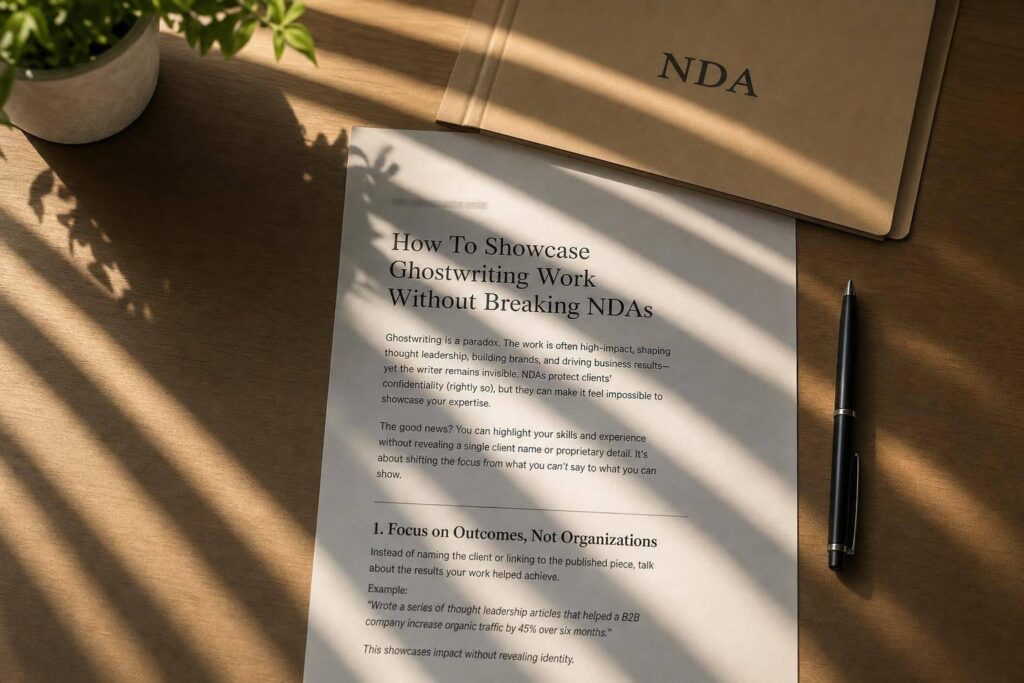
Yes, you can show ghostwriting experience without breaking an NDA. I’d do it in this order: check the contract, get written permission if the terms are unclear, build samples I own, use anonymized summaries for past work, and share sensitive material only in private.
Here’s the short version:
- Read the agreement first. NDAs, work-for-hire terms, and IP transfer clauses often block public sharing.
- Don’t assume published work is fair game. If the client owns it, I still may not be allowed to claim or display it.
- Use spec samples when in doubt. They take more time, but I own them from start to finish.
- Swap client names for summaries. I can describe scope, format, and outcomes without naming the client.
- Use testimonials with permission. A short quote about voice, deadlines, or process can help a lot.
- Keep risky samples private. View-only links, expiration dates, and
noindexpages cut exposure.
A few details matter more than most people think. Even without a client name, a narrow niche, a 40,000-word project, or a launch date can point back to one person or company. That’s where many ghostwriters slip up.
If I had to boil the whole thing down to one rule, it would be this: show the least amount of client detail needed to prove I can do the job.
| Option | Risk Level | What It Proves | Best Use |
|---|---|---|---|
| Spec samples | Low | Writing skill and format fit | New niche or strict NDA work |
| Anonymized summaries | Low to medium | Scope, process, and results | B2B, executive, or book work |
| Testimonials | Medium | Social proof | Building trust fast |
| Private excerpts | Medium to high | Direct sample quality | Only with clear approval |
So if I can’t post the work itself, I can still show that I know how to write it, shape it, and deliver it without putting a client at risk.
How to build a ghostwriting portfolio as a beginner | create a ghost writer portfolio for more jobs
Check Your Contract Before You Share Anything
Before you mention a past project on your website, LinkedIn, or anywhere else, read the signed agreement first. Even a harmless mention can breach the contract.
That review shows you what kind of portfolio sample is allowed: a public clip, a private sample, or nothing at all. The point isn’t to hide your work. It’s to show it within the limits of the deal. Let the contract tell you what you can share.
Find the portfolio rights, confidentiality limits, and ownership clauses
When you’re trying to figure out what belongs in your portfolio, four clauses matter most:
| Contract Clause | What It Means for Your Portfolio | What To Do |
|---|---|---|
| Confidentiality / NDA | Blocks public disclosure unless permission is written into the contract. | Request written permission before sharing anything. |
| Work-for-Hire | The client owns 100% of the work, which can make it hard to use as a sample. | Do not claim authorship without explicit written permission. |
| IP Assignment | Rights transfer to the client, often upon creation. | Check whether IP transfers at creation or after full payment; the timing changes what you can safely claim. |
| Testimonial Release | Allows you to use client reviews in marketing. | Make sure it is signed separately from the main contract. |
Also check for a portfolio carve-out. That’s a clause that gives you permission to display or describe your deliverables in marketing materials.
If it’s there, read the fine print. Some carve-outs come with conditions, like confidentiality limits or client approval before anything goes live. Keep signed copies, and keep a one-line note about each client’s permissions. That small habit can save you a lot of stress later.
If the contract feels vague, ask before you build your portfolio around it.
Ask for written permission when the contract is unclear
If the contract says nothing about portfolio rights, don’t treat that silence as a yes. Reach out in a professional way and ask for limited written permission.
A good starting point is simple: ask to share a short, sanitized excerpt with all identifying details removed, and use it for private sharing only.
Ask for permission to share a redacted sample privately, without the client’s name or project title. If they say no, respect that and move on.
Know when to get legal advice
Ghostwriting, book, and corporate contracts often come with tighter confidentiality and ownership terms. That’s where legal review makes sense, especially for high-value corporate work, book deals, or dense contracts.
Once you know the limits, you can build NDA-safe samples within them.
Build NDA-Safe Samples That Still Show Real Ability
Once the contract limits are clear, the next move is simple: build proof from work you own. Spec samples do exactly that. They let you show what you can do with original pieces you create yourself.
Write spec samples for the niches you want to work in
A spec sample is original work made to show your skill in a niche you want to target. You control it from start to finish. So if you want to ghostwrite business books for executives, write a sample chapter in that voice.
Format matters just as much as topic. Clients buy specific deliverables, so your samples should look like the work they already pay for.
| Sample Type | Best For | Recommended Length |
|---|---|---|
| How-To Guide | Technical/B2B Clients | 500–1,000 words |
| Ultimate Guide | Thought Leaders | 1,000–2,000 words |
| Book Excerpt | Authors/Executives | 1–2 sample chapters |
| Listicle | Bloggers/Digital Brands | 300–500 words |
Use keyword research to spot topics your target clients care about. For article samples, include a clear H1, helpful H2s, and a short CTA. That small touch shows you get the job beyond the writing itself. You understand how content is meant to move a reader, not just fill a page.
When client work is off-limits, anonymized summaries and testimonials can help fill that hole.
Use anonymized project summaries instead of client names
If you’ve done paid client work but can’t show it, use a project summary in place of the sample. The point is to explain the scope and outcome without naming the client.
A line like "Ghostwrote a 35,000-word leadership manuscript for a tech executive; the book supported lead generation" tells a prospect quite a bit. It shows you can handle long-form work, write for executives, and connect the work to business goals. Put this in a private portfolio or proposal, not on a public-facing page.
Keep it tight. Focus on:
- project type
- word count
- industry category
- measurable outcome
Only share results if your contract allows it. If there’s any doubt, skip the metrics and talk about scope and process instead.
Collect testimonials that focus on process and results, not project details
A short endorsement can do a lot when you can’t share samples. People hiring a ghostwriter care about trust, communication, and whether you can match their voice. A testimonial that says you met every deadline and nailed the client’s voice answers those concerns without giving away any private details.
Use testimonials that talk about how you work and what happened as a result, not the details of the project itself. And get written permission before you use any client quote.
"Whenever someone creates ANY type of content – whether it’s written word or video – they own the copyright to that content… even if that ‘content’ is a testimonial for you." – Amber Gilormo, Attorney, The Boutique Lawyer
It also helps to build a simple testimonial release into your offboarding process. A checkbox or short digital form is usually enough, and it saves you from chasing permission later.
If a client can’t give a public quote because of strict confidentiality, ask for a private introduction instead. In many cases, a warm intro to another entrepreneur lands harder than a public endorsement.
Present Your Portfolio in a Private, Professional Way
Organize your portfolio with samples, summaries, and testimonials
Once you have NDA-safe material, put it together in a way prospects can scan fast. Your portfolio should feel like a short, clear case for why someone should hire you. Stick to 3–6 strong pieces and cut anything that feels average.
A simple flow works well: lead with spec samples grouped by niche, follow with anonymized project summaries, and end with a few testimonials. Then add a one-line bio, such as: "I ghostwrite educational email courses for SaaS founders."
For anonymized summaries, use a four-part framework: Challenge / Approach / Process / Results. If you can’t share exact numbers, use ranges or percentages instead.
Use private sharing methods for sensitive materials
If a sample is too sensitive to post in public, shift from public proof to private access. Use view-only links limited to specific email addresses. Add link expiration dates so the material doesn’t stay exposed forever.
If a prospect asks for something more confidential, have them sign a short mutual confidentiality agreement before you send it. And if you host private samples on your own website, mark those pages noindex.
Describe your ghostwriting experience on LinkedIn and your website
Your public profiles should show experience without naming clients. Keep the wording general, but still concrete. Phrases like "ghostwrote long-form nonfiction manuscripts for executives" or "developed thought leadership articles for SaaS founders" do that well. You can also use LinkedIn’s Featured section to link to spec samples or anonymized case studies.
When a prospect pushes for client names, a short refusal is often enough:
"As a ghostwriter, I can’t speak about the exact details of my clients. This works every single time."
sbb-itb-2a9374f
Mistakes To Avoid When Showcasing Ghostwriting Work
Even NDA-safe portfolios can go off the rails when small details give too much away.
Do not share details that identify a client even if the name is removed
The biggest portfolio mistake is sharing details that make a client easy to figure out. Taking out the name isn’t enough. The niche, project scope, timeline, or company size can still point straight to one client.
For example, saying you "ghostwrote a 40,000-word manuscript on financial literacy for medical residents" can still identify the client if the niche is narrow.
The table below shows which details carry the most risk:
| Identifying Detail | Why It Risks Exposure |
|---|---|
| Specific niche or genre | Narrow topics can identify one client fast. |
| Project scope or metrics | Unique deliverables can be traced to public news. |
| Timeline or dates | Dates can match a launch or campaign. |
| Proprietary data | Internal data can reveal the client. |
A simple gut check helps here: could someone in that industry trace this back to one client? If the answer is yes, cut the detail or make it more general.
Publicly available work brings a separate problem: ownership and authorship claims.
Do not treat published work as permission to claim authorship
If a piece has been published, that does not mean you can claim it as your own. Most ghostwriting agreements include a work-for-hire or copyright transfer clause. That means the client owns the rights, and you give up any claim to authorship or public credit.
So even if the work is out in public, the contract still controls what you can say. If it transfers ownership or blocks portfolio use, publication doesn’t wipe out the confidentiality clause. And if the contract doesn’t clearly allow portfolio use, get written permission before you mention the work.
Even private samples can create trouble when they’re shared without the right sign-off.
Do not post private samples publicly without written approval
Posting a client-related excerpt on your website or social media without clear written approval is risky, even if you change names. A password-protected page doesn’t make it safe by default either. Many confidentiality clauses bar disclosure to anyone else, including people viewing a portfolio.
If you don’t have written public-use permission, keep it off public platforms.
Compare Your Main Options for Showing Experience
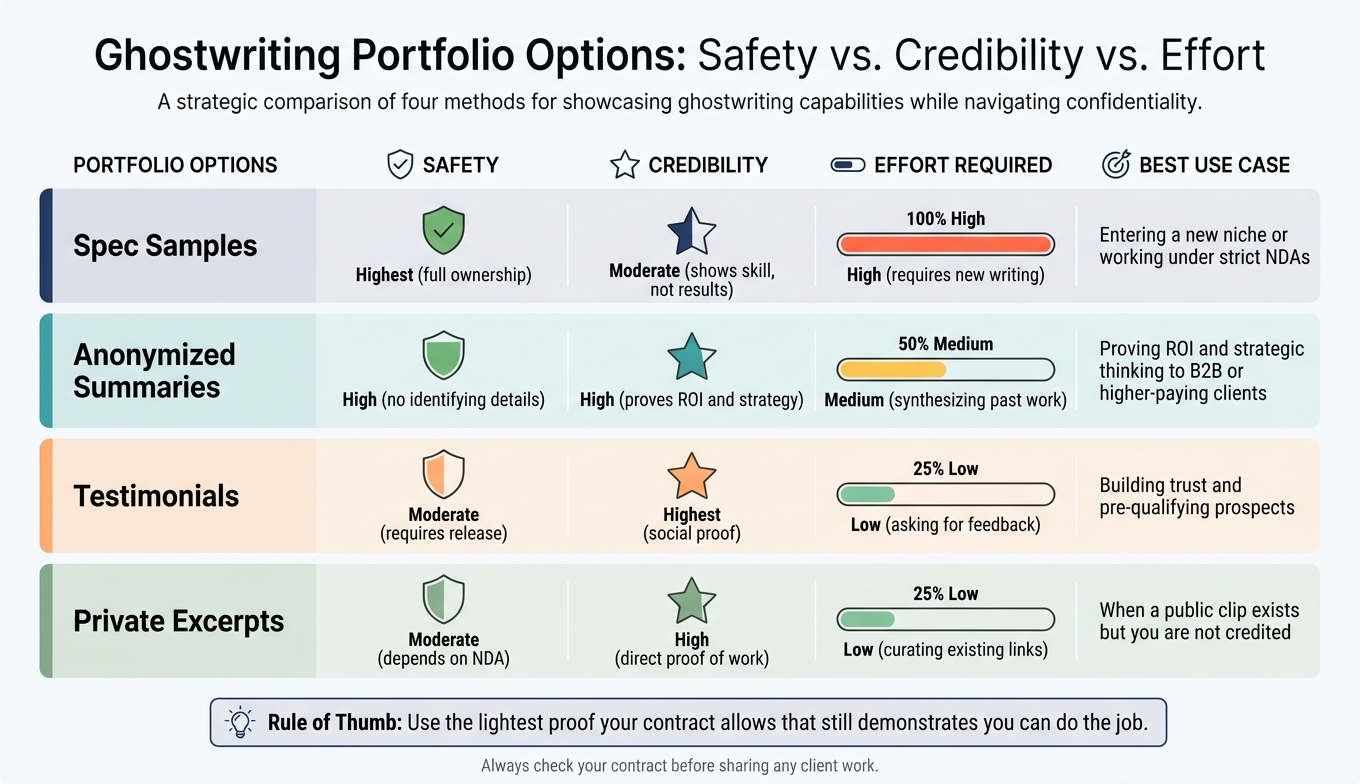
Ghostwriting Portfolio Options: Safety vs. Credibility vs. Effort
Use this comparison to pick the lightest proof that still shows you can do the job. Go with the format your contract allows, then choose the one that gives the strongest proof.
The table below lays out the tradeoff between safety, proof, and effort.
| Portfolio Option | Safety | Credibility | Effort | Best Use Case |
|---|---|---|---|---|
| Spec Samples | Highest (full ownership) | Moderate (shows skill, not results) | High (requires new writing) | Entering a new niche or working under strict NDAs |
| Anonymized Summaries | High (no identifying details) | High (proves ROI and strategy) | Medium (synthesizing past work) | Proving ROI and strategic thinking to B2B or higher-paying clients |
| Testimonials | Moderate (requires release) | Highest (social proof) | Low (asking for feedback) | Building trust and pre-qualifying prospects |
| Private Excerpts | Moderate (depends on NDA) | High (direct proof of work) | Low (curating existing links) | When a public clip exists but you are not credited |
When spec samples are the best choice
Spec samples are the safest place to start for most ghostwriters because you own the copyright from top to bottom.
"If you cannot share client work due to NDA, write detailed spec pieces."
This option makes the most sense when you’re moving into a new niche or when you can’t mention client work at all.
When anonymized summaries and testimonials add stronger proof
A spec sample shows skill. An anonymized summary shows results.
That difference matters. A clear summary built around Challenge, Approach, Process, Result lets you talk about what happened without naming the client. If an NDA blocks exact numbers, use a range or percentage instead, like "increased revenue by 30–40%", without giving away who the client was.
Testimonials bring the most social proof. But don’t skip the permission step. Get written approval before you publish anything. Once that’s in place, a testimonial that talks about how you work can help calm cautious clients and make trust easier to build.
Use the mix that fits the kind of proof your client wants to see.
Conclusion: A Simple System for Showcasing Ghostwriting Work Safely
Start with one rule: check what the agreement allows, get written permission if anything feels unclear, and don’t share anything the contract blocks.
Then use the safest proof your contract permits: spec samples, anonymized summaries, approved testimonials, or private links.
Confidentiality builds trust. Clients handling sensitive work need to know their information will stay protected, and taking NDAs seriously helps give them that peace of mind.
The system is simple: review the contract, get permission when needed, create samples you own, anonymize what you can’t name, and share sensitive material in private. Follow that order, and you can build a portfolio that earns trust.
FAQs
Can I mention ghostwriting clients at all?
No. For legal and ethical reasons, you shouldn’t reveal who your clients are.
Ghostwriting contracts often include confidentiality or non-disclosure clauses that bar you from sharing your role in the work, including in marketing materials, interviews, or public discussions.
What if my contract says nothing about portfolio use?
If your contract says nothing about portfolio use, don’t assume you can share the work. Ghostwriting is usually confidential, so you should only say you were involved if the client gives you clear permission.
If you want to show what you can do without crossing a line, you have a few safe options:
- Write strong spec pieces that show your range and voice
- Publish your own work, like a blog or newsletter
- Ask the client for written permission or a testimonial release
That way, you can prove your skills without putting client trust at risk.
How do I make a sample NDA-safe?
Remove any names, internal terms, account data, pricing, URLs, screenshots, or other details that point back to the client.
What you want is a clean sample that still shows how you write, how you organize ideas, and how you handle the topic.
A simple way to do that:
- Swap brand names for general labels like the client, the company, or the platform
- Remove direct identifiers such as contact info, product names, team names, and campaign codes
- Replace private numbers or business details with rounded figures or plain descriptions, if needed
- Keep the structure, tone, and topic coverage so the sample still feels like your work
The goal is to share a version of the piece that proves your skill without exposing private business information.
