
Credit card debt grows fast because interest is often added every day, not just once a month. If you carry a balance, a high APR, daily compounding, new charges, and small minimum payments can keep you in debt for years and add thousands in extra cost.
Here’s the short version:
- APR is not the full cost. A card with a 22.3% APR can end up costing about 25.0% over a year once daily compounding is factored in.
- Minimum payments do little. On a $5,000 balance at 22.76% APR, paying only the minimum can mean about 27 years in debt and about $7,700 in interest.
- Bigger fixed payments save a lot. That same $5,000 balance paid at $200/month can be gone in about 34 months, with about $1,786 in interest.
- New purchases make it worse. If you already carry a balance, new charges may start building interest at once.
- The best moves are simple. Stop new charges, pay above the minimum, and send extra money to the card with the highest APR first.
I’d look at this article as a plain guide to how daily compounding works, why balances shrink so slowly, and what you can do to cut interest before it eats up more of your money.
Credit Card Interest Explained: How APR Works and Compounds Your Balance
sbb-itb-2a9374f
How compound interest works on credit card debt
Credit card interest is the price you pay to borrow money. And with credit cards, that cost usually compounds daily.
Here’s the key difference: simple interest is based only on the original balance. Credit card interest isn’t. Each day’s interest gets added to what you owe, and the next day’s interest is charged on that new, higher amount. In plain English, you end up paying interest on interest.
APR, daily periodic rate, and average daily balance
This gets more expensive because card issuers often apply interest daily, not just once a month.
To make that work, they turn your APR into a Daily Periodic Rate (DPR) by dividing it by 365. On a card with a 22.3% APR, that comes out to about 0.0611% per day.
Then they apply that daily rate to your Average Daily Balance (ADB), which is the average of your end-of-day balances during the billing cycle.
The usual formula looks like this:
Average Daily Balance × Daily Periodic Rate × Number of Days in the Billing Cycle
So even if your balance moves up and down during the month, the issuer uses that average amount to figure out what interest to charge.
Why daily compounding causes balances to grow
Daily compounding is where things start to snowball. One day’s interest becomes part of the next day’s balance. Then the next day’s interest is charged on top of that. Even if you stop swiping the card, the balance can keep growing.
It’s not just interest, either. Late fees and penalties can get added to the balance and compound too. And if you’re carrying a revolving balance, new purchases may start accruing interest right away.
That’s also why the cost you feel over a year can be higher than the APR printed on the card agreement. A card with a 22.3% APR has an Effective Annual Rate (EAR) of about 25.0% when daily compounding is included.
| Advertised APR | Effective Annual Rate (Daily Compounding) |
|---|---|
| 20% | 22.1% |
| 22.3% | 25.0% |
| 25.2% | 28.7% |
| 29.9% | 34.8% |
Source: Data based on Federal Reserve and CFPB 2025 reports.
That daily build-up is a big reason minimum payments often don’t move the needle much. You pay, but a chunk of that payment goes toward interest first, so the balance may shrink at a frustratingly slow pace.
How compounding increases debt over time
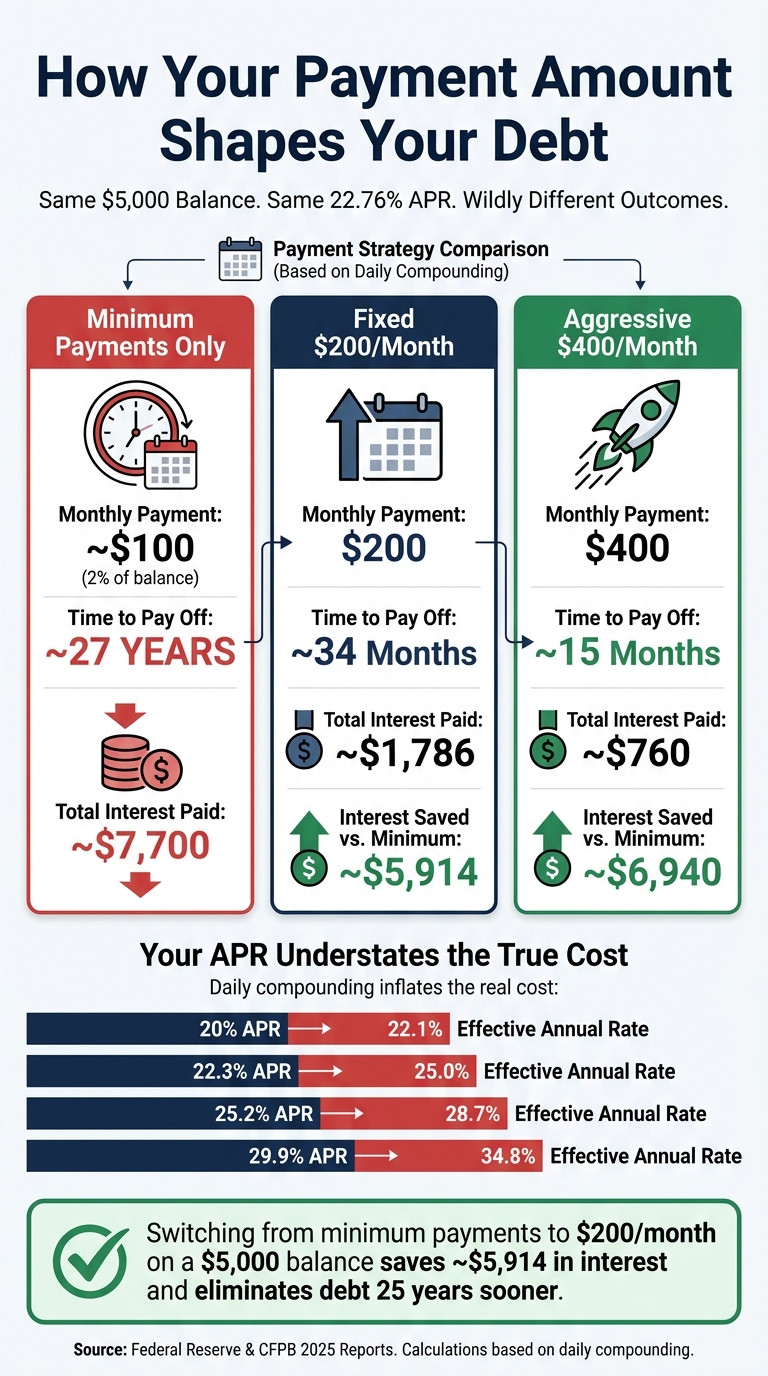
Credit Card Debt: Minimum Payments vs. Higher Payments Cost Comparison
A balance that seems under control can snowball once interest compounds every day. You don’t always feel it at first. Then you look up a few months later and wonder why the number barely moved.
The effect gets a lot easier to see when you compare minimum payments, bigger payments, and different APRs.
Why minimum payments cost more in the long run
The biggest problem with compounding shows up in how little minimum payments do to your principal. Most minimum payments are only 1% to 3% of your balance, so interest can outpace principal month after month.
Take a $5,000 balance at 22.76% APR. If you make only minimum payments, you’d pay about $7,700 in interest and stay in debt for around 27 years. That’s the part that stings.
It gets worse when you look at the first year. After 12 months of payments totaling about $1,190, the principal falls by only around $60. In plain English, most of that money goes to interest, not to wiping out what you owe.
That’s why credit card statements include minimum-payment payoff warnings under federal law. The warning is there for a reason.
How new charges and multiple cards make debt harder to manage
Once you carry a balance, new purchases often start building interest right away. Those charges also push up the balance used to figure interest, so your monthly interest cost can climb even if your payment doesn’t.
Multiple cards make the mess harder to track. One card may have a purchase APR, another may carry a higher cash advance rate, and a late payment can trigger a penalty APR that jumps to nearly 30%.
That means you’re not dealing with one debt. You’re dealing with several moving parts at once. And when each card has its own minimum payment, interest on each one can eat up most of what you send in. That’s part of how about 13% of U.S. cardholders end up in persistent debt, paying more in interest and fees each year than they knock off their balance.
Comparison table: minimum payments, higher payments, and APR impact
These gaps are a lot easier to grasp when you see them side by side.
| Scenario ($5,000 Balance) | APR | Monthly Payment | Time to Pay Off | Total Interest Paid |
|---|---|---|---|---|
| Minimum payments only | 22.76% | ~$100 (2% of balance) | ~27 years | ~$7,700 |
| Fixed higher payment | 22.76% | $200 | ~34 months | ~$1,786 |
| Aggressive payment | 22.76% | $400 | ~15 months | ~$760 |
Higher payments cut payoff time and interest sharply. Source: Data based on Federal Reserve and CFPB 2025 reports.
The next step is reducing the balance faster than interest can compound.
What you can do to reduce compounding interest
Once you pay more than the minimum, interest has less room to snowball. The fastest way to break the cycle is simple: stop adding new balance. A few focused moves can cut your interest costs fast.
Pay more than the minimum and stop adding new charges
If a card already carries a balance, stop putting new purchases on it. Switch to cash or a debit card while you pay it down. That gives the balance a chance to shrink instead of creeping up month after month.
Minimum payments usually do very little to reduce the principal. A fixed monthly payment works much better because it keeps pressure on the balance even as it drops.
Here’s what that looks like in plain numbers: on a $6,000 balance at 22% APR, making only the minimum payment can stretch repayment to about 24 years and cost about $9,000 in interest. A fixed $200 monthly payment cuts that to about 3 years and about $1,700 in interest. That’s more than $7,000 saved from one change.
Put extra payments toward the highest APR first
After you move past the minimum, the next step is deciding where the extra money should go. This is where the Debt Avalanche method helps. You put extra money toward the card with the highest APR while paying the minimum on the others.
Why start there? Because the highest-rate balance is the one draining the most money in interest. Knock that one down first, and you cut the total cost of the debt.
There’s another angle here too: ask for a lower APR. In one survey, 76% of cardholders who asked got a lower rate, with an average drop of 6.3 percentage points. That kind of cut can slow interest growth in a big way, especially if the balance is large. If you get extra cash from a bonus, tax refund, or other windfall, send it to the highest-APR balance first.
Comparison table: repayment strategies and interest savings
The difference is easiest to see side by side.
| Scenario | Balance | APR | Monthly Payment | Payoff Time | Total Interest |
|---|---|---|---|---|---|
| Minimum only | $6,000 | 22% | Recalculates at 2% | ~24 years | ~$9,000 |
| Fixed payment | $6,000 | 22% | $200 | ~3 years | ~$1,700 |
| Minimum only | $15,000 | 22% | $300 | 30+ years | ~$32,000+ |
| Fixed payment | $15,000 | 22% | $500 | ~3 years 7 months | ~$6,100 |
| Aggressive payment | $15,000 | 22% | $750 | ~2 years 1 month | ~$3,500 |
The pattern is hard to miss: higher fixed payments slash both payoff time and total interest cost. Even moving from $300 to $500 a month on a $15,000 balance saves more than $25,000 in interest over the life of the debt.
Next, put those payments into a simple payoff plan.
Using Steps To Be Debt Free to build a plan and conclusion
How Steps To Be Debt Free can help you organize your debt
Understanding compounding is a good start. But to build a payoff plan, you need to sort your balances by interest cost.
Steps To Be Debt Free offers a Free Debt Review that helps you pull your balances, APRs, and payment status into one view. That review can show which debts are draining the most money in interest and whether a card has lost its grace period.
Once you have that snapshot, it gets a lot easier to decide what to pay first. Start with the balances costing you the most.
Key takeaways to remember
A few points matter most here:
- Interest compounds daily, so carrying a balance longer costs more.
- Minimum payments barely reduce principal.
- New charges can restart or extend interest costs.
- Paying more than the minimum can cut payoff time and interest sharply.
- Pay the highest APR first to reduce total interest.
The game plan is simple: stop new charges, pay above the minimum, and go after the highest APR first.
FAQs
When does credit card interest start accruing?
For most purchases, you usually won’t be charged interest if you pay your full statement balance by the monthly due date. That’s because of the grace period, which often lasts 21 to 30 days.
If you carry a balance past the due date, interest will usually start adding up daily. Cash advances work differently. They usually don’t come with a grace period, and interest starts accruing as soon as you request the transaction.
How can I tell if I lost my grace period?
You usually lose your grace period when you carry a balance past your payment due date.
Once that happens, interest starts building on the unpaid balance. And new purchases may also start earning interest from the day you make them, not after the next due date.
Cash advances and balance transfers usually don’t come with a grace period at all. To get your grace period back, you’ll usually need to pay your full statement balance for one or two billing cycles in a row, depending on your card issuer.
Should I pay off the highest APR card first?
Yes. Putting your extra payment toward the card with the highest APR is usually the most efficient move.
This is called the avalanche method. You pay the minimum on every account, then send every extra dollar to the balance with the highest interest rate. The goal is simple: cut the total interest you pay over time.
If you’re juggling a few cards, this approach can save money while helping you chip away at debt in a clear, steady way. Steps To Be Debt Free offers a structured process to help you stay on track.
