

Authorized users can use a credit card without being legally responsible for the debt. However, their credit can still be impacted by the primary cardholder’s actions. Here’s what you need to know:
- Credit Impact: Payment history (35% of your FICO Score) and credit utilization (30%) from the account can affect your credit score.
- Spending Control: Authorized users can’t adjust settings like credit limits but can sometimes have spending caps set by the primary cardholder.
- Fees: Some cards charge fees for adding authorized users, especially premium cards.
- Rewards: Purchases may earn rewards, but these typically belong to the primary cardholder.
- Liability: Authorized users aren’t legally responsible for the debt, but financial mismanagement can harm relationships and credit.
To protect yourself:
- Review the primary cardholder’s financial habits.
- Set clear spending rules.
- Monitor your credit report regularly.
- Remove yourself from the account if issues arise.
Understanding these basics will help you use credit cards responsibly as an authorized user.
Key Credit Card Terms Authorized Users Should Know
Credit Limit, Available Credit, and Utilization
As an authorized user, you share the primary cardholder’s credit line. For instance, if the card has an $8,000 limit and a $3,200 balance, the credit utilization rate is 40%. That’s higher than the recommended threshold.
Credit utilization accounts for about 30% of a FICO® Score. This means your spending impacts not only your credit score but also the primary cardholder’s. Experts suggest keeping utilization at 30% or less, with 20% or below being even better for maintaining a healthy score. Some issuers, such as Capital One, allow the primary cardholder to set spending limits specifically for authorized users. This can be a helpful way to manage spending and avoid issues.
Knowing how credit utilization works is also key to understanding how interest can build up if balances aren’t paid in full.
APR, Interest, and Grace Period
The APR (Annual Percentage Rate) represents the yearly cost of borrowing on the card. If the primary cardholder carries a balance beyond the grace period – the time between the statement closing date and the payment due date – interest will start to accrue at the card’s APR. As an authorized user, you can’t request changes to the APR. Still, these terms matter because unpaid balances increase utilization, which can lower your credit score.
Paying off the full balance every month avoids interest charges, thanks to the grace period. While the bank holds the primary cardholder responsible for any unpaid interest, a carried balance still affects credit utilization – and by extension, your credit score.
Minimum Payment and Payment Responsibilities
The minimum payment is the smallest amount the primary cardholder must pay each month to keep the account in good standing. It’s usually calculated as a percentage of the balance or a flat amount, whichever is higher. This makes it essential for authorized users to discuss reimbursement terms with the primary cardholder. While you aren’t legally obligated to make payments, these financial habits can still shape your credit profile.
"An authorized user on a credit card is not responsible for paying the bill each month… the primary account holder will be able to see all your transactions and may ask you to reimburse them for charges." – Jim Akin
Many authorized users choose to reimburse the primary cardholder for their spending. Sorting out these details upfront can help you avoid uncomfortable conversations later.
Fees to Watch For as an Authorized User
Your spending as an authorized user can lead to extra costs for the account. For example, cash advances – using the card to withdraw cash – often come with upfront fees (typically 3%–5% of the amount) and a higher APR without a grace period. If your transactions result in a high balance and the primary cardholder misses a payment, a late fee may also be charged. Even though you’re not responsible for these fees, they can still impact your credit profile.
Some cards charge annual fees for adding authorized users, especially premium ones. For instance, The Platinum Card® from American Express charges $195 per authorized user, while the Citi® / AAdvantage® Executive World Elite Mastercard® charges $175 for up to three authorized users. On the other hand, cards like the Capital One Venture X allow up to four authorized users without any extra fee.
Rewards and Benefits for Authorized Users
As an authorized user, your purchases typically earn rewards – whether it’s points, miles, or cash back – at the same rate as the primary cardholder. However, the rewards usually belong to the primary cardholder, not you. You might earn them, but they control how they’re used unless they decide to share.
Some credit cards also extend perks like travel benefits, purchase protections, or lounge access to authorized users. However, these perks depend on the card issuer and tier. It’s always a good idea to review the cardholder agreement to understand which benefits apply to your card. This ensures there are no surprises when you try to use those perks.
sbb-itb-2a9374f
Authorized User Strategy to Build Credit Scores | Credit History Boost
Liability, Credit Impact, and Risk Management
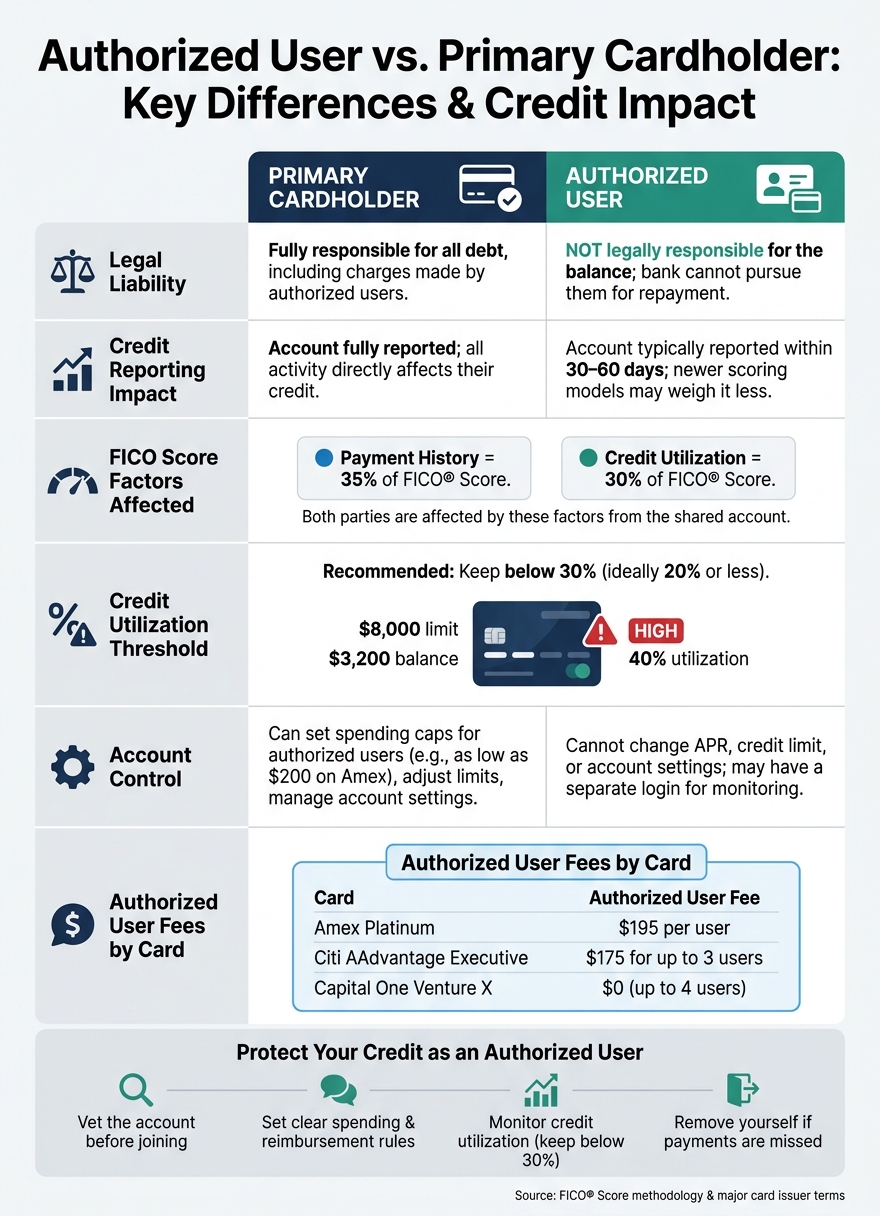
Authorized User vs. Primary Cardholder: Key Differences & Credit Impact
Legal Liability and Responsibility for Debt
As an authorized user, you’re not legally tied to the credit card agreement. This means the bank cannot hold you accountable for the card’s balance. The primary cardholder carries the full legal and financial responsibility for all charges on the account – including those made by you. This setup allows authorized users to enjoy the benefits of the account without taking on its debt. It’s a stark contrast to joint account holders, who share equal responsibility for the entire balance. As an authorized user, you’re simply a secondary participant, not a co-debtor.
"If you never agreed to repay the debt, the lender can’t hold you to it." – LegalClarity Team
However, there’s an exception in community property states like California, Texas, and Arizona. In these states, spouses might be liable for credit card debt incurred during the marriage, even if one spouse is merely an authorized user.
Credit Reporting and Score Impact
Being added to a well-managed credit card account can positively affect your credit score. Most major issuers report authorized user activity to the three main credit bureaus – Equifax, Experian, and TransUnion. Typically, the account’s full history appears on your credit report within 30 to 60 days. If the primary cardholder maintains on-time payments, low credit utilization, and a long account age, you could see a credit boost. On the flip side, missed payments or high balances could drag your score down.
Here’s why: payment history makes up about 35% of your FICO® Score, while credit utilization accounts for roughly 30%. However, newer scoring models often weigh authorized user accounts less heavily than primary ones. It’s also important to know that not all issuers report authorized user activity. For example, American Express and Chase typically don’t report activity for users under 18. These nuances highlight the importance of managing risk effectively, which we’ll dive into next.
Managing Risk and Setting Boundaries
To protect your financial health, it’s essential to establish clear boundaries and strategies when becoming an authorized user. Here are a few steps to consider:
- Vet the account: Before joining, review the primary cardholder’s credit history. If they have a pattern of late payments or high utilization, you could inherit those financial risks.
- Set spending limits: Some issuers, such as American Express, allow the primary cardholder to impose spending caps for authorized users – sometimes as low as $200.
- Monitor the account: Enable notifications for transactions and review activity regularly.
- Know when to step away: If the primary cardholder starts missing payments or maxing out the card, you can contact the issuer to remove yourself. This can be done without the primary cardholder’s consent.
To keep track of how the account is affecting your credit, check your credit reports through AnnualCreditReport.com. You can access free weekly reports from all three major bureaus.
Practical Steps for Authorized Users to Use Credit Cards Safely
Reviewing the Cardholder Agreement and Disclosures
Understanding your rights as an authorized user begins with carefully reviewing the cardholder agreement. While you can make purchases and dispute unauthorized charges, you won’t have the ability to adjust account settings or limits.
Start by confirming your status as an authorized user. Call the number on the back of the card to verify whether your activity will be reported to the three major credit bureaus. Ask for written confirmation that you are listed as an authorized user – not a joint account holder – and clarify if any additional fees apply to your role.
"Authorized users can typically make purchases, review their transaction history and dispute unauthorized charges. However, they don’t have complete access to or control over the credit card account, and they aren’t ultimately liable for the debt." – Louis DeNicola, Personal Finance Writer, Experian
Once you’ve confirmed these details, establish clear spending rules with the primary cardholder to avoid misunderstandings.
Building Healthy Spending Habits
Collaborate with the primary cardholder to set clear spending guidelines. Decide on acceptable purchase categories, whether a monthly spending cap is needed, and how reimbursements will be handled.
Many credit card issuers provide authorized users with separate online logins. Take advantage of these tools to monitor your transactions, set up real-time alerts, and track spending limits. Keeping a close eye on your activity helps you catch errors early and stay within agreed-upon guidelines. Before making any large purchases, coordinate with the primary cardholder to ensure the account’s credit utilization remains below 30%, which is ideal for maintaining a healthy credit score.
"Being financially accountable for their purchases can help the authorized user build responsible spending and financial habits." – Citi
By sticking to these habits, you’ll not only avoid conflicts but also develop strong financial discipline.
Avoiding and Addressing Debt Problems
Debt issues on shared accounts often creep up over time. Missed reimbursements or unauthorized charges should be treated as early warning signs. Address these issues immediately to prevent them from escalating.
If the primary cardholder starts missing payments or carrying high balances, your credit score could take a hit since payment history makes up about 35% of a FICO® Score. In such situations, reach out to the card issuer and request removal from the account. This step can usually be taken without the primary cardholder’s approval and helps protect your credit profile.
For cases where debt becomes unmanageable, consider exploring structured relief programs like Steps To Be Debt Free for a detailed plan to regain financial stability. These proactive measures can help you maintain control over your finances while safeguarding your credit.
Conclusion
Understanding the terms of your credit card is crucial for safeguarding your financial health and credit stability.
Being an authorized user comes with perks – like building credit and earning rewards – but these benefits only materialize when you’re fully aware of the card’s terms and conditions.
As an authorized user, you’re not legally responsible for the debt. However, the primary cardholder’s payment behavior directly impacts your credit. This makes responsible account management a shared priority.
"The last thing you want to do is sour a relationship because of one person’s financial irresponsibility." – Danyal Ahmed, Credit Card Writer, The Points Guy
Clear communication with the primary cardholder is key. Agree on spending limits, establish reimbursement protocols, and routinely review the account to avoid misunderstandings. Keeping credit utilization below 30% is a smart move to protect both parties’ credit scores.
If debt becomes an issue, act quickly – consider removing yourself from the account or seeking professional advice through resources like Steps To Be Debt Free. This proactive approach ensures you stay on top of your financial responsibilities.
FAQs
Will being an authorized user help my credit if the card has a long history?
When you’re added as an authorized user on a credit card with a solid track record, it can help boost your credit. Once the account is reported to your credit file, details like its age, payment history, and credit limit are often included in your credit report. This can positively affect your credit score by increasing your average account age and reflecting a history of consistent on-time payments – two key factors in determining creditworthiness.
How can I get removed as an authorized user, and how fast does it update my credit report?
To stop being an authorized user on a credit card, reach out to the card issuer. You can usually do this by phone, through their mobile app, or via your online account. In some cases, they may accept requests by mail. While many issuers let you make the request yourself, some might require the primary account holder to handle it. Once your removal is processed – often instantly – the account should no longer show up on your credit report. If you need assistance with managing debt, check out Steps To Be Debt Free for guidance.
Does an authorized user card build credit if I’m under 18?
Yes, it’s possible to build credit as an authorized user before turning 18, but this largely depends on the policies of the credit card issuer. Some issuers allow authorized users with no minimum age, while others set the minimum between 13 and 15 years old. However, keep in mind that some issuers may not report authorized user activity to credit bureaus until you reach the age of majority. Knowing these details can help you lay a solid groundwork for your financial future.
